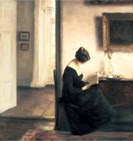
Another beautiful if slightly bad-tempered love poem this week. Addressed not to the loved one but to those - her friends? her parents? - who don't approve of the relationship. I love the directness of the opening lines, the slightly whiny exasperation of "Alas, alas, who's injured by my love?" & then the lovely, quiet image, "We'll build in sonnets pretty rooms." The lovers know that their love will last until death.
For God's sake hold your tongue, and let me love;
Or chide my palsy, or my gout;
My five gray hairs, or ruin'd fortune flout;
With wealth your state, your mind with arts improve;
Take you a course, get you a place,
Observe his Honour, or his Grace;
Or the king's real, or his stamp'd face
Contemplate ; what you will, approve,
So you will let me love.
Alas ! alas ! who's injured by my love?
What merchant's ships have my sighs drown'd?
Who says my tears have overflow'd his ground?
When did my colds a forward spring remove?
When did the heats which my veins fill
Add one more to the plaguy bill?
Soldiers find wars, and lawyers find out still
Litigious men, which quarrels move,
Though she and I do love.
Call's what you will, we are made such by love;
Call her one, me another fly,
We're tapers too, and at our own cost die,
And we in us find th' eagle and the dove.
The phoenix riddle hath more wit
By us ; we two being one, are it;
So, to one neutral thing both sexes fit.
We die and rise the same, and prove
Mysterious by this love.
We can die by it, if not live by love,
And if unfit for tomb or hearse
Our legend be, it will be fit for verse;
And if no piece of chronicle we prove,
We'll build in sonnets pretty rooms;
As well a well-wrought urn becomes
The greatest ashes, as half-acre tombs,
And by these hymns, all shall approve
Us canonized for love;
And thus invoke us, "You, whom reverend love
Made one another's hermitage;
You, to whom love was peace, that now is rage;
Who did the whole world's soul contract, and drove
Into the glasses of your eyes;
So made such mirrors, and such spies,
That they did all to you epitomize—
Countries, towns, courts beg from above
A pattern of your love."
Sunday, August 12, 2012
Saturday, August 11, 2012
Happy Anniversary Lucky & Phoebe
It's hard to believe but it's been a year since Lucky & Phoebe came to live with me. It's been exciting & nervewracking in equal measure - for me, not them. Lucky's wandering & Phoebe's daredevil climbing have given me even more grey hairs than I had a year ago but we've all survived intact & in good health & that's something to be thankful for.
I thought I'd just share some of the many photos I've taken of the girls over the year. These are some of my favourites. Here's Lucky.
And here's Phoebe.
I'm looking forward to many more happy years together for the three of us.
I thought I'd just share some of the many photos I've taken of the girls over the year. These are some of my favourites. Here's Lucky.
And here's Phoebe.
Thursday, August 9, 2012
A Room Full of Bones - Elly Griffiths
Ruth Galloway is a forensic archaeologist. She's called in to examine the bones of a medieval bishop whose coffin has been discovered during a dig. Bishop Augustine is the ancestor of Lord Danforth Smith, horse trainer & owner of the Smith Museum. When Ruth arrives at the museum for the opening of the coffin, she discovers the museum's curator, Neil Topham, lying dead on the floor near the coffin.
DCI Harry Nelson is called in to investigate Neil's death. There are no obvious signs of injury but the window was open & a book with an underlined warning is discovered. Nelson also discovers threatening letters addressed to Neil & Danforth Smith from a group called the Elginists, demanding the return of the bones of Aboriginal ancestors. Lord Smith's grandfather had been a 19th century adventurer who has brought the remains back from his travels in Australia. The remains, including several skulls, are not on display but kept in a back room. Lord Smith, however, refuses to return them. Have the Elginists stepped up their campaign of repatriation to include murder?
Nelson is also coping with a big drugs investigation. Drugs are being imported from overseas somewhere along the Norfolk coast. His team are running surveillance at night as well as now investigating the possible murder at the museum. Nelson is also dealing with his wife, Michelle's, discovery that he's the father of Ruth's daughter, Kate. Michelle has forbidden him to see either Ruth or Kate. Their few work-related encounters are awkward & Ruth tries to forget Nelson by pursuing a new relationship with Max, a man with no baggage except a boisterous dog called Claudia.
Ruth also has a new neighbour in her remote Saltmarsh neighbourhood. Bob Woonunga is an Aboriginal writer & poet. He's taking up a teaching post at Ruth's University & her Druid friend, Cathbad, recommended that he rent the house next door to Ruth. Bob is also pursuing the repatriation of the remains at the Smith Museum. Ruth is unsure about Bob. Kate & Flint, her cat, love him but she's unsure how far to trust him. When Danforth Smith dies suddenly & then Nelson becomes seriously ill, Ruth is forced to consider Cathbad's belief that they've been cursed by the spirits of the ancestors.
I really enjoy this series & this is an excellent addition to it. Ruth & Nelson are very sympathetic characters & their evolving relationship is always interesting. I also love Ruth's relationship with Kate, her uncertainties as a mother & her continual juggling of work & motherhood. The writing is in present tense, which I usually dislike, but I get so caught up in the story that it only trips me up now & then. My main niggle with the previous books in the series was that Ruth always ended up in peril of her life & it just struck me as ridiculous that she could get into these situations every time. Thankfully, this doesn't happen to Ruth in this book although another character, who should know better, does get herself into a sticky situation by ignoring basic common sense. If she had only remembered what Harriet Vane did in a similar situation in Gaudy Night, she would never have ended up in peril of her life. Still, it does result in the solution to one of the mysteries of the plot & the eventual opening of the bishop's coffin, which contains a surprise or two of its own, provides the rest. The historical & archaeological themes of the books interest me too & Cathbad's mystical new ageness gives another slant to Ruth's devotion to scientific standards of truth.
Tuesday, August 7, 2012
The Malady in Madeira - Ann Bridge
I couldn't resist going on with the next Julia Probyn novel & I'm about to begin the final book in the series, Julia in Ireland. I've just become slightly sidetracked by Elly Griffith's latest mystery, A Room Full of Bones.
Plot developments (of a personal kind) come thick & fast in the final few Julia books so you may not want to read this review if you're planning to read the series & want some surprises.
The book begins at Glentoran, the Munro family estate in the Highlands. Julia's husband, Colonel Philip Jamieson, has been killed in the Middle East while working for British Intelligence. Philip was shot but curiously, Julia hears the cryptic comment that he shouldn't have been out at all "without his respirator". Julia's cousin, Colin Munro, took charge of the mission & blotted his copybook with his superiors by retrieving Philip's body rather than continuing with the job in hand. Julia is staying at Glentoran with her son, Philip, & close friend, Mrs Hathaway.
Mrs Hathaway is going to Madeira for her health & Julia accompanies her. While there, she becomes involved in a mystery that ties in with the events surrounding her husband's death. Julia is staying with an old schoolfriend & among their acquaintances are relatives of Colin Munro's wife, Aglaia. Aglaia knows Julia through the events of The Numbered Account, & she has been sent to Madeira to recuperate after a car accident that led to her losing a baby. On a visit to a high plateau, they notice that the sheep are behaving oddly. They seem dopey & their vision is affected. The local vet can't explain it & a young boy, the son of one of the servants has similar symptoms. Julia becomes concerned when she discovers that the child had been to the plateau & arranges for him to be seen by another doctor who transfers him to a clinic in Funchal. Julia has also noticed a Russian trawler hovering along the coast & she discovers that a party of men smoking Russian cigarettes have been to the plateau with loads of equipment.
Julia is immediately suspicious as she was involved in the discovery of a Russian plot to lay out listening devices in The Dangerous Islands. She contacts Colin & asks him to come over & investigate. Colin is desperately in need of a success as his bosses were less than impressed by his conduct in the Middle East. Aglaia is also proving to be an encumbrance. She's very young, very wilful & not very clever. She doesn't understand that she shouldn't talk about Colin & his work & their relationship is suffering. She's also jealous of Julia who has always been involved in Intelligence work in an unofficial way & has a close relationship with Colin.
Colin is surprised to discover that the Russians seem to be testing the same nerve gas on Madeira that they were testing in the Middle East. The climate on Madeira is similar to that of Britain & the plan seems to be that the Russians will use the nerve gas to stupefy the population for long enough to take over government. The sheep are being used as a test case & the Russians have two young Spaniards as accomplices, pretending to be film makers when they're actually recording the results of the experiment & reporting back to the trawler in the bay.
Julia is her usual, ultra-efficient self, overhearing crucial conversations & dashing to & fro. Colin is reduced to the role of her sidekick, arranging for the London office to send out a boffin to verify their suspicions &, at the same time, trying to sort out his relationship with Aglaia. There are some wonderful minor characters, from Julia's no-nonsense Nanny Mack, who looks after her small son, to the irascible Doctor who just happens to have an interest in nerve gas & runs a clinic in Funchal where Colin & the boffin from London can hide out while they do their work.
It's all great fun & exhausting to read with the amount of talking, explaining & running around that Julia does. As always, part of the interest of the book is in the location & we learn a lot about Madeira as well as becoming involved in a classic Cold War adventure. Only one book to go! I'm going to miss Julia when I reach the end of the series.
Sunday, August 5, 2012
Sunday Poetry - John Donne
More John Donne - one of the Holy Sonnets this time. This is such a triumphant poem about the survival of the soul after death. It's comforting too, in a way, comparing death to just a longer sleep before the believers wake into eternal life.
Death be not proud, though some have called thee
Mighty and dreadfull, for, thou art not soe,
For, those, whom thou think'st, thou dost overthrow,
Die not, poore death, nor yet canst thou kill mee.
From rest and sleepe, which but thy pictures bee,
Much pleasure, then from thee, much more must flow,
And soonest our best men with thee doe goe,
Rest of their bones, and soules deliverie.
Thou art slave to Fate, Chance, kings, and desperate men,
And dost with poyson, warre, and sicknesse dwell,
And poppie, or charmes can make us sleepe as well,
And better then thy stroake; why swell'st thou then?
One short sleepe past, wee wake eternally,
And death shall be no more; death, thou shalt die.
Friday, August 3, 2012
Samplemania
The one advantage of my iPad over my e-reader is the ability to download sample chapters of a book before I buy. Sometimes the samples lead me on to buy the book in question, eg Love in the Sun by Leo Walmsley or Angel of the Revolution by George Chetwynd Griffith (which I was alerted to by this post on Catherine Pope's Victorian Geek blog). Like Catherine, I'm not a science fiction fan but Catherine's description of the plot sounded more like futuristic fiction (it's a 19th century novel about the invention of an airplane & Nihilist plots to end the world as we know it - or should I say, as they knew it then!). So, I downloaded the sample chapters, enjoyed them & bought the book.
I also have a sample of C P Snow's The Search because it provides a vital clue in one of my favourite detective novels, Gaudy Night by Dorothy L Sayers - but I haven't read it yet. Sometimes I read about a book on a blog & think I'll just pop over to Amazon & see if there's a sample of it available - & there often is.
However, I have many more samples than whole books, most of which I haven't even cracked open yet. If you click on the pictures, you should be able to see them more clearly. My plan is to read the samples then see if I can buy the books, if I want to read them, for my e-reader which is so much lighter & more convenient for reading. Of course, I have nearly 200 books on the e-reader & I haven't read most of those either. You may have noticed a pattern here, especially after my recent post about my library - my mother would have said that my eyes are bigger than my stomach. At least the samples are free and non-fattening.
Here are just a few of the samples I have waiting to be read. Any suggestions for moving one of them to the top (front?) of the iPad gratefully received.
The History Room by Eliza Graham
The Valorous Years by A J Cronin
The Dead Man's Message by Florence Marryat
Just Send Me Word by Orlando Figes
John Clare By Jonathan Bate
Ukridge by P G Wodehouse
Tour de Force by Christianna Brand
The Faded Map by Alistair Moffat
The Woman Reader by Belinda Jack
The Free Fishers & Midwinter by John Buchan
Am I the only one who does this? Please reasssure me that I'm not alone.
Thursday, August 2, 2012
The High Path - Ted Walker
The High Path is another of the lovely pocket hardback editions of memoirs published by Slightly Foxed. I'm collecting the memoirs but, of course, have only read about half of them so far. Slightly Foxed Editions are another reason why I don't think e-books will ever totally replace the physical book. They are such beautiful, tactile objects. The size is perfect for slipping in a bag or coat pocket & the paper is the same creamy paper used for the Slightly Foxed quarterly journal. Subtle gold blocking on the spine & a ribbon bookmark complete the perfect book package.
Ted Walker was a poet & it's obvious from this book that poetry was his natural language. The High Path tells the story of Ted's childhood in Sussex until he goes to Cambridge in 1953. Ted's father moved from Birmingham in the early 30s looking for work. Soon he was able to encourage his brother, Jack to join him & he was able to marry Winnie, his girlfriend back in Birmingham. Ted was born a year later &, after the tragic death of a sister, Ruth, his mother was told she shouldn't have more children so Ted looked set to be an only child. The Walkers lived in a flat that backed on to the high path of the title & soon, Ted's father's family moved in to the flat upstairs.
Ted led the self-contained life of an only child, so much so that his early experiences of school & other children were quite a shock. Schooldays in general were not happy & he's scathing about the quality of the teaching staff at the Grammar School he attended as a scholarship boy. Only a few of his teachers are remembered with affection, most memorably Miss Miles, a stand-in teacher,
I wish I could meet Miss Miles again. I should like to tell her that she taught me more about the entrancing power of words in that quiet lull during the Battle of Britain than any teacher subsequently did...She related the story of Romulus and Remus with such narrative and descriptive skills that I was left with the most vivid sense of having been actually suckled by the she-wolf, of having handled every rough block of stone built on the seven hills of Rome, of having not only sharpened the knife and stabbed Remus but also of having been Remus himself, dead by my twin brother's hand.
That mention of the Battle of Britain is typical of the casual way that the war is mentioned in the book. The main consequence of the war to Ted is that the beach at the back of his house is off-limits as it's been covered in barbed-wire & landmines to fend off the German invasion that was expected at any minute. The joy with which the beach was reopened when the war ended is obvious,
The tide was just out, the sun was just setting. There were hundreds of people strolling, their faces lit with pink delight. This, then, was what Peace was: to stand and gaze at the unsinister sea; to pick up a streamer of bladder-wrack and watch it lift with the wind... We paddled, kicking the water, testing the salt on our lips. And when it began to get dark, I walked back up the shingle and sat for a few minutes on my own, looking at the silhouettes of breakwaters that had not been repaired or replaced for six years.
There are many stories here about the embarrassments & agonies of childhood. I felt for young Ted in the tortuous combination of underwear & straightjacket that his mother made him wear. Then there were the homemade boots that curled to one side & the awful remedies his mother tried on him to cure his constipation. The Walkers weren't poor but they were careful. Ted's father divided his wages into different tins every week, including one tin he called Ted's Start-Up tin with the money for Ted's future career. Ted was always a loner, especially at school. Even the birth of his brother when he was ten didn't change that. As he says, "If you are ten before you have your brother, you remain an only child." He was too old to feel jealousy & his brother grew up to be his best friend.
His closest relationship is with his father. They play a mad game of cricket where the idea wasn't to make runs but to see how many ways they could hit the ball so as to make the both fall about laughing. His father decides that Ted should learn French so they both go along for the initial lesson with Mr Jupp. The first lesson is nearly a disaster as Mr Jupp's frantic gestures at the window as he repeats C'est la fenêtre & father & son look through the window at the passersby & try to work out what he means. Eventually they get it & run home gesturing at every window they see shouting C'est la fenêtre . Mr Jupp teaches Ted from a book depicting the life of a well-to-do family & their servants.
I, who sat in Mr Jupp's wizard parlour in my curly boots, was supposed to identify with the monied crowd, clapping my hands to attract the attention of Mr Jupp, who played the eternal lackey. I would summon him (a waiter swatting imaginary flies with an imaginary towel) to bring me an aperitif; command him (a fawning tailor in the Rue de Rivoli) to make me a redingote. Ever-present was the lady whose invisible form by the passage door was to be bowed to before we practised the third person singular.
The memoir ends with Ted on his way to Cambridge. Ted has started writing poetry & destroying it all. He writes to T S Eliot & gets a kind reply. He spends his holidays as a builder's labourer or falls on his feet helping a rich couple travel around Europe with his French learnt from Mr Jupp. He has met Lorna, his first serious girlfriend who will become his wife, & they are miserably contemplating years apart while he studies at university & then does his National Service & she goes to training college. The High Path is a quiet memoir told with humour & affection - & occasional anger & frustration. It's another lovely addition to the series of Slightly Foxed Editions.
Labels:
books,
childhood,
England,
memoir,
Slightly Foxed,
Ted Walker
Subscribe to:
Posts (Atom)