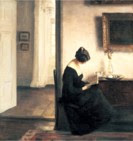
There are a couple of poems by Millay in the anthology &, even though I posted several of her poems earlier in the year, I can't resist just one more. This is Sonnet XXXI, published in the collection The Harp-Weaver in 1923. I love the threat in that last line.
Oh, oh, you will be sorry for that word!
Give me back my book and take my kiss instead.
Was it my enemy or my friend I heard,
"What a big book for such a little head!"
Come, I will show you now my newest hat,
And you may watch me purse my mouth and prink!
Oh, I shall love you still, and all of that.
I never again shall tell you what I think.
I shall be sweet and crafty, soft and sly;
You will not catch me reading any more:
I shall be called a wife to pattern by;
And some day when you knock and push the door,
Some sane day, not too bright and not too stormy,
I shall be gone, and you may whistle for me.
Showing posts with label Edna St Vincent Millay. Show all posts
Sunday, September 20, 2015
Sunday, July 5, 2015
Sunday Poetry - Edna St Vincent Millay
I've finished reading Edna St Vincent Millay's third book of poetry, Second April, so this will be the last of her poems in Sunday Poetry for a while. I've enjoyed discovering her work & will definitely look out for more of her poetry. I loved the poems in Second April especially, & this one, called Alms is melancholy & resigned. I love to read wintry books & poetry at this time of year.
My heart is what it was before,
A house where people come and go;
But it is winter with your love,
The sashes are beset with snow.
I light the lamp and lay the cloth,
I blow the coals to blaze again;
But it is winter with your love,
The frost is thick upon the pane..
I know a winter when it comes:
The leaves are listless on the boughs;
I watched your love a little while,
And brought my plants into the house.
I water them and turn them south,
I snap the dead brown from the stem;
But it is winter with your love,
I only tend and water them.
There was a time I stood and watched
The small, ill-natured sparrows' fray;
I loved the beggar that I fed,
I cared for what he had to say,
I stood and watched him out of sight:
Today I reach around the door
And set a bowl upon the step;
My heart is what it was before,
But it is winter with your love;
I scatter crumbs upon the sill,
And close the window, —and the birds
May take or leave them, as they will.
Sunday, June 28, 2015
Sunday Poetry - Edna St Vincent Millay
This poem is from Millay's third collection of poetry, Second April. It's called Journey & captures the weariness of the traveller while also recognizing that the speaker wouldn't be happy if she wasn't always moving on or moving forward in her life.
Ah, could I lay me down in this long grass
And close my eyes, and let the quiet wind
Blow over me—I am so tired, so tired
Of passing pleasant places! All my life,
Following Care along the dusty road,
Have I looked back at loveliness and sighed;
Yet at my hand an unrelenting hand
Tugged ever, and I passed. All my life long
Over my shoulder have I looked at peace;
And now I fain would lie in this long grass
And close my eyes.
Yet onward!
Cat birds call
Through the long afternoon, and creeks at dusk
Are guttural. Whip-poor-wills wake and cry,
Drawing the twilight close about their throats.
Only my heart makes answer. Eager vines
Go up the rocks and wait; flushed apple-trees
Pause in their dance and break the ring for me;
And bayberry, that through sweet bevies thread
Of round-faced roses, pink and petulant,
Look back and beckon ere they disappear.
Only my heart, only my heart responds.
Yet, ah, my path is sweet on either side
All through the dragging day,—sharp underfoot
And hot, and like dead mist the dry dust hangs—
But far, oh, far as passionate eye can reach,
And long, ah, long as rapturous eye can cling,
The world is mine: blue hill, still silver lake,
Broad field, bright flower, and the long white road
A gateless garden, and an open path:
My feet to follow, and my heart to hold
Ah, could I lay me down in this long grass
And close my eyes, and let the quiet wind
Blow over me—I am so tired, so tired
Of passing pleasant places! All my life,
Following Care along the dusty road,
Have I looked back at loveliness and sighed;
Yet at my hand an unrelenting hand
Tugged ever, and I passed. All my life long
Over my shoulder have I looked at peace;
And now I fain would lie in this long grass
And close my eyes.
Yet onward!
Cat birds call
Through the long afternoon, and creeks at dusk
Are guttural. Whip-poor-wills wake and cry,
Drawing the twilight close about their throats.
Only my heart makes answer. Eager vines
Go up the rocks and wait; flushed apple-trees
Pause in their dance and break the ring for me;
And bayberry, that through sweet bevies thread
Of round-faced roses, pink and petulant,
Look back and beckon ere they disappear.
Only my heart, only my heart responds.
Yet, ah, my path is sweet on either side
All through the dragging day,—sharp underfoot
And hot, and like dead mist the dry dust hangs—
But far, oh, far as passionate eye can reach,
And long, ah, long as rapturous eye can cling,
The world is mine: blue hill, still silver lake,
Broad field, bright flower, and the long white road
A gateless garden, and an open path:
My feet to follow, and my heart to hold
Sunday, June 21, 2015
Sunday Poetry - Edna St Vincent Millay
I've moved on to Millay's second book of poetry, A Few Figs from Thistles, & it seems appropriate that I've discovered Millay as I seem to be reading about several American writers at the moment. I've just finished reading Willa Cather's letters & her letters to Dorothy Canfield Fisher (author of Persephone's The Home Maker) were especially interesting. Cather & Canfield Fisher met when Cather was just establishing herself as an author & the six year age gap seemed enormous. Canfield (as she then was) looked up to Cather & admired her. However, they had a falling out in about 1905, & it was many years before the estrangement was resolved. The cause of the quarrel had puzzled scholars for years until the discovery of some of Cather's letters to Canfield in a barn (of all places) where they had been forgotten when Canfield Fisher's papers were donated to the University of Vermont in the 1950s. You can read the whole story here in this fascinating article by Mark J Madigan.
Willa Cather also knew Sarah Orne Jewett, so now I want to read more of her work. I read The Country of the Pointed Firs many years ago but now want to read her other stories. I also have several books on the tbr shelves that I want to get to - Elaine Showalter's survey of American women's literature, A Jury of Her Peers, Work by Louisa May Alcott, A New England Nun and other stories by Mary Eleanor Wilkins Freeman, Ruth Hall by Fanny Fern & The Morgesons by Elizabeth Stoddard (my 19th century book group will be reading this soon) as well as several unread Cathers & two books by Canfield Fisher, The Brimming Cup and The Deepening Stream. Any recommendations about where I should begin?
Anyway, back to Millay. This is Recuerdo (which means I remember in Spanish as I've just discovered). After the more melancholy poems of recent weeks, this one is happy & bouncy in mood & rhythm.
Willa Cather also knew Sarah Orne Jewett, so now I want to read more of her work. I read The Country of the Pointed Firs many years ago but now want to read her other stories. I also have several books on the tbr shelves that I want to get to - Elaine Showalter's survey of American women's literature, A Jury of Her Peers, Work by Louisa May Alcott, A New England Nun and other stories by Mary Eleanor Wilkins Freeman, Ruth Hall by Fanny Fern & The Morgesons by Elizabeth Stoddard (my 19th century book group will be reading this soon) as well as several unread Cathers & two books by Canfield Fisher, The Brimming Cup and The Deepening Stream. Any recommendations about where I should begin?
Anyway, back to Millay. This is Recuerdo (which means I remember in Spanish as I've just discovered). After the more melancholy poems of recent weeks, this one is happy & bouncy in mood & rhythm.
We were very tired, we were very merry—
We had gone back and forth all night on the ferry.
It was bare and bright, and smelled like a stable—
But we looked into a fire, we leaned across a table,
We lay on a hill-top underneath the moon;
And the whistles kept blowing, and the dawn came soon.
We were very tired, we were very merry—
We had gone back and forth all night on the ferry;
And you ate an apple, and I ate a pear,
From a dozen of each we had bought somewhere;
And the sky went wan, and the wind came cold,
And the sun rose dripping, a bucketful of gold.
We were very tired, we were very merry,
We had gone back and forth all night on the ferry.
We hailed, “Good morrow, mother!” to a shawl-covered head,
And bought a morning paper, which neither of us read;
And she wept, “God bless you!” for the apples and pears,
And we gave her all our money but our subway fares
We had gone back and forth all night on the ferry.
It was bare and bright, and smelled like a stable—
But we looked into a fire, we leaned across a table,
We lay on a hill-top underneath the moon;
And the whistles kept blowing, and the dawn came soon.
We were very tired, we were very merry—
We had gone back and forth all night on the ferry;
And you ate an apple, and I ate a pear,
From a dozen of each we had bought somewhere;
And the sky went wan, and the wind came cold,
And the sun rose dripping, a bucketful of gold.
We were very tired, we were very merry,
We had gone back and forth all night on the ferry.
We hailed, “Good morrow, mother!” to a shawl-covered head,
And bought a morning paper, which neither of us read;
And she wept, “God bless you!” for the apples and pears,
And we gave her all our money but our subway fares
Sunday, June 14, 2015
Sunday Poetry - Edna St Vincent Millay
Edna St Vincent Millay wrote many sonnets & I especially like this early sonnet about the grief of missing a loved one.
Time does not bring relief; you all have lied
Who told me time would ease me of my pain!
I miss him in the weeping of the rain;
I want him at the shrinking of the tide;
The old snows melt from every mountain-side,
And last year’s leaves are smoke in every lane;
But last year’s bitter loving must remain
Heaped on my heart, and my old thoughts abide.
There are a hundred places where I fear
To go,—so with his memory they brim.
And entering with relief some quiet place
Where never fell his foot or shone his face
I say, “There is no memory of him here!”
And so stand stricken, so remembering him.
Time does not bring relief; you all have lied
Who told me time would ease me of my pain!
I miss him in the weeping of the rain;
I want him at the shrinking of the tide;
The old snows melt from every mountain-side,
And last year’s leaves are smoke in every lane;
But last year’s bitter loving must remain
Heaped on my heart, and my old thoughts abide.
There are a hundred places where I fear
To go,—so with his memory they brim.
And entering with relief some quiet place
Where never fell his foot or shone his face
I say, “There is no memory of him here!”
And so stand stricken, so remembering him.
Sunday, June 7, 2015
Sunday Poetry - Edna St Vincent Millay
Another sonnet from Millay's first collection, Renascence and other poems. I love the way we're just dropped into a situation, one of those imaginings that we all have (if we're the worrying sort) about a loved one. It reminds me of the scene in Waterloo Bridge, where Myra (Vivien Leigh) sees the newspaper report of Roy's death while she's waiting to meet his mother in a teashop & has to try to look as though nothing is wrong. I must watch that movie again, it's one of my favourites.
If I should learn, in some quite casual way,
That you were gone, not to return again—
Read from the back-page of a paper, say,
Held by a neighbor in a subway train,
How at the corner of this avenue
And such a street (so are the papers filled)
A hurrying man—who happened to be you—
At noon to-day had happened to be killed,
I should not cry aloud—I could not cry
Aloud, or wring my hands in such a place—
I should but watch the station lights rush by
With a more careful interest on my face,
Or raise my eyes and read with greater care
Where to store furs and how to treat the hair.
If I should learn, in some quite casual way,
That you were gone, not to return again—
Read from the back-page of a paper, say,
Held by a neighbor in a subway train,
How at the corner of this avenue
And such a street (so are the papers filled)
A hurrying man—who happened to be you—
At noon to-day had happened to be killed,
I should not cry aloud—I could not cry
Aloud, or wring my hands in such a place—
I should but watch the station lights rush by
With a more careful interest on my face,
Or raise my eyes and read with greater care
Where to store furs and how to treat the hair.
Sunday, May 31, 2015
Sunday Poetry - Edna St Vincent Millay
More Edna this week. Another poem from her first collection, Renascence and other poems.
Love, if I weep it will not matter,
And if you laugh I shall not care;
Foolish am I to think about it,
But it is good to feel you there.
Love, in my sleep I dreamed of waking,—
White and awful the moonlight reached
Over the floor, and somewhere, somewhere,
There was a shutter loose,—it screeched!
Swung in the wind,—and no wind blowing!—
I was afraid, and turned to you,
Put out my hand to you for comfort,—
And you were gone! Cold, cold as dew,
Under my hand the moonlight lay!
Love, if you laugh I shall not care,
But if I weep it will not matter,—
Ah, it is good to feel you there!
Love, if I weep it will not matter,
And if you laugh I shall not care;
Foolish am I to think about it,
But it is good to feel you there.
Love, in my sleep I dreamed of waking,—
White and awful the moonlight reached
Over the floor, and somewhere, somewhere,
There was a shutter loose,—it screeched!
Swung in the wind,—and no wind blowing!—
I was afraid, and turned to you,
Put out my hand to you for comfort,—
And you were gone! Cold, cold as dew,
Under my hand the moonlight lay!
Love, if you laugh I shall not care,
But if I weep it will not matter,—
Ah, it is good to feel you there!
Sunday, May 24, 2015
Sunday Poetry - Edna St Vincent Millay
Edna St Vincent Millay is a poet I don't know very much about. I've read her poems in anthologies & always thought I should know more about her. So, when I saw a Dover edition of her poetry for about $3 at Clouston & Hall's website, I decided the time had come to investigate further.
Millay was a poet from childhood, writing her first poem at the age of 5. This edition is a collection of her first three volumes of poetry, the first, Renascence and other poems, published when she was just 25. The title poem of that collection is wonderful, with echoes of Emily Brontë, Emily Dickinson & Andrew Marvell. It's too long to post but you can read it here. Many of the poems are about lost love, often about how difficult it is for the speaker to carry on without the loved one. They're grounded in the everyday, the domestic, which I love. In another poem, Interim, the speaker looks at the book left open on a table, the last words written by the beloved, remembers the first sweet pea of the season brought in from the garden, "'Twas much like any other flower to me, / Save that it was the first. I did not know / Then, that it was the last." I feel that I've discovered a new poet & want to read everything I can get my hands on. There's a biography by Nancy Milford, who wrote a biography of Zelda Fitzgerald that I read & enjoyed many years ago & I must buy some more of the poetry. Anything else I should read? Any recommendations from the Millay fans out there?
Love has gone and left me and the days are all alike;
Eat I must, and sleep I will, — and would that night were here!
But ah! — to lie awake and hear the slow hours strike!
Would that it were day again! — with twilight near!
Love has gone and left me and I don't know what to do;
This or that or what you will is all the same to me;
But all the things that I begin I leave before I'm through, —
There's little use in anything as far as I can see.
Love has gone and left me, — and the neighbors knock and borrow,
And life goes on forever like the gnawing of a mouse, —
And to-morrow and to-morrow and to-morrow and to-morrow
There's this little street and this little house.
Millay was a poet from childhood, writing her first poem at the age of 5. This edition is a collection of her first three volumes of poetry, the first, Renascence and other poems, published when she was just 25. The title poem of that collection is wonderful, with echoes of Emily Brontë, Emily Dickinson & Andrew Marvell. It's too long to post but you can read it here. Many of the poems are about lost love, often about how difficult it is for the speaker to carry on without the loved one. They're grounded in the everyday, the domestic, which I love. In another poem, Interim, the speaker looks at the book left open on a table, the last words written by the beloved, remembers the first sweet pea of the season brought in from the garden, "'Twas much like any other flower to me, / Save that it was the first. I did not know / Then, that it was the last." I feel that I've discovered a new poet & want to read everything I can get my hands on. There's a biography by Nancy Milford, who wrote a biography of Zelda Fitzgerald that I read & enjoyed many years ago & I must buy some more of the poetry. Anything else I should read? Any recommendations from the Millay fans out there?
Love has gone and left me and the days are all alike;
Eat I must, and sleep I will, — and would that night were here!
But ah! — to lie awake and hear the slow hours strike!
Would that it were day again! — with twilight near!
Love has gone and left me and I don't know what to do;
This or that or what you will is all the same to me;
But all the things that I begin I leave before I'm through, —
There's little use in anything as far as I can see.
Love has gone and left me, — and the neighbors knock and borrow,
And life goes on forever like the gnawing of a mouse, —
And to-morrow and to-morrow and to-morrow and to-morrow
There's this little street and this little house.
Subscribe to:
Posts (Atom)