I know very little about Italian history & even less about Italy in the medieval period so, when I picked up this biography of Joanna I of Naples, I was interested to learn more. What a fascinating journey it turned out to be.
Joanna was born in 1326, and, after being orphaned very young, grew up at the Court of her grandfather, Robert the Wise, King of Naples & his second wife, the very religious Sancia of Majorca. Robert was a descendant of the Angevin rulers & held his kingdom of Naples as a fiefdom of the Papacy, paying a yearly tribute for the privilege. Robert's reign was a golden age of prosperity but there were problems, mostly of Robert's own making. Robert's second marriage, to Sancia, was childless, mostly because she was extremely religious & would not allow him his conjugal rights. As Robert had no living sons, this was a problem for the succession. He made his granddaughter, Joanna, his heir but, in so doing, dispossessed his nephew, Carobert, the son of Robert's elder brother. Carobert was sent off to Hungary to become King in due course. However, the long-term consequences of this decision would have a catastrophic effect on the security of the kingdom during Joanna's reign. Robert attempted to address Carobert's grievances by offering to marry Joanna to his son, Andrew. The boy was a year younger than Joanna & arrived in Naples at the age of six. Joanna & Andrew were married soon after & Robert made all his nobles swear allegiance to the couple as the future king & queen. It was hoped that this would satisfy the Hungarian claims to the throne of Naples.
Joanna came to the throne at the age of 17. She had had a thorough education in courtly ways from her grandfather & in religious matters from her step-grandmother, Sancia. Joanna's marriage, however, was not a happy one, despite the birth of a son, Charles Martel. Although Joanna & Andrew had been brought up together, they were not close. There was prejudice against Andrew by the leading nobles, both because he was Hungarian & because his marriage to Joanna prevented one of their sons from becoming king. Andrew was also compared unfavourable with Joanna's cousins, the Durazzo & Taranto families, who also aspired to the crown. Joanna faced many challenges during her years as queen but none was more confronting than the murder of Andrew by a group of jealous nobles in 1345, just two years after she came to the throne.
Joanna's Hungarian in-laws were outraged & Andrew's brother, Louis, now King of Hungary & his formidable mother, Elizabeth, demanded justice. They also used the murder as a lever to push Louis' own claims to the throne of Naples. Joanna was accused of involvement in the murder & was forced to flee Naples & seek the Pope's protection at Avignon. She was then forced to go on trial for her husband's murder at the Papal Court before Pope Clement VI. Joanna convinced the Pope of her innocence although she wasn't able to save the lives of many of her closest friends & supporters who were imprisoned, horribly tortured & executed by the Hungarians, who ruled Naples after her flight. Joanna had to leave her young son behind & he was taken back to Hungary by his relations, where he died soon after.
Joanna knew that she had to remarry quickly. She needed a champion, a proven warrior who would help her regain her kingdom. She chose Louis of Taranto, who had his own claim to the throne of Naples. Eventually, after bribing the Pope with the transfer of the city of Avignon to his authority, the Pope recognized Joanna's marriage to Louis & advanced the money they would need to amass an army to drive the Hungarians out of Naples. They were successful & by 1349, Joanna had reclaimed her kingdom. Unfortunately, Joanna's personal life was never easy. She & Louis had two daughters, who both died young. Their marriage collapsed soon after the return to Naples & Louis was accused of treating Joanna very badly, attacking her physically & flaunting his affairs. Joanna married twice more. After Louis' death in 1362, she married James IV, King of Majorca. This was another disaster. James had been imprisoned as a young man by the King of Aragon for over 15 years & emerged from this ordeal with this health shattered, both physically & mentally. After James's death in 1375, Joanna finally found the husband she had needed all along. At the age of 49, she married 55 year old Otto of Brunswick. Otto was a member of a minor German noble family, a very inferior match in worldly terms. However, he was a fine soldier, had no claim to the Neapolitan throne & no expectations of usurping Joanna's prerogatives. Unlike her first three husbands, Otto had no prospect of being crowned King Consort & doesn't seem to have expected it.
Joanna's relations with the Papacy were also fascinating. She was bound very closely to the Pope of the day because of Naples' status as a vassal of the Papacy. Joanna's relations with successive Popes were vital, both because the Pope had such power over the kingdom & its people in both a spiritual & a practical sense. Joanna was excommunicated several times & Naples placed under an Interdict. However, Joanna mostly managed to steer clear of major disruptions, quite a feat during this time when the Pope had been forced to flee Rome for Avignon &, near the end of Joanna's reign, she became involved in the Great Schism, when there were two Popes vying for legitimacy.
It can be very difficult to get a sense of the life of an individual woman in the Middle Ages, especially when there are no private letters or diaries to consult. Joanna speaks to us in the form of official letters but also in her actions. She was remarkable because she was the only woman in this period to rule in her own right. Although she needed to marry to support her rule, she never allowed her consorts to rule alongside her. She was incredibly unlucky as her reign coincided with outbreaks of plague & the growth of the Free Companies, bands of mercenaries let loose across Europe after the conclusion of wars. Economic conditions were also bad, with poor harvests & the collapse of the great banking families who had financially supported Joanna's grandfather, Robert the Wise. Joanna faced constant plotting by her Hungarian relations as well as her Neapolitan family, all of them ruthlessly ambitious. She also had no heir, which only increased the plotting as the factions circled her throne.
Joanna has had a reputation as a wicked adulteress, murdering her first husband & committing almost any crime. However, these stories seem to have more to do with the fact that she was a woman than with any truth about the accusations. She was the last ruler of Naples to hold Provence & to extend her rule to Sicily & Piedmont. She was a solicitous ruler to her people & did what she could to relieve the many privations they suffered due to plague & disaster. She built hospitals & tried to promote justice for all her subjects. Pope Clement VII wrote of Joanna after her death,
Of all the illustrious women of this world, Joanna, radiant rose among thorns, infolded us, the whole Roman Church and her subjects in an amazingly sweet scent ... She passed on from the misery of this world to the beatitude of God's kingdom where she lives and reigns and where, despising and mocking her adversaries, she recovers the sceptre that has been taken from her and receives her crown among the same martyrs.
Clement owed his position to Joanna as she had supported him during the Schism so his accolades are not entirely objective. However, I certainly agree with Nancy Goldstone that Joanna was a remarkable ruler who achieved an enormous amount for a woman in the 14th century. Goldstone tells a complicated story with great clarity. I was able to keep track of the many different factions & families even though I listened to the book on audio. I also have her book, Four Queens, about the Provencal sisters who all married European kings, on the tbr shelves & I'm looking forward to reading it, as well as reading some more Italian history.
Showing posts with label Italy. Show all posts
Tuesday, June 2, 2015
Tuesday, March 10, 2015
The Letters of Lord Byron - selected by R G Howarth
Lord Byron is one of the most famous literary figures the world has ever known. Whether his fame is due to his romantically early death in the cause of Greek independence or because of his scandalous private life, Byron was famous amongst his contemporaries & remains famous today. His fame should rest on his wonderful poetry & his letters, which I've been reading over the last month, rather than speculation about whether he had an affair with his half-sister or what he could possibly have done to make his wife leave him only a year after their marriage. The letters are full of fun & wit. I laughed out loud often but Byron also writes of his misery over the death of friends; his despair at his famously unhappy marriage & the aftermath of his separation from Annabella. He tells a fantastically good story & often skewers an opponent (often his much-loathed mother-in-law, Lady Noel) with a witty phrase.
His correspondents include his half-sister, Augusta, his friends, Thomas Moore & John Cam Hobhouse, & his publisher, John Murray. The letters to Murray are my favourites. In between instructions for the publication of his latest work, he implores Murray to send him supplies of magnesia, corn plasters & tooth powder. Quotations from Shakespeare (particularly Macbeth), Scott & other favourite authors are just dropped in everywhere, in the middle of sentences, as if his thoughts were a mixture of his reading & his own experience.
Most of the letters were written in his self-imposed exile in Italy, where he went to escape the gossip surrounding the end of his marriage. Byron was already famous for his poetry by this time, especially Childe Harold's Pilgrimage, which drew on his experiences travelling in Greece & the Middle East. His style is so readable, racy & colloquial, like a novel in verse, giving the impression that it was just dashed off, written as quickly as it can be read. The public confused the man with his creations & the image of the Byronic hero was an amalgam of Byron himself & his characters. His relationships, most notoriously with Lady Caroline Lamb, who called him "mad, bad and dangerous to know" & wrote a novel, Glenarvon, about their affair, added to the mystique surrounding him.
As you can see, I kept putting sticky notes in my copy as I read & I'd much rather share some of my favourite passages so you can hear the man himself rather than me trying to describe him.
To Anne Isabella Milbanke, after their engagement,
I did not believe such a woman existed - at least for me,- and I sometimes fear I ought to wish that she had not. I must turn from the subject.
My love, do forgive me if I have written in a spirit that renders you uncomfortable. I cannot embody my feelings in words. I have nothing to desire - nothing I would see altered in you - but so much in myself. I can conceive no misery equal to mine, if I failed in making you happy,- and yet how can I hope to do justice to those merits from whose praise there is not a dissentient voice?
14 October 1814
To his sister, Augusta,
I heard the other day that she (Annabella) was very unwell. I was shocked enough - and sorry enough, God knows, but never mind; H (Hobhouse) tells me however that she is not ill; that she had been indisposed, but is better and well to do - This is a relief. As for me I am in good health, and fair, though very unequal spirits; but for all that - she - or rather the Separation - has broken my heart. I feel as if an Elephant had trodden on it. I am convinced that I shall never get over it - but I try.
8 September 1816
To Thomas Moore,
I rejoice to hear of your forthcoming in February - though I tremble for the 'magnificence' which you attribute to the new Childe Harold. I am glad you like it; it is a fine indistinct piece of poetical desolation, and my favourite. I was half mad during the time of its composition, between metaphysics, mountains, lakes, love unextinguishable, thoughts unutterable, and the nightmare of my own delinquencies. I should, many a good day, have blown my brains out, but for the recollection that it would have given pleasure to my mother-in-law; and, even then, if I could have been certain to haunt her - but I won't dwell upon these trifling family matters.
28 January 1817
To John Murray,
The story of Shelley's agitation (on the famous night when Byron, the Shelleys & Dr Polidori told each other ghost stories & Mary Shelley had the nightmare that resulted in her writing Frankenstein) is true. I can't tell what seized him for he don't want courage. He was once with me in a gale of Wind, in a small boat, right under the rocks between Meillerie and St Gingo. ... The sail was mismanaged, and the boat was filling fast. He can't swim. I stripped off my coat - made him strip off his and take hold of an oar, telling him that I thought (being an expert swimmer) I could save him, if he would not struggle when I took hold of him ... He answered me with the greatest coolness, that 'he had no notion of being saved, and that I would have enough to do to save myself, and begged not to trouble me.' Luckily, the boat righted, and, baling, we got round a point into St Gingo ...
And yet the same Shelley, who was as cool as it was possible to be in such circumstances ... certainly had the fit of phantasy which Polidori describes, though not exactly as he describes it.
15 May 1819
To John Murray,
Dear Murray,
I have been thinking over our late correspondence, and wish to propose to you the following articles for our future:-
1stly That you shall write to me of yourself, of the health, wealth, and welfare of all friends; but of me (quoad me) little or nothing.
2dly That you shall send me Soda powders, tooth-powder, tooth-brushes, or any such anti-odontalgic or chemical articles, as heretofore, ad libitum, upon being re-imbursed for the same.
3dly that you shall not send me any modern, or (as they are called) new, publications in English whatsoever, save and excepting any writing, prose or verse, of (or reasonably presumed to be of) Walter Scott, Crabbe, Moore ... or any especial single work of fancy, which is thought to be of considerable merit. ...
5thly That you send me no opinions whatsoever, whether good, bad, or indifferent, of yourself, or your friends, or others, concerning any work, or works, of mine, past, present, or to come.
24 September 1821
This edition is a reprint of the 1933 selection of the Letters by R G Howarth. Byron's Letters were originally collected & published by Thomas Moore, who deleted some material considered too shocking or embarrassing for publication, replacing the offending words with asterisks. It wasn't until Leslie Marchand's 12 volume Collected Letters was published in the 1970s, that an unexpurgated edition was available.
Thank you to Mike Walmer for sending me a review copy.
His correspondents include his half-sister, Augusta, his friends, Thomas Moore & John Cam Hobhouse, & his publisher, John Murray. The letters to Murray are my favourites. In between instructions for the publication of his latest work, he implores Murray to send him supplies of magnesia, corn plasters & tooth powder. Quotations from Shakespeare (particularly Macbeth), Scott & other favourite authors are just dropped in everywhere, in the middle of sentences, as if his thoughts were a mixture of his reading & his own experience.
Most of the letters were written in his self-imposed exile in Italy, where he went to escape the gossip surrounding the end of his marriage. Byron was already famous for his poetry by this time, especially Childe Harold's Pilgrimage, which drew on his experiences travelling in Greece & the Middle East. His style is so readable, racy & colloquial, like a novel in verse, giving the impression that it was just dashed off, written as quickly as it can be read. The public confused the man with his creations & the image of the Byronic hero was an amalgam of Byron himself & his characters. His relationships, most notoriously with Lady Caroline Lamb, who called him "mad, bad and dangerous to know" & wrote a novel, Glenarvon, about their affair, added to the mystique surrounding him.
As you can see, I kept putting sticky notes in my copy as I read & I'd much rather share some of my favourite passages so you can hear the man himself rather than me trying to describe him.
To Anne Isabella Milbanke, after their engagement,
I did not believe such a woman existed - at least for me,- and I sometimes fear I ought to wish that she had not. I must turn from the subject.
My love, do forgive me if I have written in a spirit that renders you uncomfortable. I cannot embody my feelings in words. I have nothing to desire - nothing I would see altered in you - but so much in myself. I can conceive no misery equal to mine, if I failed in making you happy,- and yet how can I hope to do justice to those merits from whose praise there is not a dissentient voice?
14 October 1814
To his sister, Augusta,
I heard the other day that she (Annabella) was very unwell. I was shocked enough - and sorry enough, God knows, but never mind; H (Hobhouse) tells me however that she is not ill; that she had been indisposed, but is better and well to do - This is a relief. As for me I am in good health, and fair, though very unequal spirits; but for all that - she - or rather the Separation - has broken my heart. I feel as if an Elephant had trodden on it. I am convinced that I shall never get over it - but I try.
8 September 1816
To Thomas Moore,
I rejoice to hear of your forthcoming in February - though I tremble for the 'magnificence' which you attribute to the new Childe Harold. I am glad you like it; it is a fine indistinct piece of poetical desolation, and my favourite. I was half mad during the time of its composition, between metaphysics, mountains, lakes, love unextinguishable, thoughts unutterable, and the nightmare of my own delinquencies. I should, many a good day, have blown my brains out, but for the recollection that it would have given pleasure to my mother-in-law; and, even then, if I could have been certain to haunt her - but I won't dwell upon these trifling family matters.
28 January 1817
To John Murray,
The story of Shelley's agitation (on the famous night when Byron, the Shelleys & Dr Polidori told each other ghost stories & Mary Shelley had the nightmare that resulted in her writing Frankenstein) is true. I can't tell what seized him for he don't want courage. He was once with me in a gale of Wind, in a small boat, right under the rocks between Meillerie and St Gingo. ... The sail was mismanaged, and the boat was filling fast. He can't swim. I stripped off my coat - made him strip off his and take hold of an oar, telling him that I thought (being an expert swimmer) I could save him, if he would not struggle when I took hold of him ... He answered me with the greatest coolness, that 'he had no notion of being saved, and that I would have enough to do to save myself, and begged not to trouble me.' Luckily, the boat righted, and, baling, we got round a point into St Gingo ...
And yet the same Shelley, who was as cool as it was possible to be in such circumstances ... certainly had the fit of phantasy which Polidori describes, though not exactly as he describes it.
15 May 1819
To John Murray,
Dear Murray,
I have been thinking over our late correspondence, and wish to propose to you the following articles for our future:-
1stly That you shall write to me of yourself, of the health, wealth, and welfare of all friends; but of me (quoad me) little or nothing.
2dly That you shall send me Soda powders, tooth-powder, tooth-brushes, or any such anti-odontalgic or chemical articles, as heretofore, ad libitum, upon being re-imbursed for the same.
3dly that you shall not send me any modern, or (as they are called) new, publications in English whatsoever, save and excepting any writing, prose or verse, of (or reasonably presumed to be of) Walter Scott, Crabbe, Moore ... or any especial single work of fancy, which is thought to be of considerable merit. ...
5thly That you send me no opinions whatsoever, whether good, bad, or indifferent, of yourself, or your friends, or others, concerning any work, or works, of mine, past, present, or to come.
24 September 1821
This edition is a reprint of the 1933 selection of the Letters by R G Howarth. Byron's Letters were originally collected & published by Thomas Moore, who deleted some material considered too shocking or embarrassing for publication, replacing the offending words with asterisks. It wasn't until Leslie Marchand's 12 volume Collected Letters was published in the 1970s, that an unexpurgated edition was available.
Thank you to Mike Walmer for sending me a review copy.
Thursday, October 31, 2013
The Lost Stradivarius - John Meade Falkner
Halloween always seems to be the right time to read a few ghost stories. The Lost Stradivarius was the choice of my 19th century book group &, although I'd read it before, I enjoyed revisiting it at this ghostly time of year. Although, having said that, Halloween is in the middle of spring in Australia rather than autumn with that lovely sense of the year drawing in so it doesn't feel particularly ghostly. However, my reading focus is mostly toward northern hemisphere writers so I can feel autumnal no matter what the weather.
I think ghost stories work best as short stories or novellas. It's too much to expect a reader to keep up that suspension of disbelief (if you do, in fact, disbelieve) over hundreds of pages. The Lost Stradivarius is a very tidy 160pp & is in the form of two narratives. The first is by Miss Sophia Maltravers. Sophia is writing to her nephew, Edward, a student at Oxford in 1867, about events that happened some 30 years before. Edward's father, John, died young & his life was very unhappy at the end. Sophia wants her nephew to understand his father & so decides to tell him what she knows of his life & the strange events that led to his death.
John Maltravers went up to Oxford, to Magdalen Hall, at the age of 19. He loved music & was a violinist of some talent. He especially enjoyed playing duets with his good friend, William Gaskell. Mr Gaskell visits Rome during his vacation to study piano & returns with some manuscript music bound into a volume. The young men begin to play a suite by Graziani for violin & harpsichord & they are pleased with the result. However, John becomes almost obsessed with this suite & they play it every time they meet. One night, when he is practicing the piece alone, John hears a creaking sound, as if someone had sat down in the wicker chair in the corner of his room. He turns around but can see no one. When he finishes playing the suite, he hears a sound as if someone had risen from the chair but again, sees nothing. This phenomenon occurs whenever the piece is played &, one night, John does see the figure of a man rising from the chair & walking through the wall of his room.
At the place in the wall where the ghostly figure disappears, John discovers a secret cupboard & inside it, he finds a violin. The instrument needs restringing but is otherwise in good condition & the label inside proclaims it to be by the great Stradivari. John takes the violin to an expert for an opinion & when the man assumes that the violin belongs to him, John doesn't enlighten him. This first untruth is the beginning of John's downfall. John becomes consumed by the violin & becomes possessed by the malignant spirit of the original owner, Adrian Temple. Temple lived in the same rooms 80 years before John, had traveled to Italy to study music & led a dissolute life. He disappeared in Rome in mysterious circumstances & his body was never found.
John falls in love with Constance Temple, a friend of his sister's &, coincidentally, a member of the same family as Adrian Temple. On a visit to Royston, Constance's family home, John is so shocked by the sight of a portrait of the man he knows only as his ghostly visitor, that his health collapses. John & Constance marry & John insists on traveling to Italy for their honeymoon. John's behaviour grows stranger & his obsession with the violin & Rome results in estrangement from Constance. Eventually he returns to live in Rome alone under the malign influence of Adrian Temple, in the very same house Temple lived in at the end of his life. His identification with Temple becomes so strong that his health completely gives way & Sophia goes out to Italy to try to bring her brother home.
The other narrative is by William Gaskell. He attempts to explain the decline of John Maltravers's health in a more scientific rational way than Sophia who is convinced of the supernatural influence of Adrian Temple. He also explores the events of Temple's life in more detail & muses on the philosophical influence of certain pieces of music on a susceptible mind.
The Lost Stradivarius is an atmospheric tale with some very shivery, Gothic moments. Constance tells the story as she heard it from her brother as well as from her own observations (her journey to Italy is wonderful as she experiences the strangeness of John's behavior & the foreignness of her surroundings) & what she discovers afterwards. John Meade Falkner only wrote two other novels. Moonfleet is a story of smugglers & adventure, written for children & The Nebuly Coat, which is a mystery set in Dorset where a young architect goes to supervise some restoration work in the local church. I have copies of both & would definitely like to read them one of these days.
I think ghost stories work best as short stories or novellas. It's too much to expect a reader to keep up that suspension of disbelief (if you do, in fact, disbelieve) over hundreds of pages. The Lost Stradivarius is a very tidy 160pp & is in the form of two narratives. The first is by Miss Sophia Maltravers. Sophia is writing to her nephew, Edward, a student at Oxford in 1867, about events that happened some 30 years before. Edward's father, John, died young & his life was very unhappy at the end. Sophia wants her nephew to understand his father & so decides to tell him what she knows of his life & the strange events that led to his death.
John Maltravers went up to Oxford, to Magdalen Hall, at the age of 19. He loved music & was a violinist of some talent. He especially enjoyed playing duets with his good friend, William Gaskell. Mr Gaskell visits Rome during his vacation to study piano & returns with some manuscript music bound into a volume. The young men begin to play a suite by Graziani for violin & harpsichord & they are pleased with the result. However, John becomes almost obsessed with this suite & they play it every time they meet. One night, when he is practicing the piece alone, John hears a creaking sound, as if someone had sat down in the wicker chair in the corner of his room. He turns around but can see no one. When he finishes playing the suite, he hears a sound as if someone had risen from the chair but again, sees nothing. This phenomenon occurs whenever the piece is played &, one night, John does see the figure of a man rising from the chair & walking through the wall of his room.
At the place in the wall where the ghostly figure disappears, John discovers a secret cupboard & inside it, he finds a violin. The instrument needs restringing but is otherwise in good condition & the label inside proclaims it to be by the great Stradivari. John takes the violin to an expert for an opinion & when the man assumes that the violin belongs to him, John doesn't enlighten him. This first untruth is the beginning of John's downfall. John becomes consumed by the violin & becomes possessed by the malignant spirit of the original owner, Adrian Temple. Temple lived in the same rooms 80 years before John, had traveled to Italy to study music & led a dissolute life. He disappeared in Rome in mysterious circumstances & his body was never found.
John falls in love with Constance Temple, a friend of his sister's &, coincidentally, a member of the same family as Adrian Temple. On a visit to Royston, Constance's family home, John is so shocked by the sight of a portrait of the man he knows only as his ghostly visitor, that his health collapses. John & Constance marry & John insists on traveling to Italy for their honeymoon. John's behaviour grows stranger & his obsession with the violin & Rome results in estrangement from Constance. Eventually he returns to live in Rome alone under the malign influence of Adrian Temple, in the very same house Temple lived in at the end of his life. His identification with Temple becomes so strong that his health completely gives way & Sophia goes out to Italy to try to bring her brother home.
The other narrative is by William Gaskell. He attempts to explain the decline of John Maltravers's health in a more scientific rational way than Sophia who is convinced of the supernatural influence of Adrian Temple. He also explores the events of Temple's life in more detail & muses on the philosophical influence of certain pieces of music on a susceptible mind.
The Lost Stradivarius is an atmospheric tale with some very shivery, Gothic moments. Constance tells the story as she heard it from her brother as well as from her own observations (her journey to Italy is wonderful as she experiences the strangeness of John's behavior & the foreignness of her surroundings) & what she discovers afterwards. John Meade Falkner only wrote two other novels. Moonfleet is a story of smugglers & adventure, written for children & The Nebuly Coat, which is a mystery set in Dorset where a young architect goes to supervise some restoration work in the local church. I have copies of both & would definitely like to read them one of these days.
Tuesday, October 29, 2013
Fenny - Lettice Cooper
Ellen Fenwick is on her way to a villa outside Florence to take up a summer post as a governess. It's 1933, Ellen is 26 & has been working as a teacher in a North of England school for several years while caring for her mother. Her mother's illness prevented Ellen from taking a trip to America after she graduated from Oxford but now, her mother has died & she takes this opportunity to travel.
This first trip outside England is a revelation for Ellen. The Rivers family - Charles, Madeleine & their daughter, Juliet - are kind & the Villa Meridiana is like a dream to Ellen. Before long, she has become known as Fenny, has cut her hair & begun to release herself from her grey tweed past & embrace the warmer colours & textures of her Italian present. The summer that Fenny spends with the Rivers family changes her in other ways. She falls in love with Daniel, an English tutor living with a neighbouring family, the Warners. Mr Warner is an American now married to an Italian, Lucrezia. He has a son, Shand, from his first marriage & Lucrezia has a daughter, Donata. They have a daughter together, Blanche. Fenny soon realises that Shand is desperately unhappy in Italy & hates his stepmother who is brittle & artificial & has a string of admirers. Fenny's relationship with Daniel is tentative & hampered by his moodiness. He grew up in a mining community & was the only one of his family to escape working in the pits. The betrayal that ends their relationship bursts the bubble of Fenny's happiness & infatuation with Italy.
Four years later Fenny is now living with the Warners & teaching their daughters. She's still part of the community of ex-pat English & Americans, living in another country villa & immune from the political changes of Italy in the late 1930s. Shand is now 16 & still desperate to go home to America & live with the aunts who cared for him when he was a baby after his mother died. Fenny dislikes Lucrezia Warner but loves Italy & finds herself drifting along in her comfortable life until a crisis sends her life in a new direction.
In 1938, Fenny is living in Florence & working in a travel agency. On a trip home to England just after the Munich crisis her family encourage her to return home for good lest she be trapped in Italy if war breaks out. Fenny thinks she is only returning to Italy for a few weeks, just to see how the political situation turns out. However, after a chance meeting with Professor Arturo Marelli, who she had met with his young wife, Graziella, a year before, Fenny's life takes a new turn. Her involvement with Arturo & his circle enmesh her more deeply in Italy & when the war begins, she is unable to return home, even if she had wanted to. Her growing realization of the consequences of political opposition to Mussolini's regime & her loyalty to her friends as well as her love for Arturo will leave a mark on the rest of her life.
This is such a wonderful book. Lettice Cooper's descriptions of Italy are gorgeous & she really shows how Fenny responds to the warmth & beauty of Florence & the countryside from the moment she arrives. This is Italy before the hordes of tourists took over. It was a time when visitors could stroll along the streets of Florence, visiting empty churches & sitting at outdoor cafes almost as one of the locals. I discovered from reading the Introduction by Francis King (after I'd finished the book, of course) that Lettice Cooper had visited Italy frequently & based the Villa Meridiana on a villa she (& King) knew & had stayed in. The details of Fenny's life are so beautifully described. The changes in her hair & clothing are representative of the changes in her emotional & spiritual life. The visit home to England shows her how much she has changed as she realises how little she has in common with her brother's family as he worries about the coming war & tries to convince her to leave Italy. By this time, though, Fenny knows she will never leave golden Italy for grey, gloomy England.
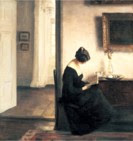
I can't believe this book is out of print. Persephone have reprinted another of Lettice Cooper's novels, The New House, one of my favourite Persephones) & Bloomsbury have a couple more available as ebooks but Fenny would surely be popular with anyone who's read Elizabeth Von Arnim's Enchanted April. On a purely aesthetic note, isn't the cover of this Virago edition gorgeous? The painting is Sewing by Harold Knight & reminds me of how much more evocative the old Virago covers were than most of the current designs (the recent Winifred Holtby & Angela Thirkell covers are exceptions).
This first trip outside England is a revelation for Ellen. The Rivers family - Charles, Madeleine & their daughter, Juliet - are kind & the Villa Meridiana is like a dream to Ellen. Before long, she has become known as Fenny, has cut her hair & begun to release herself from her grey tweed past & embrace the warmer colours & textures of her Italian present. The summer that Fenny spends with the Rivers family changes her in other ways. She falls in love with Daniel, an English tutor living with a neighbouring family, the Warners. Mr Warner is an American now married to an Italian, Lucrezia. He has a son, Shand, from his first marriage & Lucrezia has a daughter, Donata. They have a daughter together, Blanche. Fenny soon realises that Shand is desperately unhappy in Italy & hates his stepmother who is brittle & artificial & has a string of admirers. Fenny's relationship with Daniel is tentative & hampered by his moodiness. He grew up in a mining community & was the only one of his family to escape working in the pits. The betrayal that ends their relationship bursts the bubble of Fenny's happiness & infatuation with Italy.
Four years later Fenny is now living with the Warners & teaching their daughters. She's still part of the community of ex-pat English & Americans, living in another country villa & immune from the political changes of Italy in the late 1930s. Shand is now 16 & still desperate to go home to America & live with the aunts who cared for him when he was a baby after his mother died. Fenny dislikes Lucrezia Warner but loves Italy & finds herself drifting along in her comfortable life until a crisis sends her life in a new direction.
In 1938, Fenny is living in Florence & working in a travel agency. On a trip home to England just after the Munich crisis her family encourage her to return home for good lest she be trapped in Italy if war breaks out. Fenny thinks she is only returning to Italy for a few weeks, just to see how the political situation turns out. However, after a chance meeting with Professor Arturo Marelli, who she had met with his young wife, Graziella, a year before, Fenny's life takes a new turn. Her involvement with Arturo & his circle enmesh her more deeply in Italy & when the war begins, she is unable to return home, even if she had wanted to. Her growing realization of the consequences of political opposition to Mussolini's regime & her loyalty to her friends as well as her love for Arturo will leave a mark on the rest of her life.
This is such a wonderful book. Lettice Cooper's descriptions of Italy are gorgeous & she really shows how Fenny responds to the warmth & beauty of Florence & the countryside from the moment she arrives. This is Italy before the hordes of tourists took over. It was a time when visitors could stroll along the streets of Florence, visiting empty churches & sitting at outdoor cafes almost as one of the locals. I discovered from reading the Introduction by Francis King (after I'd finished the book, of course) that Lettice Cooper had visited Italy frequently & based the Villa Meridiana on a villa she (& King) knew & had stayed in. The details of Fenny's life are so beautifully described. The changes in her hair & clothing are representative of the changes in her emotional & spiritual life. The visit home to England shows her how much she has changed as she realises how little she has in common with her brother's family as he worries about the coming war & tries to convince her to leave Italy. By this time, though, Fenny knows she will never leave golden Italy for grey, gloomy England.
I can't believe this book is out of print. Persephone have reprinted another of Lettice Cooper's novels, The New House, one of my favourite Persephones) & Bloomsbury have a couple more available as ebooks but Fenny would surely be popular with anyone who's read Elizabeth Von Arnim's Enchanted April. On a purely aesthetic note, isn't the cover of this Virago edition gorgeous? The painting is Sewing by Harold Knight & reminds me of how much more evocative the old Virago covers were than most of the current designs (the recent Winifred Holtby & Angela Thirkell covers are exceptions).
Tuesday, April 30, 2013
The Betrothed - Alessandro Manzoni
I've discovered so many new (to me) authors & books through my 19th century bookgroup & this is another one. I'd never heard of Manzoni although he's one of the best-known Italian authors of the 19th century. Verdi wrote his Requiem in his honour & this novel, The Betrothed, is considered one of the finest historical novels of the period. It struck me as I was reading this novel that I've read many English, French & Russian novels written in the 19th century but very few from other European countries. The conveners of my 19th century bookgroup are doing their best to remedy this lack in my education.
The Betrothed has a simple story at its heart. Renzo & Lucia are in love & wish to marry. They live in a village in the Duchy of Milan. The story takes place in the 1630s when this part of Italy was ruled by Spain. The peasants are hard-working but at the mercy of petty overlords who act with impunity & are virtually tyrants. One of these, Don Rodrigo, wants Lucia for himself & will stop at nothing to possess her. Don Rodrigo's bravoes (hired thugs) have intimidated the nervous, cowardly priest, Don Abbondio, until he's too afraid to perform the marriage ceremony. The couple fear Rodrigo's next move &, when their plan to trick Don Abbondio into marrying them fails, they, along with Lucia's mother, Agnese, leave the village to escape Rodrigo's influence.
The couple are advised by the Capuchin monk, Father Cristoforo. He is a brave, fearless man who has entered the monastery as penitence for his own misdeeds. He confronts Rodrigo & tries to shame him into leaving Lucia in peace but this only results in Rodrigo using his political influence to have Father Cristoforo transferred to a faraway monastery. Lucia has been advised to take refuge in a convent with the mysterious Nun of Monza while Renzo heads to Milan to consult the Capuchins there. The lovers must undergo many trials in their long separation. Lucia is kidnapped from the convent & her fate is looking dire until rescue comes from an unexpected source. In her relief, she pledges her virginity in gratitude to the Virgin for her deliverance as she now believes that she will never see Renzo again.
Renzo reaches Milan after several adventures on the road but is then caught up in riots caused by famine & finds himself with a warrant for his arrest after he's taken for one of the ringleaders. Then, war breaks out & Lucia & her mother, along with Don Abbondio & his wily housekeeper, Perpetua, must take refuge from the approach of enemy soldiers. After this, plague breaks out. In all this time, Lucia & Renzo have had little news of each other apart from some comically misinterpreted letters written by friends as the lovers are illiterate. When Renzo survives the plague, he is determined to find Lucia & sets off on his final long journey.to discover the truth.
The Betrothed is a wonderful book with enough romance, adventure & evil to satisfy any reader. The characters are beautifully drawn. Lucia is good, honest & beautiful, determined to stay true to Renzo & well-supported by her feisty, resourceful mother, Agnese. Renzo is brave & impulsive although unfortunately prone to drinking a little too much in taverns & making impulsive speeches that get him into trouble. He's always worked hard - he has a farm but is also a trained silk worker - & he's not intimidated by Don Rodrigo & his thugs. He has an innate belief in his own self-worth & won't accept that evil, in the form of Don Rodrigo or any other petty tyrant, should have power over his life.
The portraits of the religious characters are interesting. The village priest, Don Abbondio, is timid with his superiors but confident with his parishioners. He just wants an easy life & his cowardly dithering is very funny. His housekeeper, Perpetua, keeps him in line, mostly for his own good. Father Christoforo is a penitent man who does all he can for Lucia & Renzo. His advice is good although his powers don't match his desire to help. Lucia's refuge at the Convent at Monza leads to the strange story of Gertrude, the Nun of Monza, who was forced into the convent by her wealthy family & who becomes enamoured of her power. Finally, Cardinal Borromeo, based on a real person, is the model of a churchman - kind, charitable, learned.
The many people the lovers meet on their travels, from the mysterious Unnamed, a petty tyrant like Rodrigo who undergoes a miraculous change of heart to the kind relatives & friends who help Renzo with food & work on his journey, are all fascinating & all individual. The epic scenes of famine, war & plague are horrifying yet compelling & obviously based on extensive historical research. Our narrator does digress occasionally into a chapter or two of exposition on the causes of the war or the political situation & this can become a little tedious. The only exception to this is the chapters on the progress of the plague which were compelling reading if disturbing in their detail about the horrors people suffered. But, as soon as we return to Lucia & Renzo, the pace picks up & I raced on to the end to discover their fate.
The Betrothed has a simple story at its heart. Renzo & Lucia are in love & wish to marry. They live in a village in the Duchy of Milan. The story takes place in the 1630s when this part of Italy was ruled by Spain. The peasants are hard-working but at the mercy of petty overlords who act with impunity & are virtually tyrants. One of these, Don Rodrigo, wants Lucia for himself & will stop at nothing to possess her. Don Rodrigo's bravoes (hired thugs) have intimidated the nervous, cowardly priest, Don Abbondio, until he's too afraid to perform the marriage ceremony. The couple fear Rodrigo's next move &, when their plan to trick Don Abbondio into marrying them fails, they, along with Lucia's mother, Agnese, leave the village to escape Rodrigo's influence.
The couple are advised by the Capuchin monk, Father Cristoforo. He is a brave, fearless man who has entered the monastery as penitence for his own misdeeds. He confronts Rodrigo & tries to shame him into leaving Lucia in peace but this only results in Rodrigo using his political influence to have Father Cristoforo transferred to a faraway monastery. Lucia has been advised to take refuge in a convent with the mysterious Nun of Monza while Renzo heads to Milan to consult the Capuchins there. The lovers must undergo many trials in their long separation. Lucia is kidnapped from the convent & her fate is looking dire until rescue comes from an unexpected source. In her relief, she pledges her virginity in gratitude to the Virgin for her deliverance as she now believes that she will never see Renzo again.
Renzo reaches Milan after several adventures on the road but is then caught up in riots caused by famine & finds himself with a warrant for his arrest after he's taken for one of the ringleaders. Then, war breaks out & Lucia & her mother, along with Don Abbondio & his wily housekeeper, Perpetua, must take refuge from the approach of enemy soldiers. After this, plague breaks out. In all this time, Lucia & Renzo have had little news of each other apart from some comically misinterpreted letters written by friends as the lovers are illiterate. When Renzo survives the plague, he is determined to find Lucia & sets off on his final long journey.to discover the truth.
The Betrothed is a wonderful book with enough romance, adventure & evil to satisfy any reader. The characters are beautifully drawn. Lucia is good, honest & beautiful, determined to stay true to Renzo & well-supported by her feisty, resourceful mother, Agnese. Renzo is brave & impulsive although unfortunately prone to drinking a little too much in taverns & making impulsive speeches that get him into trouble. He's always worked hard - he has a farm but is also a trained silk worker - & he's not intimidated by Don Rodrigo & his thugs. He has an innate belief in his own self-worth & won't accept that evil, in the form of Don Rodrigo or any other petty tyrant, should have power over his life.
The portraits of the religious characters are interesting. The village priest, Don Abbondio, is timid with his superiors but confident with his parishioners. He just wants an easy life & his cowardly dithering is very funny. His housekeeper, Perpetua, keeps him in line, mostly for his own good. Father Christoforo is a penitent man who does all he can for Lucia & Renzo. His advice is good although his powers don't match his desire to help. Lucia's refuge at the Convent at Monza leads to the strange story of Gertrude, the Nun of Monza, who was forced into the convent by her wealthy family & who becomes enamoured of her power. Finally, Cardinal Borromeo, based on a real person, is the model of a churchman - kind, charitable, learned.
The many people the lovers meet on their travels, from the mysterious Unnamed, a petty tyrant like Rodrigo who undergoes a miraculous change of heart to the kind relatives & friends who help Renzo with food & work on his journey, are all fascinating & all individual. The epic scenes of famine, war & plague are horrifying yet compelling & obviously based on extensive historical research. Our narrator does digress occasionally into a chapter or two of exposition on the causes of the war or the political situation & this can become a little tedious. The only exception to this is the chapters on the progress of the plague which were compelling reading if disturbing in their detail about the horrors people suffered. But, as soon as we return to Lucia & Renzo, the pace picks up & I raced on to the end to discover their fate.
Saturday, May 22, 2010
My Cousin Rachel - Daphne Du Maurier


I read most of Daphne Du Maurier’s novels as a teenager in the 70s. Rebecca was my favourite, of course. I loved Laurence Olivier in the Hitchcock movie (even though they had to change a few plot points to make Max less culpable) & I read the book over & over again. I still have a few of the novels to go & I’ve only read one of her volumes of short stories. I borrowed most of her books from my local library in the old yellow Gollancz hardbacks.
I was very pleased when Virago started reprinting Du Maurier so I could catch up on a few titles I’d never read, including some of the non-fiction books she wrote about her family. I’d also like to find time to reread Margaret Forster’s biography of Daphne. If you click on the photo, I hope you can see the titles of my Du Mauriers more clearly. The 3rd book down with the very faded spine is The Rebecca Notebook & other memories. After I took the photo I remembered my copy of Vanishing Cornwall which is on another tbr shelf. My Cousin Rachel was another of the books I read back then. When Cornflower announced it as her next Book Club choice, I was inspired to take my copy down from the shelf for a reread.
My Cousin Rachel made a great impression on me as a teenager. I remember being unsure who to believe – Philip, the young naive narrator, or beautiful sophisticated Rachel. This time, I was much more firmly on Rachel’s side, although there’s enough doubt in my mind about some of her actions & motivations to still be tantalisingly unsure. That’s the beauty of Du Maurier’s skill as a writer. The balance sways one way & another without ever coming to rest completely. As Philip’s godfather tells him,
There are some women, Philip, good women very possibly, who through no fault of their own, impel disaster. Whatever they touch somehow turns to tragedy. I don’t know why I say this to you, but I feel I must.
The story is one of jealousy & love. Philip Ashley has been brought up by his cousin, Ambrose, a middle-aged bachelor, at their family home in Cornwall. Ambrose travels to Italy for his health, &, while he’s there, he meets a distant relation, the beautiful Rachel, Countess Sangaletti. Philip is amazed to hear that Ambrose & Rachel have married & they are living in her villa in Naples. Philip is jealous but soon his jealousy turns to concern as Ambrose’s letters become mysterious. There are hints of poison & madness. Ambrose’s final letter, delivered as Philip is already on his way to Naples to find out what is going on, is just a few scribbled lines.
For God’s sake, come to me quickly. She has done for me at last, Rachel, my torment. If you delay, it may be too late.
Philip arrives in Naples to the news that Ambrose is dead & Rachel has already left Naples, no one knows her destination. The scenes in Italy are beautifully done. Philip, young, stiff, very English, has travelled from cold, windswept, provincial Cornwall to warm, sensual, cosmopolitan Naples. He’s out of his depth. Shocked by the news of Ambrose’s death, suspicious of the servants at the villa & hostile to Signor Rainaldi, Rachel’s friend & lawyer, he is determined to find out the truth. Heartbroken, he returns to England to hear from his godfather, Nick Kendall, that Rachel has arrived in England & wants to visit. Ambrose hadn’t changed his will on his marriage so Philip has inherited everything. Rachel has nothing. Philip is immediately suspicious of her motives.
Once she arrives, however, he is beguiled by Rachel. She captivates everyone she meets – apart from Philip’s childhood friend, Louise Kendall, who is jealous in her turn. Philip becomes increasingly infatuated with Rachel, culminating with his desire to give her the property outright when he becomes his own master on his 25th birthday. But there are still questions & doubts. Ambrose’s family has a history of brain fevers, maybe madness. His illness in Italy was similar to a brain fever & his paranoid letters could have been a result of this. Rachel is an enthusiastic & knowledgeable gardener & brews herbal tisanas & remedies. Did she poison Ambrose? If she knew he hadn’t changed his will, there would be no point. But, did she know? She presents herself as a heartbroken widow, she plays the part well, but is she just trying to influence Philip to give her an allowance? Then, stories begin to circulate of the life she led with her first husband, a dissolute gambler who was killed in a duel. By now, Philip is in thrall to Rachel & desperate to marry her. The scene is set for the final tragedy.
I shall become a Justice of the Peace, as Ambrose was, & also be returned, one day, to Parliament. I shall continue to be honoured & respected, like all my family before me. Farm the land well, look after the people. No one will ever guess the burden of blame I carry on my shoulders; nor will they know that every day, haunted still by doubt, I ask myself a question which I cannot answer. Was Rachel innocent or guilty? Maybe I shall learn that too, in Purgatory.
This is a fantastic read, full of suspense. The romance of Cornwall, an unreliable, impulsive narrator, an enigmatic heroine & those unanswered questions. Du Maurier was a superb storyteller & this is one of her most successful novels. If you haven’t already read it, you’re in for a treat.
Subscribe to:
Posts (Atom)