Showing posts with label Christina Rossetti. Show all posts

Sunday, July 10, 2016

Sunday Poetry - Christina Rossetti

This is one of the poems from Rossetti's sonnet sequence Monna Innominata, which she modeled on Elizabeth Barrett Browning's famous Sonnets from the Portuguese. I love all the poems in this set but I don't think I've featured this one before.

Many in aftertimes will say of you
‘He loved her’ – while of me what will they say?
Not that I loved you more than just in play,
For fashion’s sake as idle women do.
Even let them prate; who know not what we knew
Of love and parting in exceeding pain.
Of parting hopeless here to meet again,
Hopeless on earth, and heaven is out of view.
But by my heart of love laid bare to you.
My love that you can make not void nor vain,
Love that foregoes you but to claim anew
Beyond this passage of the gate of death,
I charge you at the Judgment make it plain
My love of you was life and not a breath.

Sunday, April 12, 2015

Sunday Poetry - Christina Rossetti

One final poem from the anthology I've been reading during Lent. Christina Rossetti is one of my favourite poets & this lovely poem is one of her most optimistic & joyful. Rossetti lived such a quiet life in many ways. I remember reading her letters over several years as they were published & I thought they were fascinating even though they were often just short notes about a charity she was involved in or an enquiry after a friend. There was very little about her poetry but I loved their quiet domesticity as she cared for several elderly aunts & her mother in their last years.

My heart is like a singing bird
        Whose nest is in a water'd shoot;
My heart is like an apple-tree
        Whose boughs are bent with thickset fruit;
My heart is like a rainbow shell
        That paddles in a halcyon sea;
My heart is gladder than all these
        Because my love is come to me.

Raise me a dais of silk and down;
        Hang it with vair and purple dyes;
Carve it in doves and pomegranates,
        And peacocks with a hundred eyes;
Work it in gold and silver grapes,
        In leaves and silver fleurs-de-lys;
Because the birthday of my life
        Is come, my love is come to me
.

Sunday, March 18, 2012

Sunday Poetry - Christina Rossetti

Today I've chosen a favourite poem from a favourite poet, Christina Rossetti. Her work ranges from poems & stories for children to the amazing Goblin Market. I like her quietly intense love poems like this one, called Echo in my anthology, & her sonnet sequence, Monna Innominata, written in admiring admiration of Elizabeth Barrett Browning's Sonnets from the Portuguese.

Come to me in the silence of the night;
Come in the speaking silence of a dream;
Come with soft rounded cheeks and eyes as bright
As sunlight on a stream;
Come back in tears,
Of memory, hope, love of finished years.


Oh dream how sweet, too sweet, too bitter sweet,
Whose wakening should have been in Paradise,
Where souls brimful of love abide and meet;
Where thirsting longing eyes
Watch the slow door
That opening, letting in, lets out no more.


Yet come to me in dreams, that I may live
My very life again though cold in death:
Come back to me in dreams, that I may give
Pulse for pulse, breath for breath:
Speak low, lean low,
As long ago, my love, how long ago!

Saturday, June 19, 2010

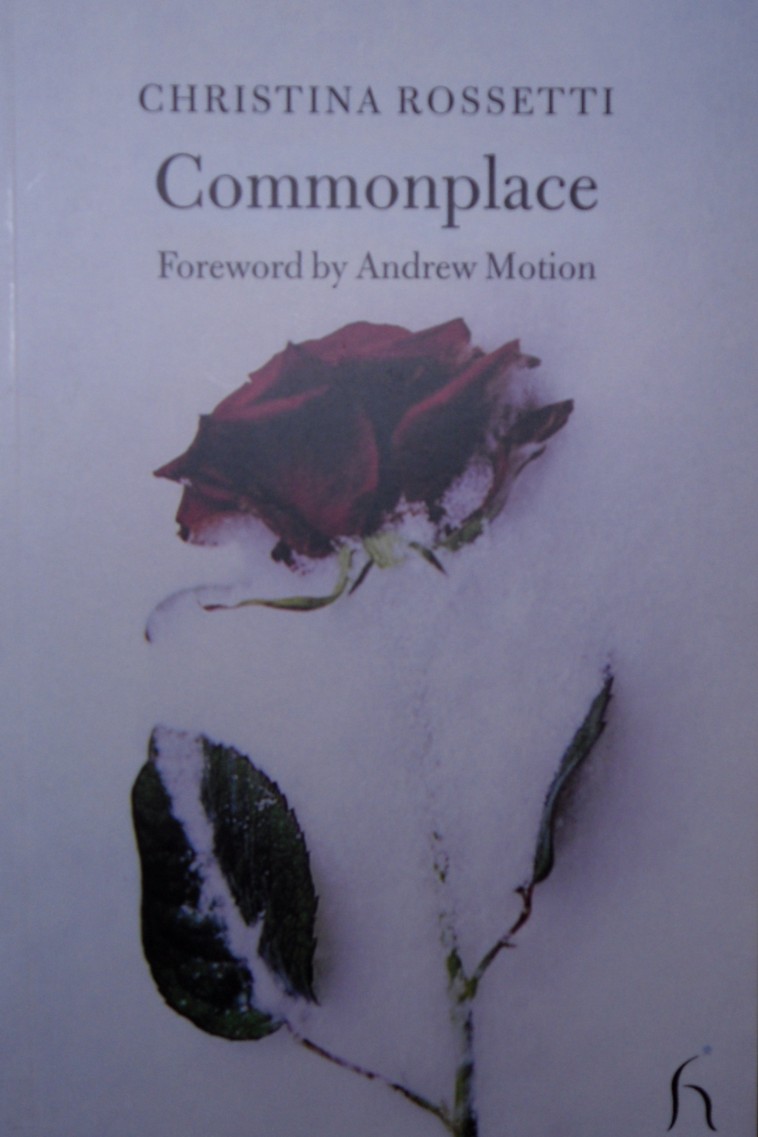
Commonplace - Christina Rossetti


Christina Rossetti is one of my favourite poets. She was a member of a talented family. Her brother, Dante Gabriel, was a founding member of the Pre Raphaelite Brotherhood, a group of young Victorian artists who wanted to revolutionise the staid world of the Royal Academy. Christina was a model for Gabriel in several paintings but I prefer the beautiful chalk drawings he did of her like the one above.

Her most famous poem, Goblin Market, is an extraordinary poem about sisterhood, love & temptation. She also wrote very movingly of love & loss, especially in the Monna Innominata sonnets. Christina also wrote children’s stories & fables with a religious theme as well as a few other pieces of short fiction. Commonplace is one of these, & Hesperus Press has reprinted it in a beautiful edition with yet another of their stunning cover designs. Commonplace is the story of the three Charlmont sisters, Catherine, Lucy & Jane. They’ve lived in Brompton-on-Sea all their lives. Their father went missing in a boating accident when Catherine was 12 & Jane not yet born. Their mother died in childbirth after making Catherine promise that one of the girls would always be at home to welcome back their father when he returns. Of course, he never does return & by the time Jane is 18, the three sisters are entrenched in their comfortable, middle-class existence in Brompton-on-Sea.

Catherine, in her early 30s, has been a mother to Jane & Lucy & feels the responsibility of her position. Lucy is a gentle soul who has loved & lost & is almost resigned to spinsterhood. Jane is dependant financially on her sisters (her father made no provision for her in his will because he didn’t know his wife was pregnant when he died), spoilt, wilful & determined to marry comfortably to escape her dependency. She hasn’t a romantic or sensitive bone in her body. In these three women, Christina Rossetti explores the options for middle-class women in Victorian England. There are some very funny scenes, especially when Jane decides to marry a pompous name-dropper, much older than herself. This man, Mr Durham, has a daughter, Stella, who has married Alan Hartley, the object of Lucy’s unrequited love. Lucy surprises herself by becoming very fond of Stella & finally seeing through Alan’s shallow charms. All is not lost for her though as an old suitor reappears on the scene.

Rossetti packs a lot into just 60pp. Many other Victorian writers would have found enough plot here for a three volume novel. Commonplace is a slight story, a bit of a curiosity from an author better known for her poetry, but I found it an interesting exploration of the constraints on middle-class women of the time.

Sunday, January 3, 2010

Footnotes essential


I love footnotes. A volume of letters or a diary just isn’t complete without exhaustive footnotes, preferably right there at the bottom of the page so I can just glance down & check who or what the writer is referring to. Even when I think I know, I still like to check just to be sure. The only problem I had with Pepys’s Diary was that there were no footnotes. There’s a Biographical Index which had information about each person so if I forgot which William was which (this happened quite often), I could go to the Index & check. But, it just wasn’t the same. Two more of my best reads of last year were Christina Rossetti’s Letters edited by A Harrison & the Selected Journals of L M Montgomery edited by Mary Rubio & Elizabeth Waterston. The Journals had the notes at the back but Rossetti’s Letters had the footnotes right there at the end of each letter for instant reference. Some of my favourite books of all have been letters & diaries – Charlotte Bronte’s Letters (that's one of Charlotte's letters there), Virginia Woolf’s Diaries, The Mitford sisters’ Letters, Sylvia Townsend Warner’s Diaries, Dorothy L Sayers’s Letters (I still have several volumes of these to go), the selected letters of Keats, Vera Brittain, Frances Partridge... I also have some waiting on my tbr shelves that I really want to read this year. Penelope Fitzgerald’s letters, the letters of the Duchess of Devonshire & Paddy Leigh Fermor, Jessica Mitford’s letters & the selected letters & journals of Byron. Will they live up to my standards when it comes to footnotes? I hope so.

Saturday, January 2, 2010

Book of the year 2009 - Pepys's Diary


I keep a list of books I've read. I've been doing this since 1979 so I've just completed 30 years of recording my reading. I usually come up with a list of my Top 10 books of the year but I could only come up with a Top 5 list for 2009. I read more books than usual, 172, but there weren't as many standout books for me last year. I reread quite a bit & these are always favourites, but I don't put rereads on my Top list. In 2009, my Top 5 was dominated by diaries & letters. I read the final volumes of Christina Rossetti's Letters & L M Montgomery's Journals. I've been reading these over several years, waiting for them to be published & then available through ILL & last year, I finally got hold of the last volumes. But, my book of the year was The Diary of Samuel Pepys. Only the Shorter Pepys I should add, although the Shorter is still 1000pp long. I would love to read the complete Diary now that I've had a taste, but living with Sam for the few weeks it took me to read this volume was a wonderful introduction to his world. It took a little while to get into the rhythm of the Diary & to work out who everyone was. The Diary begins at a moment of high drama in 1660 with the political machinations which will lead to the Restoration of Charles II. Pepys is actually in the fleet that goes to Holland to bring the new King back to England. From that moment, he's plunged into an immense amount of work as a hard working clerk to the Navy Board. He's a witness to many public events in the nine years of the Diary including the Great Fire & the plague as well as the Dutch War. His personal life is, if anything, even more fascinating. His love of the theatre, fine clothes & bad women is told with such honesty. This is what I loved most about the Diary. Although he was only writing for himself, he is meticulous in justifying every extravagance. He vowed he would only attend so many plays per month, but he's ingenious at getting around his own vow when he's desperate to see a performance. His sexual adventures are hidden, even from himself, in a peculiar mixture of French & Latin as if he can't quite admit to himself that he's behaving badly. He's honest about his sometimes shabby treatment of his much younger wife, Elizabeth, & enjoys describing his bodily ailments & their cures. The minutiae of everyday life for an up & coming clerk in government service is just fascinating. I also admired his pride in his success as he adds up every month how much he's worth. At the end of the book I felt bereft. Pepys stopped writing the Diary in 1669 because he thought he was losing his sight. Luckily, he didn't, but what a shame that he didn't resume the Diary. Imagine what we could have learnt about the rest of the reign of Charles II, the short, disastrous reign of James II & the Glorious Revolution. Still, I'm so grateful for what Pepys did write & that I have the whole 10 vols to look forward to reading in the future.