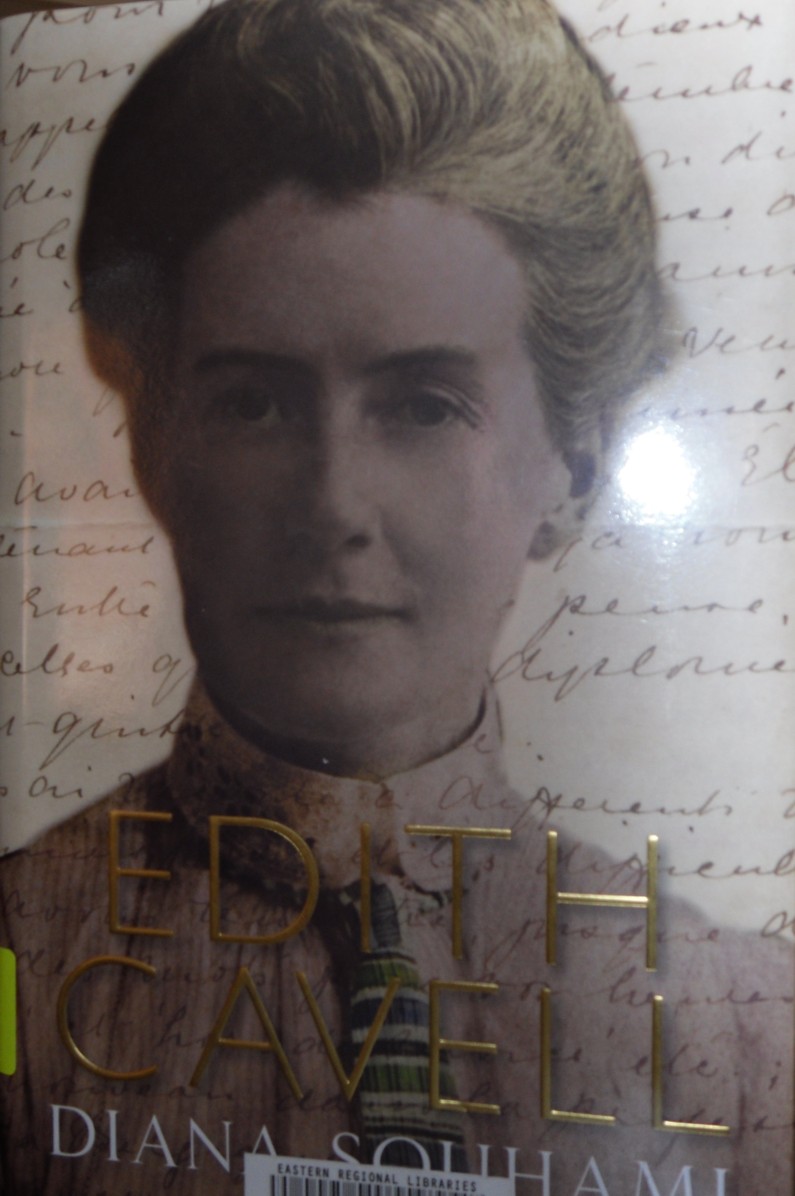
When I reviewed Diana Souhami's biography of Edith Cavell last year, I commented that it was difficult to really know what Edith was like as a person. I enjoyed Souhami's biography & she had obviously done extensive research but there are not many personal documents by Edith as she destroyed so much when she became aware that she was about to be arrested. Terri Arthur contacted me after reading my review & said that she was writing a novel about Edith Cavell to try & convey what she was really like. Recently,
Terri sent me a copy of her novel, Fatal Decision, so I've been able to decide whether she has been able to accomplish this.
I think Terri Arthur has definitely succeeded in presenting Edith Cavell as a woman rather than the saint of legend. Maybe only fiction would have allowed this as Arthur has been able to use her imagination to recreate the character of a woman whose terrible death has overshadowed everything else about her. The facts of her life are well-known. Edith Cavell was a nursing matron in charge of a training school for nurses in Brussels during WWI when Belgium was occupied by the German Army. She became involved in a resistance group that helped Allied soldiers who had become trapped in Belgium to escape to England, Holland or France. She was arrested, put on trial as a spy, convicted, sentenced to death & shot at dawn on October 12th 1915.
The novel begins with Edith applying to nurse at the London Hospital. Here she is influenced by Eva Luckes, the formidable matron & disciple of Florence Nightingale. Although Luckes is very hard on her students, Edith is determined to succeed. Edith makes friends although she is seen by some as stiff & humourless. She volunteers to help in a typhoid epidemic & in this episode she demonstrates her determination to overcome her weaknesses. Edith's overwhelming concern for the care of her patients is paramount. All her work can't impress Matron Luckes, however, who gives her a lacklustre assessment when she finishes her studies. Edith works in hospitals in a variety of roles until the opportunity to go to Brussels & start a school for nurses is offered to her by a former pupil from her time as a governess in Europe.
The nursing school has to overcome many hurdles, including the objections of the Catholic Church, whose nuns had been the willing but unschooled nurses up to this time. Edith & Dr Eugene Depage work to overcome prejudice against an English Protestant teaching nursing to women who had always seen it as a demeaning occupation. By the time WWI breaks out, the school & Edith have a reputation for excellence. Edith & her nurses begin work under the Red Cross, helping wounded soldiers on both sides of the conflict. Their hospital & nursing home is in Ixelles, south of Brussels, & in the direct path of the German invasion. When the Germans occupy Belgium, a military administration is set up to govern the civilian population.
The fatal decision that Edith makes is to help wounded Allied soldiers trying to escape occupied Belgium & rejoin the Allies in France. With her strong religious & moral convictions, Edith was unlikely to refuse a plea for help. The first two soldiers who arrive at the clinic lead to many more. Edith admitted to helping 200 soldiers escape at her trial but the true number is probably closer to 1000. Edith became part of an underground movement that brought the men in from the surrounding forests where they were hiding, sent them to Edith for medical aid, then sent them on with guides to take them to the border complete with disguises & false identity papers. Edith was aware of the danger of the work she was doing & only involved a few trusted members of her staff. However, she never considered stopping her work, even when she was aware that the clinis was being watched & the authorities were closing in. While one Allied soldier needed her help, she would not refuse it.
The most important person in Edith's life was Elizabeth Wilkins, a nurse who became her best friend & deputy in everything. The portrait of their close friendship is especially moving. The novel is bookended with scenes of Elizabeth in London & Norwich at remembrance services for Edith. The scenes with Elizabeth are a very effective way of humanising Edith as are the scenes of Edith with her beloved dog, Jack. Jack was a stray that Edith took in despite all objections & he proved loyal to the end.
The underground movement was eventually infiltrated & betrayed. Edith's interrogation & trial were a disgrace. She did make some crucial admissions that prejudiced her case but her commitment to truth may have led her to make some naive mistakes. She was forced to sign a confession written in German, which she didn't understand. The defence counsel assigned to her wasn't permitted to visit her or know the charges against her. All her fellow accused were treated similarly but the occupying forces were determined to make an example of this English nurse who dared to defy their rule & Edith, along with several others, were condemned to death.
Edith’s family had heard of her arrest & tried to discover more
information through the Foreign Office. The American Legation was their
only source of news as the US was neutral & still had a diplomatic
presence in Brussels. The American ambassador, Brand Whitlock, did what he could but he was effectively blocked by the military government & stricken with illness at a crucial time. The judges were Prussian military officers & they were determined to make an example of Edith. It was the worst decision the Germans made during WWI. The execution of an Englishwoman, a nurse, brought condemnation from around the world.
Fatal Decision is an absorbing novel. The large cast of characters, from the other nurses & staff at the clinic to the escaping soldiers to the German authorities, are all beautifully portrayed. The author is a nurse & the medical detail is obviously written with
experience & knowledge. Arthur has a real empathy with Edith Cavell
& she's used what letters & documents survive to inform her
portrait of a brave woman who lived & died for her convictions.
Showing posts with label Edith Cavell. Show all posts
Saturday, April 14, 2012
Saturday, April 2, 2011
Edith Cavell - Diana Souhami
Edith Cavell is one of those people in history who is known for how she died rather than how she lived. Edith Cavell was a nursing matron in charge of a training school for nurses in Brussels during WWI when Belgium was occupied by the German Army. She became involved in a resistance group that helped Allied soldiers who had become trapped in Belgium to escape to England, Holland or France. She was arrested, put on trial as a spy, convicted, sentenced to death & shot at dawn on October 12th 1915. Diana Souhami’s new biography of Cavell aims to present a fuller picture of this middle-aged Englishwoman than the saintly image of martyrdom that has been the dominant image since her death.
Edith Cavell was born in a Norfolk village in 1865. Her childhood was happy, her education typical of her time. She originally worked as a governess but disliked the ambiguous position & lack of independence involved in working in other people’s houses. Edith’s sister, Florence, had become a nurse & Edith decided that she too would pursue a career in nursing. Nursing had only recently become a respectable choice for middle-class women who wanted or needed to work. Florence Nightingale’s work in the Crimea & her efforts to make nursing an honourable profession were starting to have an effect on the training of nurses. So, as Edith approached 30, she took the first steps that would start her on her new career.
She applied to the Metropolitan Asylums Board in London for any vacancy they might have for an Assistant Nurse in a London hospital. She began work at the Fountains Fever Hospital at Tooting which had been set up to care for patients with typhus & other infectious diseases. After several months here doing mostly menial work, Edith decided to undertake formal training as a nurse. She was accepted & trained at the London Hospital under the formidable matron, Eva Luckes. Eva Luckes was a friend of Florence Nightingale & followed her precepts in the training of her nurses. The London Hospital had an excellent reputation & Matron, although given to discouraging comments in her notes on her students, was intensely interested in all her nurses & was a source of help & encouragement throughout their careers. Matron Luckes’s comment on Edith Cavell was typical, “Edith Cavell had a self-sufficient manner which was very apt to prejudice people against her.” Edith’s career at the London was steady rather than spectacular & she was often unsuccessful when applying for senior posts. So, when she was asked to go to Brussels in 1907 to set up a nurses’ training school, she saw it as the challenge she had been looking for.
The school on the Rue de la Culture was set up by M Depage, a surgeon who was keen to implement Nightingale-style training with the nurses in his hospital. He heard of Edith through a family she had worked for when she was a governess. She spoke French & had been trained at the London. That was recommendation enough. Edith worked hard, training the nurses, recreating the atmosphere & standards of Eva Luckes’s school at the London. She was starting from scratch & there were many hurdles to overcome, both bureaucratic & personal, but by the time war broke out in 1914, Edith & her school were a success.
The invasion & occupation of Belgium by the German Army was a shock but at first, Edith’s work went on. She worked under the banner of the Red Cross to nurse soldiers of both sides. But, as invasion turned to occupation, the fighting moved into France & Flanders & the focus of Edith’s work turned to helping Allied soldiers trapped behind enemy lines in Belgium to escape. There were many small groups of people doing what they could to obstruct the Germans. Prince Reginald de Croy & his sister, Marie, set up a Red Cross hospital at their chateau Bellignies at the beginning of the war. They also helped soldiers escape by setting up a network of safe houses & guides who would pass the men along until they could safely cross the border. Edith Cavell became involved with this network. The Germans took over the chateau but his didn’t stop the de Croys operating right under their noses. The de Croys had many willing helpers in the villages around them & in Brussels as well.
Edith would take in soldiers, hiding them in the nursing school until they could be supplied with false identity papers. She then led them to safe crossing places on the border. Hundreds of men were helped, not all of them made it to safety but several of them got to England & passed messages from Edith to her family. Her mother would then write to Edith letting her know of a visit from so-and-so & Edith would know that at least some of the men had got to safety. The authorities were determined to crack down on these networks of underground escape routes. There were many people involved but they were careful not to know too much. They only knew a few people in the group but inevitably they were infiltrated by spies or they were indiscreet. By June 1915, the role of the nursing school & its Matron in the escape networks was known to the authorities. The school was kept under surveillance & Edith knew that arrest could not be far away. She continued her work until the last moment although she did destroy her diaries, letters & any notes she had. The last letter Edith’s mother received was written in mid-June & leaves little doubt that Edith knew what lay ahead.
Do not forget if anything very serious should happen you could probably send me a message thro’ the American Ambassador in London (not a letter). All is quiet here as usual. We are only a small number so many being at the front nursing the Belgian soldiers – but also we have less work for no one can think about being ill at present.
“Anything very serious” meant news of her arrest. In early August, she was indeed arrested along with over 20 others in her circuit. The story of Edith’s trial is one of the German occupation authority determined to make an example of an English nurse accused of espionage. The fact that she was English meant she was at more risk than her so-accused. England was the enemy & the conditions of wartime meant that basic principles of law were ignored. Edith was interrogated by men who spoke no French & she spoke no German. The questions & answers were translated to her but the statements she was made to sign were in German so she couldn’t check their accuracy. She was kept in solitary confinement for two months before her trial. Her strong religious faith was her only comfort as she was only allowed brief visits from friends. She worried about her nurses & her dog, Jack, more than about her own fate.
The trial was appallingly run. Dozens of defendants were tried at once, their defence counsel unable to speak to them beforehand. Edith was accused of espionage (a capital offence) although there was no evidence that she had tried to pass information to the Allies or send the young men she helped to the front line. Five of the 35 defendants, including Edith Cavell, were sentenced to death. Most of the others received prison sentences with hard labour. Eight were acquitted. Edith’s family had heard of her arrest & tried to discover more information through the Foreign Office. The American Legation was their only source of news as the US was neutral & still had a diplomatic presence in Brussels. Souhami details the lack of urgency shown by the US Minister, Brand Whitlock, in investigating Edith’s case. When the death sentence was pronounced, it was too late for his futile efforts to do any good. Edith Cavell was shot at dawn on October 12th 1915.
Edith’s execution was one of the worst propaganda mistakes Germany made during WWI. The Allies were horrified that an Englishwoman, a nurse, had been treated so brutally. Her fate was the subject of newspaper editorials, sermons, propaganda cards like this one (from ww1-propaganda-cards.com). Her name became a symbol of all that was vicious & brutal about the enemy in wartime. Edith Cavell ceased to be a woman & became a symbol of innocence, virtue & saintliness.
I made a point of visiting this statue of Edith Cavell (picture from cheminsdememoire.gouv.fr) when I was in London years ago. It epitomises the legend. Her famous last words are inscribed on it, “Patriotism is not enough. I must have no hatred or bitterness for anyone.” These words were not on the statue when it was unveiled in 1920. They were regarded as too pacifist a statement in the immediate aftermath of the war. Fortunately, protests by prominent women’s groups ensured that they were added later as a contribution to world peace.
Previous biographies haven’t tried very hard to look behind the veil of the saint. For all Diana Souhami’s research, & it is phenomenal, I don’t know that she has succeeded in making Edith come alive to the reader. The last year of Edith's life takes up more than half the book. Edith was a good woman. She was religious, dutiful, committed to helping those less fortunate. The self-sufficiency or self-containment mentioned in Eva Luckes’s comment on her student nurse is what makes Edith Cavell so hard to know. I don’t feel I know her any more now than I did before reading the book although, of course, I know much more about her life. Edith’s letters to her mother & her concern for the welfare of Jack are the most intimate glimpses we get of her. Of course, she had to destroy all her personal papers before her arrest but the remembrances of those she worked with have all been coloured by her terrible death. She is still a symbol rather than a living, breathing woman. Having said that, I enjoyed this book for the picture of nursing in late Victorian times, the life of a vicar’s daughter who wanted to do something useful with her life & the inspiring actions of a woman who followed her conscience & made her own decisions about her duty to her fellow man.
Edith Cavell was born in a Norfolk village in 1865. Her childhood was happy, her education typical of her time. She originally worked as a governess but disliked the ambiguous position & lack of independence involved in working in other people’s houses. Edith’s sister, Florence, had become a nurse & Edith decided that she too would pursue a career in nursing. Nursing had only recently become a respectable choice for middle-class women who wanted or needed to work. Florence Nightingale’s work in the Crimea & her efforts to make nursing an honourable profession were starting to have an effect on the training of nurses. So, as Edith approached 30, she took the first steps that would start her on her new career.
She applied to the Metropolitan Asylums Board in London for any vacancy they might have for an Assistant Nurse in a London hospital. She began work at the Fountains Fever Hospital at Tooting which had been set up to care for patients with typhus & other infectious diseases. After several months here doing mostly menial work, Edith decided to undertake formal training as a nurse. She was accepted & trained at the London Hospital under the formidable matron, Eva Luckes. Eva Luckes was a friend of Florence Nightingale & followed her precepts in the training of her nurses. The London Hospital had an excellent reputation & Matron, although given to discouraging comments in her notes on her students, was intensely interested in all her nurses & was a source of help & encouragement throughout their careers. Matron Luckes’s comment on Edith Cavell was typical, “Edith Cavell had a self-sufficient manner which was very apt to prejudice people against her.” Edith’s career at the London was steady rather than spectacular & she was often unsuccessful when applying for senior posts. So, when she was asked to go to Brussels in 1907 to set up a nurses’ training school, she saw it as the challenge she had been looking for.
The school on the Rue de la Culture was set up by M Depage, a surgeon who was keen to implement Nightingale-style training with the nurses in his hospital. He heard of Edith through a family she had worked for when she was a governess. She spoke French & had been trained at the London. That was recommendation enough. Edith worked hard, training the nurses, recreating the atmosphere & standards of Eva Luckes’s school at the London. She was starting from scratch & there were many hurdles to overcome, both bureaucratic & personal, but by the time war broke out in 1914, Edith & her school were a success.
The invasion & occupation of Belgium by the German Army was a shock but at first, Edith’s work went on. She worked under the banner of the Red Cross to nurse soldiers of both sides. But, as invasion turned to occupation, the fighting moved into France & Flanders & the focus of Edith’s work turned to helping Allied soldiers trapped behind enemy lines in Belgium to escape. There were many small groups of people doing what they could to obstruct the Germans. Prince Reginald de Croy & his sister, Marie, set up a Red Cross hospital at their chateau Bellignies at the beginning of the war. They also helped soldiers escape by setting up a network of safe houses & guides who would pass the men along until they could safely cross the border. Edith Cavell became involved with this network. The Germans took over the chateau but his didn’t stop the de Croys operating right under their noses. The de Croys had many willing helpers in the villages around them & in Brussels as well.
Edith would take in soldiers, hiding them in the nursing school until they could be supplied with false identity papers. She then led them to safe crossing places on the border. Hundreds of men were helped, not all of them made it to safety but several of them got to England & passed messages from Edith to her family. Her mother would then write to Edith letting her know of a visit from so-and-so & Edith would know that at least some of the men had got to safety. The authorities were determined to crack down on these networks of underground escape routes. There were many people involved but they were careful not to know too much. They only knew a few people in the group but inevitably they were infiltrated by spies or they were indiscreet. By June 1915, the role of the nursing school & its Matron in the escape networks was known to the authorities. The school was kept under surveillance & Edith knew that arrest could not be far away. She continued her work until the last moment although she did destroy her diaries, letters & any notes she had. The last letter Edith’s mother received was written in mid-June & leaves little doubt that Edith knew what lay ahead.
Do not forget if anything very serious should happen you could probably send me a message thro’ the American Ambassador in London (not a letter). All is quiet here as usual. We are only a small number so many being at the front nursing the Belgian soldiers – but also we have less work for no one can think about being ill at present.
“Anything very serious” meant news of her arrest. In early August, she was indeed arrested along with over 20 others in her circuit. The story of Edith’s trial is one of the German occupation authority determined to make an example of an English nurse accused of espionage. The fact that she was English meant she was at more risk than her so-accused. England was the enemy & the conditions of wartime meant that basic principles of law were ignored. Edith was interrogated by men who spoke no French & she spoke no German. The questions & answers were translated to her but the statements she was made to sign were in German so she couldn’t check their accuracy. She was kept in solitary confinement for two months before her trial. Her strong religious faith was her only comfort as she was only allowed brief visits from friends. She worried about her nurses & her dog, Jack, more than about her own fate.
The trial was appallingly run. Dozens of defendants were tried at once, their defence counsel unable to speak to them beforehand. Edith was accused of espionage (a capital offence) although there was no evidence that she had tried to pass information to the Allies or send the young men she helped to the front line. Five of the 35 defendants, including Edith Cavell, were sentenced to death. Most of the others received prison sentences with hard labour. Eight were acquitted. Edith’s family had heard of her arrest & tried to discover more information through the Foreign Office. The American Legation was their only source of news as the US was neutral & still had a diplomatic presence in Brussels. Souhami details the lack of urgency shown by the US Minister, Brand Whitlock, in investigating Edith’s case. When the death sentence was pronounced, it was too late for his futile efforts to do any good. Edith Cavell was shot at dawn on October 12th 1915.
Edith’s execution was one of the worst propaganda mistakes Germany made during WWI. The Allies were horrified that an Englishwoman, a nurse, had been treated so brutally. Her fate was the subject of newspaper editorials, sermons, propaganda cards like this one (from ww1-propaganda-cards.com). Her name became a symbol of all that was vicious & brutal about the enemy in wartime. Edith Cavell ceased to be a woman & became a symbol of innocence, virtue & saintliness.
I made a point of visiting this statue of Edith Cavell (picture from cheminsdememoire.gouv.fr) when I was in London years ago. It epitomises the legend. Her famous last words are inscribed on it, “Patriotism is not enough. I must have no hatred or bitterness for anyone.” These words were not on the statue when it was unveiled in 1920. They were regarded as too pacifist a statement in the immediate aftermath of the war. Fortunately, protests by prominent women’s groups ensured that they were added later as a contribution to world peace.
Previous biographies haven’t tried very hard to look behind the veil of the saint. For all Diana Souhami’s research, & it is phenomenal, I don’t know that she has succeeded in making Edith come alive to the reader. The last year of Edith's life takes up more than half the book. Edith was a good woman. She was religious, dutiful, committed to helping those less fortunate. The self-sufficiency or self-containment mentioned in Eva Luckes’s comment on her student nurse is what makes Edith Cavell so hard to know. I don’t feel I know her any more now than I did before reading the book although, of course, I know much more about her life. Edith’s letters to her mother & her concern for the welfare of Jack are the most intimate glimpses we get of her. Of course, she had to destroy all her personal papers before her arrest but the remembrances of those she worked with have all been coloured by her terrible death. She is still a symbol rather than a living, breathing woman. Having said that, I enjoyed this book for the picture of nursing in late Victorian times, the life of a vicar’s daughter who wanted to do something useful with her life & the inspiring actions of a woman who followed her conscience & made her own decisions about her duty to her fellow man.
Labels:
books,
Diana Souhami,
Edith Cavell,
history,
nursing,
resistance,
WWI
Subscribe to:
Posts (Atom)