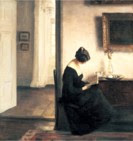
After last week's melancholy Hardy, this week's poem, The Ruined Maid, is much more spritely. The speaker's view of the advantages of ruin, at least as far as clothes & "polish" go are witty & satirical but I wonder how chirpy 'Melia will be in a few years time? The Persephone Post from a couple of weeks ago featured Augustus Egg's triptych, Past and Present 1, 2, 3, which gives a more traditional, middle-class view of a woman's ruin.
"O 'Melia, my dear, this does everything crown!
Who could have supposed I should meet you in Town?
And whence such fair garments, such prosperi-ty?" —
"O didn't you know I'd been ruined?" said she.
— "You left us in tatters, without shoes or socks,
Tired of digging potatoes, and spudding up docks;
And now you've gay bracelets and bright feathers three!" —
"Yes: that's how we dress when we're ruined," said she.
— "At home in the barton you said thee' and thou,'
And thik oon,' and theäs oon,' and t'other'; but now
Your talking quite fits 'ee for high compa-ny!" —
"Some polish is gained with one's ruin," said she.
— "Your hands were like paws then, your face blue and bleak
But now I'm bewitched by your delicate cheek,
And your little gloves fit as on any la-dy!" —
"We never do work when we're ruined," said she.
— "You used to call home-life a hag-ridden dream,
And you'd sigh, and you'd sock; but at present you seem
To know not of megrims or melancho-ly!" —
"True. One's pretty lively when ruined," said she.
— "I wish I had feathers, a fine sweeping gown,
And a delicate face, and could strut about Town!" —
"My dear — a raw country girl, such as you be,
Cannot quite expect that. You ain't ruined," said she.
Showing posts with label Thomas Hardy. Show all posts
Sunday, August 14, 2016
Sunday, August 7, 2016
Sunday Poetry - Thomas Hardy
Thomas Hardy is the right poet for my mood this week. I've had one of those annoying colds that never really becomes a proper cold (necessitating a couple of cosy days in a warm room with a pot of tea, a cat or two & books). Just sniffles & a nose that runs for two days, stops for a day & a half & then starts again. Feeling melancholy & a bit sorry for myself, Hardy was the perfect companion in misery.
This is one of the poems Hardy wrote after the death of his first wife, Emma. They had been estranged for some time before her death, although still living in the same house. Her death released a flood of memories of their life together, especially the happy times when they first met. It was published in his collection, Satires of Circumstance.
I found her out there
On a slope few see,
That falls westwardly
To the sharp-edged air,
Where the ocean breaks
On the purple strand,
And the hurricane shakes
The solid land.
I brought her here,
And have laid her to rest
In a noiseless nest
No sea beats near.
She will never be stirred
In her loamy cell
By the waves long heard
And loved so well.
So she does not sleep
By those haunted heights
The Atlantic smites
And the blind gales sweep,
Whence she often would gaze
At Dundagel's far head,
While the dipping blaze
Dyed her face fire-red;
And would sigh at the tale
Of sunk Lyonnesse,
While a wind-tugged tress
Flapped her cheek like a flail;
Or listen at whiles
With a thought-bound brow
To the murmuring miles
She is far from now.
Yet her shade, maybe,
Will glide underground
Till it catch the sound
Of that western sea
As it swells and sobs
Where she once domiciled,
And joy in its throbs
With the heart of a child.
This is one of the poems Hardy wrote after the death of his first wife, Emma. They had been estranged for some time before her death, although still living in the same house. Her death released a flood of memories of their life together, especially the happy times when they first met. It was published in his collection, Satires of Circumstance.
I found her out there
On a slope few see,
That falls westwardly
To the sharp-edged air,
Where the ocean breaks
On the purple strand,
And the hurricane shakes
The solid land.
I brought her here,
And have laid her to rest
In a noiseless nest
No sea beats near.
She will never be stirred
In her loamy cell
By the waves long heard
And loved so well.
So she does not sleep
By those haunted heights
The Atlantic smites
And the blind gales sweep,
Whence she often would gaze
At Dundagel's far head,
While the dipping blaze
Dyed her face fire-red;
And would sigh at the tale
Of sunk Lyonnesse,
While a wind-tugged tress
Flapped her cheek like a flail;
Or listen at whiles
With a thought-bound brow
To the murmuring miles
She is far from now.
Yet her shade, maybe,
Will glide underground
Till it catch the sound
Of that western sea
As it swells and sobs
Where she once domiciled,
And joy in its throbs
With the heart of a child.
Tuesday, February 2, 2016
Cakes and Ale - W Somerset Maugham
I've always known that Somerset Maugham lampooned Hugh Walpole in this novel, Cakes and Ale, but I didn't realise that he also used many recognisable aspects of the life of Thomas Hardy as well. Hardy died in 1928, only two years before this book was published, & the critics were shocked at Maugham's irreverence. After reading Walpole's Rogue Herries last year & being reminded of the scandal, I wanted to read Cakes and Ale, which, of course, has been sitting on my tbr shelves since 2011. Hugh Walpole's reputation never really recovered from his portrayal as Alroy Kear. He even wrote a letter to Maugham, asking why he had betrayed their friendship, & signed it Alroy Maugham Walpole. In his satirical portrait of literary society, Maugham also pokes fun at critics, society painters & literary hostesses. The book is very funny but I can understand why Walpole (& Hardy's widow, Florence) was so upset. The portrait of Alroy Kear is absolutely wicked & made Walpole a laughing stock.
William Ashenden is a moderately well-known writer. His friendship with Alroy Kear is intermittent & Kear usually only contacts him when he wants a favour. So, an urgent phone call from Kear asking him to lunch raises all his suspicions. Kear has been asked by Amy Driffield, widow of the famous Grand Old Man of English letters, Edward Driffield, to write a biography of her husband. Amy is summed up in one beautiful phrase, "Mrs Driffield looked as though she had taken a dose of castor oil and had just been trying to get the taste of it out of her mouth by sucking a lemon." Kear is a popular middlebrow novelist, an expert at self-promotion & flattery. He remembers that Ashenden knew Driffield when he was a boy, when Ashenden lived in the country town of Blackstable with his uncle, the vicar. Driffield was also a local boy & was married to his first wife, Rosie, who had been a barmaid. Kear wants Ashenden to write down his reminiscences but it soon transpires that only the facts & anecdotes that portray the literary lion in the making will be required. Rosie will be quietly airbrushed out of the story, an embarrassing mistake. The Edward Driffield who ran away to sea, enjoyed singing vulgar music hall songs & married beneath him will have no place in the official Life.
The request makes Ashenden suspicious as he knows exactly the kind of hagiography that Kear will write. Edward Driffield married Amy, who had been his nurse when he had pneumonia, when he was already an old man. She was much younger, very respectable & determined to make Driffield respectable too. Ashenden remembers his friendship with the Driffields. As a teenager, home for the summer holidays, he first met them out cycling & they taught him to ride. His uncle disapproved of Driffield, who has only published a few disreputable novels. Nevertheless, young Ashenden continues to see them during his school holidays until he is shocked by the news that they've skipped out one night, leaving debts everywhere. The locals suspect that "Lord" George Kemp (the local coal merchant, called "Lord" because he gave himself airs), one of Rosie's admirers, has helped with the flit.
Several years later, Ashenden is a medical student in London, trying to write his first novel in the evenings. He bumps into Rosie, who is pleased to see him & unembarrassed by the thought of their midnight flit. Ashenden becomes part of the Driffield's Bohemian circle that includes writers & painters, all of whom seem to visit for the sake of Rosie rather than Edward. Rosie is a wonderful character. She is completely natural. She's attractive, kind, thoughtful & just wants everyone to be happy. Ashenden soon discovers that this means having affairs with her husband's friends if it makes them happy & soon he, too, is one of Rosie's lovers. When Ashenden becomes jealous, Rosie sums up her whole philosophy of life,
I looked at Rosie now, with angry, hurt, resentful eyes; she smiled at me, and I wish I knew how to describe the sweet kindliness of her beautiful smile; her voice was exquisitely gentle.
'Oh, my dear, why d'you bother your head about any others?What harm does it do to you? Don't I give you a good time! Aren't you happy when you're with me?'
'Awfully.'
'Well, then. It's so silly to be fussy and jealous. Why not be happy with what you can get? Enjoy yourself while you have the chance, I say; we shall all be dead in a hundred years, and what will anything matter then? Let's have a good time while we can.'
She put her arms around my neck and pressed her lips against mine. I forgot my wrath. I only thought of her beauty and her enveloping kindness.
'You must take me as I am, you know.' she whispered.
'All right,' I said.
I don't know if Hardy refused to take a bath for the last three years of his life or if he liked to sing vulgar music hall songs but this is how Ashenden describes Edward Driffield. There are lots of parallels with Hardy though. The lower-class, embarrassing first wife; the much younger second wife who produced an official biography (actually written by Hardy himself); the scandal over the death of a child in one of his novels; the long old age at Fern Court (Hardy's Max Gate), the house in his old home town that the author had always wanted to own; the parade of younger authors & critics clamouring to visit the Grand Old Man of Letters in his last years; the fuss over the funeral arrangements with the establishment wanting a grand ceremony at Westminster Abbey against the author's wishes. Driffield is an elusive character. We never really know what he thinks about Rosie's behaviour. He seems content to be in the background. Rosie dominates the scene as she must do because we see her through Ashenden's recollections.
I feel as though I need to know more about Somerset Maugham's life now. He used the character of Ashenden in a series of short stories based on his own experience as a Secret Service agent during WWI. I wonder why he used the same character here? Was it because he was living in France when he wrote the book & felt he could poke fun at the literary world from a safe distance but still wanted them to know that it was really him, Maugham, expressing his own feelings? Although he denied that Kear was based on Walpole & Driffield based on Hardy, no one believed him. I have the Ashenden stories on the tbr shelves & I remember a TV series based on them in the 1990s (although I thought Robert Powell played Ashenden & I see it was Alex Jennings. Maybe Powell read the audio book?)
Speaking of audio books, I listened to Cakes and Ale read beautifully by James Saxon.
William Ashenden is a moderately well-known writer. His friendship with Alroy Kear is intermittent & Kear usually only contacts him when he wants a favour. So, an urgent phone call from Kear asking him to lunch raises all his suspicions. Kear has been asked by Amy Driffield, widow of the famous Grand Old Man of English letters, Edward Driffield, to write a biography of her husband. Amy is summed up in one beautiful phrase, "Mrs Driffield looked as though she had taken a dose of castor oil and had just been trying to get the taste of it out of her mouth by sucking a lemon." Kear is a popular middlebrow novelist, an expert at self-promotion & flattery. He remembers that Ashenden knew Driffield when he was a boy, when Ashenden lived in the country town of Blackstable with his uncle, the vicar. Driffield was also a local boy & was married to his first wife, Rosie, who had been a barmaid. Kear wants Ashenden to write down his reminiscences but it soon transpires that only the facts & anecdotes that portray the literary lion in the making will be required. Rosie will be quietly airbrushed out of the story, an embarrassing mistake. The Edward Driffield who ran away to sea, enjoyed singing vulgar music hall songs & married beneath him will have no place in the official Life.
The request makes Ashenden suspicious as he knows exactly the kind of hagiography that Kear will write. Edward Driffield married Amy, who had been his nurse when he had pneumonia, when he was already an old man. She was much younger, very respectable & determined to make Driffield respectable too. Ashenden remembers his friendship with the Driffields. As a teenager, home for the summer holidays, he first met them out cycling & they taught him to ride. His uncle disapproved of Driffield, who has only published a few disreputable novels. Nevertheless, young Ashenden continues to see them during his school holidays until he is shocked by the news that they've skipped out one night, leaving debts everywhere. The locals suspect that "Lord" George Kemp (the local coal merchant, called "Lord" because he gave himself airs), one of Rosie's admirers, has helped with the flit.
Several years later, Ashenden is a medical student in London, trying to write his first novel in the evenings. He bumps into Rosie, who is pleased to see him & unembarrassed by the thought of their midnight flit. Ashenden becomes part of the Driffield's Bohemian circle that includes writers & painters, all of whom seem to visit for the sake of Rosie rather than Edward. Rosie is a wonderful character. She is completely natural. She's attractive, kind, thoughtful & just wants everyone to be happy. Ashenden soon discovers that this means having affairs with her husband's friends if it makes them happy & soon he, too, is one of Rosie's lovers. When Ashenden becomes jealous, Rosie sums up her whole philosophy of life,
I looked at Rosie now, with angry, hurt, resentful eyes; she smiled at me, and I wish I knew how to describe the sweet kindliness of her beautiful smile; her voice was exquisitely gentle.
'Oh, my dear, why d'you bother your head about any others?What harm does it do to you? Don't I give you a good time! Aren't you happy when you're with me?'
'Awfully.'
'Well, then. It's so silly to be fussy and jealous. Why not be happy with what you can get? Enjoy yourself while you have the chance, I say; we shall all be dead in a hundred years, and what will anything matter then? Let's have a good time while we can.'
She put her arms around my neck and pressed her lips against mine. I forgot my wrath. I only thought of her beauty and her enveloping kindness.
'You must take me as I am, you know.' she whispered.
'All right,' I said.
I don't know if Hardy refused to take a bath for the last three years of his life or if he liked to sing vulgar music hall songs but this is how Ashenden describes Edward Driffield. There are lots of parallels with Hardy though. The lower-class, embarrassing first wife; the much younger second wife who produced an official biography (actually written by Hardy himself); the scandal over the death of a child in one of his novels; the long old age at Fern Court (Hardy's Max Gate), the house in his old home town that the author had always wanted to own; the parade of younger authors & critics clamouring to visit the Grand Old Man of Letters in his last years; the fuss over the funeral arrangements with the establishment wanting a grand ceremony at Westminster Abbey against the author's wishes. Driffield is an elusive character. We never really know what he thinks about Rosie's behaviour. He seems content to be in the background. Rosie dominates the scene as she must do because we see her through Ashenden's recollections.
I feel as though I need to know more about Somerset Maugham's life now. He used the character of Ashenden in a series of short stories based on his own experience as a Secret Service agent during WWI. I wonder why he used the same character here? Was it because he was living in France when he wrote the book & felt he could poke fun at the literary world from a safe distance but still wanted them to know that it was really him, Maugham, expressing his own feelings? Although he denied that Kear was based on Walpole & Driffield based on Hardy, no one believed him. I have the Ashenden stories on the tbr shelves & I remember a TV series based on them in the 1990s (although I thought Robert Powell played Ashenden & I see it was Alex Jennings. Maybe Powell read the audio book?)
Speaking of audio books, I listened to Cakes and Ale read beautifully by James Saxon.
Sunday, January 31, 2016
Sunday Poetry - Thomas Hardy
As I've just finished listening to the audio book of Cakes and Ale by W Somerset Maugham which features a character based on Thomas Hardy, I felt I needed a typically melancholic Hardy poem today. I also wanted a poem about rain. I don't find rain melancholy & we had some lovely rain in Melbourne on Friday that filled up my rain water tanks & gave the garden a thorough drink. This is not to be sniffed at in the middle of an Australian summer. This poem, Rain on a Grave, is very Hardy.
Clouds spout upon her
Their waters amain
In ruthless disdain, –
Her who but lately
Had shivered with pain
As at touch of dishonour
If there had lit on her
So coldly, so straightly
Such arrows of rain:
One who to shelter
Her delicate head
Would quicken and quicken
Each tentative tread
If drops chanced to pelt her
That summertime spills
In dust-paven rills
When thunder-clouds thicken
And birds close their bills.
Would that I lay there
And she were housed here!
Or better, together
Were folded away there
Exposed to one weather
We both, – who would stray there
When sunny the day there,
Or evening was clear
At the prime of the year.
Soon will be growing
Green blades from her mound,
And daisies be showing
Like stars on the ground,
Till she form part of them –
Ay – the sweet heart of them,
Loved beyond measure
With a child’s pleasure
All her life’s round.
Clouds spout upon her
Their waters amain
In ruthless disdain, –
Her who but lately
Had shivered with pain
As at touch of dishonour
If there had lit on her
So coldly, so straightly
Such arrows of rain:
One who to shelter
Her delicate head
Would quicken and quicken
Each tentative tread
If drops chanced to pelt her
That summertime spills
In dust-paven rills
When thunder-clouds thicken
And birds close their bills.
Would that I lay there
And she were housed here!
Or better, together
Were folded away there
Exposed to one weather
We both, – who would stray there
When sunny the day there,
Or evening was clear
At the prime of the year.
Soon will be growing
Green blades from her mound,
And daisies be showing
Like stars on the ground,
Till she form part of them –
Ay – the sweet heart of them,
Loved beyond measure
With a child’s pleasure
All her life’s round.
Sunday, October 11, 2015
Sunday Poetry - Thomas Hardy
I came across this introduction to A Laodicean, one of Hardy's lesser-known novels, yesterday. It's one I haven't read so I skimmed any parts of the article that looked like giving away too much plot. Of course, I immediately wanted to read it, even though I'm reading Buchan's Three Hostages for the 1924 Club, listening to Dombey and Son & just about to start George Meredith's Evan Harrington for my 19th century bookgroup. Luckily I have a copy so I won't be tempted to break my book-buying ban but I'll have to wait for a gap in the reading schedule. In the meantime, here's The Going, one of the lovely poems Hardy wrote after the death of his first wife, Emma.
Why did you give no hint that night
That quickly after the morrow's dawn,
And calmly, as if indifferent quite,
You would close your term here, up and be gone
Where I could not follow
With wing of swallow
To gain one glimpse of you ever anon!
Never to bid good-bye
Or lip me the softest call,
Or utter a wish for a word, while I
Saw morning harden upon the wall,
Unmoved, unknowing
That your great going
Had place that moment, and altered all.
Why do you make me leave the house
And think for a breath it is you I see
At the end of the alley of bending boughs
Where so often at dusk you used to be;
Till in darkening dankness
The yawning blankness
Of the perspective sickens me!
You were she who abode
By those red-veined rocks far West,
You were the swan-necked one who rode
Along the beetling Beeny Crest,
And, reining nigh me,
Would muse and eye me,
While Life unrolled us its very best.
Why, then, latterly did we not speak,
Did we not think of those days long dead,
And ere your vanishing strive to seek
That time's renewal? We might have said,
"In this bright spring weather
We'll visit together
Those places that once we visited."
Well, well! All's past amend,
Unchangeable. It must go.
I seem but a dead man held on end
To sink down soon. . . . O you could not know
That such swift fleeing
No soul foreseeing--
Not even I--would undo me so!
Why did you give no hint that night
That quickly after the morrow's dawn,
And calmly, as if indifferent quite,
You would close your term here, up and be gone
Where I could not follow
With wing of swallow
To gain one glimpse of you ever anon!
Never to bid good-bye
Or lip me the softest call,
Or utter a wish for a word, while I
Saw morning harden upon the wall,
Unmoved, unknowing
That your great going
Had place that moment, and altered all.
Why do you make me leave the house
And think for a breath it is you I see
At the end of the alley of bending boughs
Where so often at dusk you used to be;
Till in darkening dankness
The yawning blankness
Of the perspective sickens me!
You were she who abode
By those red-veined rocks far West,
You were the swan-necked one who rode
Along the beetling Beeny Crest,
And, reining nigh me,
Would muse and eye me,
While Life unrolled us its very best.
Why, then, latterly did we not speak,
Did we not think of those days long dead,
And ere your vanishing strive to seek
That time's renewal? We might have said,
"In this bright spring weather
We'll visit together
Those places that once we visited."
Well, well! All's past amend,
Unchangeable. It must go.
I seem but a dead man held on end
To sink down soon. . . . O you could not know
That such swift fleeing
No soul foreseeing--
Not even I--would undo me so!
Sunday, May 17, 2015
Sunday Poetry - Thomas Hardy
A poem from another war this week. Hardy's Drummer Hodge is about a young Wessex soldier, killed during the Boer War in South Africa & buried under a foreign sky, with "strange stars amid the gloam". I thought of this poem because I read an article in the latest BBC History magazine about the Relief of Mafeking & that reminded me that, in Testament of Youth, Vera Brittain writes that the celebrations for the Relief were among her earliest memories (another coincidence - if you read the article on the Relief in History Today that I've linked to, you'll see another highlighted article, about Somerville College as a military hospital in WWI. Is it any wonder that I spend too much time on the internet when one thing leads to another like that?).
The mentions of the veldt, the kopje & the Karoo also reminded me of one of Vera & Roland's favourite books, The Story of an African Farm by Olive Schreiner. I read this many years ago & remember being unimpressed by it. I probably read it in the afterglow of my first reading of Testament of Youth. I feel that I should read it again & see how I feel about it 35 years later.
They throw in Drummer Hodge, to rest
Uncoffined -- just as found:
His landmark is a kopje-crest
That breaks the veldt around:
And foreign constellations west
Each night above his mound.
Young Hodge the drummer never knew --
Fresh from his Wessex home --
The meaning of the broad Karoo,
The Bush, the dusty loam,
And why uprose to nightly view
Strange stars amid the gloam.
Yet portion of that unknown plain
Will Hodge for ever be;
His homely Northern breast and brain
Grow to some Southern tree,
And strange-eyed constellations reign
His stars eternally.
The mentions of the veldt, the kopje & the Karoo also reminded me of one of Vera & Roland's favourite books, The Story of an African Farm by Olive Schreiner. I read this many years ago & remember being unimpressed by it. I probably read it in the afterglow of my first reading of Testament of Youth. I feel that I should read it again & see how I feel about it 35 years later.
They throw in Drummer Hodge, to rest
Uncoffined -- just as found:
His landmark is a kopje-crest
That breaks the veldt around:
And foreign constellations west
Each night above his mound.
Young Hodge the drummer never knew --
Fresh from his Wessex home --
The meaning of the broad Karoo,
The Bush, the dusty loam,
And why uprose to nightly view
Strange stars amid the gloam.
Yet portion of that unknown plain
Will Hodge for ever be;
His homely Northern breast and brain
Grow to some Southern tree,
And strange-eyed constellations reign
His stars eternally.
Sunday, August 18, 2013
Sunday Poetry - Thomas Gray & Thomas Hardy
One of my favourite novels is Thomas Hardy's Far From the Madding Crowd. Gabriel Oak is Hardy's most attractive hero, a farmer who works hard through several disasters & is always constant in his love for Bathsheba Everdene, the wilful heroine. I love the scene when he first proposes to Bathsheba & describes his perfect evening after they're married. After promising her such inducements as a piano, a 10 pound gig & a cucumber frame, he says "And at home by the fire, whenever you look up there I shall be - and whenever I look up there will be you". Unfortunately this seems to be the last straw for Bathsheba (or maybe it was his indelicate promise to announce the births of all their children in the newspaper) & she refuses him.
The title of the novel comes from the poem by Thomas Gray, Elegy in a Country Churchyard. Published in 1751, it is regarded as Gray's masterpiece & is still his best-known work. It is thought that he began writing it in the graveyard of St Giles church in Stoke Poges, Buckinghamshire.
It's a long poem (the full text is here) but I've just chosen these few stanzas that will give an idea of the gentle melancholy & quiet charm of the poem. It exemplifies that calm, stoic spirit of the Age of Reason. I can see why it would appeal to Hardy for one of his most rural novels with a calm, stoic hero in the solidly-named Gabriel Oak.
Far from the madding crowd's ignoble strife,
Their sober wishes never learn'd to stray;
Along the cool sequester'd vale of life
They kept the noiseless tenor of their way.
Yet ev'n these bones from insult to protect
Some frail memorial still erected nigh,
With uncouth rhymes and shapeless sculpture deck'd,
Implores the passing tribute of a sigh.
Their name, their years, spelt by th' unletter'd muse,
The place of fame and elegy supply:
And many a holy text around she strews,
That teach the rustic moralist to die.
For who, to dumb Forgetfulness a prey,
This pleasing anxious being e'er resign'd,
Left the warm precincts of the cheerful day,
Nor cast one longing ling'ring look behind?
On some fond breast the parting soul relies,
Some pious drops the closing eye requires;
Ev'n from the tomb the voice of Nature cries,
Ev'n in our Ashes live their wonted Fires.
The title of the novel comes from the poem by Thomas Gray, Elegy in a Country Churchyard. Published in 1751, it is regarded as Gray's masterpiece & is still his best-known work. It is thought that he began writing it in the graveyard of St Giles church in Stoke Poges, Buckinghamshire.
It's a long poem (the full text is here) but I've just chosen these few stanzas that will give an idea of the gentle melancholy & quiet charm of the poem. It exemplifies that calm, stoic spirit of the Age of Reason. I can see why it would appeal to Hardy for one of his most rural novels with a calm, stoic hero in the solidly-named Gabriel Oak.
Far from the madding crowd's ignoble strife,
Their sober wishes never learn'd to stray;
Along the cool sequester'd vale of life
They kept the noiseless tenor of their way.
Yet ev'n these bones from insult to protect
Some frail memorial still erected nigh,
With uncouth rhymes and shapeless sculpture deck'd,
Implores the passing tribute of a sigh.
Their name, their years, spelt by th' unletter'd muse,
The place of fame and elegy supply:
And many a holy text around she strews,
That teach the rustic moralist to die.
For who, to dumb Forgetfulness a prey,
This pleasing anxious being e'er resign'd,
Left the warm precincts of the cheerful day,
Nor cast one longing ling'ring look behind?
On some fond breast the parting soul relies,
Some pious drops the closing eye requires;
Ev'n from the tomb the voice of Nature cries,
Ev'n in our Ashes live their wonted Fires.
Sunday, December 9, 2012
Sunday Poetry - Thomas Hardy
Christmas is almost upon us so my last poem by Thomas Hardy has a Christmas theme. It's not his best known Christmas poem, The Oxen, but one I hadn't read before I discovered it in my Selected Poems this week. In Yuletide in a Younger World, the speaker is looking back, with a melancholy eye, to Christmases past & remembering the wonder that Christmas used to bring.
We believed in highdays then,
And could glimpse at night
On Christmas Eve
Imminent oncomings of radiant revel -
Doings of delight:-
Now we have no such sight.
We had eyes for phantoms then,
And at bridge or stile
On Christmas Eve
Clear beheld those countless ones who had crossed it
Cross again in file:-
Such has ceased longwhile!
We liked divination then,
and, as they homeward wound
On Christmas Eve,
We could read men's dreams within them spinning
Even as wheels spin round:-
Now we are blinker-bound.
We heard still small voices then,
And, in the dim serene
Of Christmas Eve,
Caught the fartime tones of fire-filled prophets
Long on earth unseen....
-Can such ever have been?
We believed in highdays then,
And could glimpse at night
On Christmas Eve
Imminent oncomings of radiant revel -
Doings of delight:-
Now we have no such sight.
We had eyes for phantoms then,
And at bridge or stile
On Christmas Eve
Clear beheld those countless ones who had crossed it
Cross again in file:-
Such has ceased longwhile!
We liked divination then,
and, as they homeward wound
On Christmas Eve,
We could read men's dreams within them spinning
Even as wheels spin round:-
Now we are blinker-bound.
We heard still small voices then,
And, in the dim serene
Of Christmas Eve,
Caught the fartime tones of fire-filled prophets
Long on earth unseen....
-Can such ever have been?
Sunday, December 2, 2012
Sunday Poetry - Thomas Hardy
This is a late poem by Hardy, written in 1927. The speaker is looking back to a time when he still had the energy to climb a hill to look at the moon rise. It's melancholy but with a touch of humour at the disadvantages of age.
We used to go to Froom-hill Barrow,
To see the round moon rise
Into the heath-rimmed skies,
Trudging thither by plough and harrow
Up the pathway, steep and narrow,
Singing a song.
Now we do not go there. Why?
Zest burns not so high!
Latterly we've only conned her
With a passing glance
From window or door by chance,
Hoping to go again, high yonder,
As we used, and gaze, and ponder,
Singing a song.
Thitherward we do not go:
Feet once quick are slow!
We used to go to Froom-hill Barrow,
To see the round moon rise
Into the heath-rimmed skies,
Trudging thither by plough and harrow
Up the pathway, steep and narrow,
Singing a song.
Now we do not go there. Why?
Zest burns not so high!
Latterly we've only conned her
With a passing glance
From window or door by chance,
Hoping to go again, high yonder,
As we used, and gaze, and ponder,
Singing a song.
Thitherward we do not go:
Feet once quick are slow!
Sunday, November 25, 2012
Sunday Poetry - Thomas Hardy
When I set out for Lyonnesse was written in 1870 & it has the feeling of a ballad of olden times. Hardy's county of Wessex used the geography of southern England but he replaced a lot of the actual place names with imaginary ones. Lyonnesse is his name for the Isles of Scilly. This is a more optimistic poem than last week's choice and although we don't know what happened to the speaker on his visit to Lyonnesse, it obviously made him very happy.
When I set out for Lyonnesse,
A hundred miles away,
The rime was on the spray,
And starlight lit my lonesomeness
When I set out for Lyonnesse
A hundred miles away.
What would bechance at Lyonnesse
While I should sojourn there
No prophet durst declare,
Nor did the wisest wizard guess
What would bechance at Lyonnesse
While I should sojourn there.
When I came back from Lyonnesse
With magic in my eyes,
All marked with mute surmise
My radiance rare and fathomless,
When I came back from Lyonnesse
With magic in my eyes!
When I set out for Lyonnesse,
A hundred miles away,
The rime was on the spray,
And starlight lit my lonesomeness
When I set out for Lyonnesse
A hundred miles away.
What would bechance at Lyonnesse
While I should sojourn there
No prophet durst declare,
Nor did the wisest wizard guess
What would bechance at Lyonnesse
While I should sojourn there.
When I came back from Lyonnesse
With magic in my eyes,
All marked with mute surmise
My radiance rare and fathomless,
When I came back from Lyonnesse
With magic in my eyes!
Sunday, November 18, 2012
Sunday Poetry - Thomas Hardy
For the next few weeks I'll be featuring the poetry of Thomas Hardy in Sunday Poetry. He's always been one of my favourite authors of novels & poetry. I love that melancholy streak in his writing even though sometimes, as in Jude the Obscure, it becomes a little overwhelming. I'll never forget reading the crucial scene of despair in that novel (I won't describe it for fear of spoilers but if you've read the novel, you know the scene I mean, I'm sure). I was sitting on a train, coming home from university, on a gloomy, wet evening in the middle of winter. Maybe that was more appropriate than reading it on a gloriously sunny day but it was so overwhelmingly sad. Mostly I enjoy Hardy's realistic but grim view of human nature & the workings of Fate but Jude is such a sad book. I would like to reread it one day & see if I can find any optimism in it the second time around.
This week's poem is called He Fears His Good Fortune, which reminded me of Jude & of Hardy's whole outlook on life, really. It was published in his collection, Moments of Vision, in 1917.
There was a glorious time
At an epoch of my prime;
Mornings beryl-bespread,
And evenings golden-red;
Nothing gray:
And in my heart I said,
"However this chanced to be,
It is too full for me,
Too rare, too rapturous, rash,
Its spell must close with a crash
Some day!"
The radiance went on
Anon and yet anon,
And sweetness fell around
Like manna on the ground.
"I've no claim,"
Said I, "to be thus crowned:
I am not worthy this:-
Must it not go amiss? -
Well . . . let the end foreseen
Come duly!--I am serene."
--And it came.
This week's poem is called He Fears His Good Fortune, which reminded me of Jude & of Hardy's whole outlook on life, really. It was published in his collection, Moments of Vision, in 1917.
There was a glorious time
At an epoch of my prime;
Mornings beryl-bespread,
And evenings golden-red;
Nothing gray:
And in my heart I said,
"However this chanced to be,
It is too full for me,
Too rare, too rapturous, rash,
Its spell must close with a crash
Some day!"
The radiance went on
Anon and yet anon,
And sweetness fell around
Like manna on the ground.
"I've no claim,"
Said I, "to be thus crowned:
I am not worthy this:-
Must it not go amiss? -
Well . . . let the end foreseen
Come duly!--I am serene."
--And it came.
Sunday, October 28, 2012
Sunday Poetry - Thomas Hardy
I love this poem, Channel Firing, by Thomas Hardy (picture from here), written just months before the beginning of WWI. Hardy was in his 70s & had lived through many wars in his lifetime. He could see another war approaching & wanted to remind us that war is pointless. The perspective of a group of dead soldiers from some other war woken by gunnery practice shows that nothing ever changes. As God says, "The world is as it used to be". There's even a touch of Emily Dickinson in that opening image, "We thought it was the Judgment-Day / And sat upright." although I don't know if Hardy ever read her. And, of course, Hardy ends with references to Camelot & Stonehenge, that historical England that was so much a part of his artistic vision.
That night your great guns, unawares,
Shook all our coffins as we lay,
And broke the chancel window-squares,
We thought it was the Judgment-day
And sat upright. While drearisome
Arose the howl of wakened hounds:
The mouse let fall the altar-crumb,
The worms drew back into the mounds,
The glebe cow drooled. Till God called, “No;
It’s gunnery practice out at sea
Just as before you went below;
The world is as it used to be:
“All nations striving strong to make
Red war yet redder. Mad as hatters
They do no more for Christés sake
Than you who are helpless in such matters.
“That this is not the judgment-hour
For some of them’s a blessed thing,
For if it were they’d have to scour
Hell’s floor for so much threatening....
“Ha, ha. It will be warmer when
I blow the trumpet (if indeed
I ever do; for you are men,
And rest eternal sorely need).”
So down we lay again. “I wonder,
Will the world ever saner be,”
Said one, “than when He sent us under
In our indifferent century!”
And many a skeleton shook his head.
“Instead of preaching forty year,”
My neighbour Parson Thirdly said,
“I wish I had stuck to pipes and beer.”
Again the guns disturbed the hour,
Roaring their readiness to avenge,
As far inland as Stourton Tower,
And Camelot, and starlit Stonehenge.
That night your great guns, unawares,
Shook all our coffins as we lay,
And broke the chancel window-squares,
We thought it was the Judgment-day
And sat upright. While drearisome
Arose the howl of wakened hounds:
The mouse let fall the altar-crumb,
The worms drew back into the mounds,
The glebe cow drooled. Till God called, “No;
It’s gunnery practice out at sea
Just as before you went below;
The world is as it used to be:
“All nations striving strong to make
Red war yet redder. Mad as hatters
They do no more for Christés sake
Than you who are helpless in such matters.
“That this is not the judgment-hour
For some of them’s a blessed thing,
For if it were they’d have to scour
Hell’s floor for so much threatening....
“Ha, ha. It will be warmer when
I blow the trumpet (if indeed
I ever do; for you are men,
And rest eternal sorely need).”
So down we lay again. “I wonder,
Will the world ever saner be,”
Said one, “than when He sent us under
In our indifferent century!”
And many a skeleton shook his head.
“Instead of preaching forty year,”
My neighbour Parson Thirdly said,
“I wish I had stuck to pipes and beer.”
Again the guns disturbed the hour,
Roaring their readiness to avenge,
As far inland as Stourton Tower,
And Camelot, and starlit Stonehenge.
Sunday, May 13, 2012
Sunday Poetry - Thomas Hardy
I love Thomas Hardy's poetry. He wrote some of his most passionate yet melancholy love poetry after the death of his first wife, Emma. The regret for the wasted years full of misunderstandings is very moving. If you haven't already read it, I can recommend Claire Tomalin's wonderful biography of Hardy, The Time-Torn Man, which begins with the outpouring of poetry & memory that was prompted by Emma's death. I don't know if this poem, The End of the Episode, is about Emma. It's from a collection published in 1909 & it's full of Hardy's favourite notes of missed opportunities & longing for the past.
Indulge no more may we
In this sweet-bitter pastime:
The love-light shines the last time
Between you, Dear, and me.
There shall remain no trace
Of what so closely tied us,
And blank as ere love eyed us
Will be our meeting-place.
The flowers and thymy air,
Will they now miss our coming?
The dumbles thin their humming
To find we haunt not there?
Though fervent was our vow,
Though ruddily ran our pleasure,
Bliss has fulfilled its measure,
And sees its sentence now.
Ache deep; but make no moans:
Smile out; but stilly suffer:
The paths of love are rougher
Than thoroughfares of stones.
Indulge no more may we
In this sweet-bitter pastime:
The love-light shines the last time
Between you, Dear, and me.
There shall remain no trace
Of what so closely tied us,
And blank as ere love eyed us
Will be our meeting-place.
The flowers and thymy air,
Will they now miss our coming?
The dumbles thin their humming
To find we haunt not there?
Though fervent was our vow,
Though ruddily ran our pleasure,
Bliss has fulfilled its measure,
And sees its sentence now.
Ache deep; but make no moans:
Smile out; but stilly suffer:
The paths of love are rougher
Than thoroughfares of stones.
Tuesday, April 5, 2011
A Pair of Blue Eyes - Thomas Hardy
A Pair of Blue Eyes was Hardy’s third published novel & I think it’s the first that could be described as typical Hardy. By that I mean that he uses irony & fate in this novel as he does in his more accomplished novels, The Mayor of Casterbridge & Far From The Madding Crowd. This is also an interesting novel because the situation & setting are closely linked to Hardy’s own early life & his first meeting with his first wife Emma.
The plot of A Pair of Blue Eyes concerns three people who are all innocents in their own way. Stephen Smith, a young architect’s assistant is sent from his London office to a village in Cornwall to look at the tower of the church with a view to rebuilding it. Stephen stays with the rector, Christopher Swancourt, & is immediately attracted to Elfride, the rector’s beautiful daughter. Elfride has led a sheltered life. Her father is a widower & he has kept Elfride at home. She’s not well-educated or socially experienced. She has barely seen a handsome young man so when Stephen arrives, she is as ready to fall in love as he is. Mr Swancourt is a snob & very socially conscious. Stephen is treated as an honoured guest & the growing attraction between the young people is smiled upon until it emerges that Stephen is the son of the local stone mason & builder. Stephen’s parents are Mr Swancourt’s parishioners &, as he sees it, social inferiors. Stephen’s efforts to educate himself & enter a profession are nothing to the fact of his lowly origins. Mr Swancourt forbids the relationship.
Stephen & Elfride continue to correspond & decide to force the issue by running away & marrying. They meet in Plymouth but discover that it’s too late for them to be married that day. They decide to carry on to London & marry there the next morning. Elfride becomes more uneasy as the journey continues & when they reach London, she takes fright & wants to go home. Stephen is too inexperienced & self-effacing to insist on her staying in London & he accompanies Elfride back on the next train. When they reach home, no one recognizes them except Mrs Jethway, a woman who already holds a grudge against Elfride. Mrs Jethway’s son had been in love with Elfride but she had rejected his proposals & shortly after, he died. Mrs Jethway blames Elfride for his death & her grief has become a monomania. However, nothing is said, the lovers are not discovered. Shortly after, Stephen has an opportunity to further his career & maybe make his fortune by going out to India. He leaves Elfride, pledging his undying love & they continue secretly writing to each other.
Mr Swancourt remarries &, through his new wife, Elfride is introduced to Henry Knight, a man in his 30s who is a writer & critic living in London. Henry Knight also knows Stephen, as he had been his mentor & helped his education. Knight is an innocent too as he has never been in love & has a vision of womanhood gained from reading rather than living. When he falls in love with Elfride, he believes her to be completely innocent, unkissed & unloved. To Knight, this is her main charm. Elfride begins to forget Stephen & falls in love with Knight & they become engaged. She gradually becomes uneasy as she learns more of his ideas of love & becomes frightened that he will stop loving her if he discovers her relationship with Stephen. She is also haunted by Mrs Jethway who keeps hinting that she will tell Knight what she knows about Elfride’s relationships with her son & Stephen. Then, Stephen returns after a successful time in India & the scene is set for revelations & misery.
Hardy’s writing about landscape & place is always one of his attractions for me & his writing about Cornwall is very beautiful. There are several scenes with the characters walking on the clifftops near Beeny Cliff, including a memorable scene when Knight falls over the cliff & is left hanging on by his fingers until Elfride comes to his rescue by constructing a rope from her petticoats. Endelstow in the book is based on St Juliot where Hardy went as a young man to look at the local church & met his first wife, Emma & their social situations were very similar but that seems to be the only autobiographical element in the book. Death is also ever-present & there’s a wonderful scene in the church where several villagers, including Stephen’s father, are renovating the burial vault of the Lord Luxellian of the manor to accommodate his wife. It’s like the gravedigger’s scene in Hamlet as the men stop work & eat their lunch sitting on the coffins of long-dead Luxellians.
Later that same day, newly-engaged Knight & Elfride are walking near the church & go into the vault to see how the work progresses, meeting up with Stephen, who has returned home to visit his parents. This is such an uncomfortable scene, as Stephen watches the young woman he thought was his own fiancée on the arm of another man, his friend & mentor. Elfride is terrified that Stephen will speak & Knight is oblivious to all these undercurrents & thinks Stephen awkward & Elfride overcome by the close atmosphere. It's not until the final pages of the book that another irony in this scene is revealed.
I love Hardy’s obsession with Fate although it can be a little contrived as when Elfride finds herself kissing Stephen & later, Henry Knight, while sitting on the tombstone of poor young Jethway. If you love Hardy, A Pair of Blue Eyes is a chance to catch him at the beginning of his career with all his major themes & preoccupations in place, just waiting for the touch of genius that came later.
The plot of A Pair of Blue Eyes concerns three people who are all innocents in their own way. Stephen Smith, a young architect’s assistant is sent from his London office to a village in Cornwall to look at the tower of the church with a view to rebuilding it. Stephen stays with the rector, Christopher Swancourt, & is immediately attracted to Elfride, the rector’s beautiful daughter. Elfride has led a sheltered life. Her father is a widower & he has kept Elfride at home. She’s not well-educated or socially experienced. She has barely seen a handsome young man so when Stephen arrives, she is as ready to fall in love as he is. Mr Swancourt is a snob & very socially conscious. Stephen is treated as an honoured guest & the growing attraction between the young people is smiled upon until it emerges that Stephen is the son of the local stone mason & builder. Stephen’s parents are Mr Swancourt’s parishioners &, as he sees it, social inferiors. Stephen’s efforts to educate himself & enter a profession are nothing to the fact of his lowly origins. Mr Swancourt forbids the relationship.
Stephen & Elfride continue to correspond & decide to force the issue by running away & marrying. They meet in Plymouth but discover that it’s too late for them to be married that day. They decide to carry on to London & marry there the next morning. Elfride becomes more uneasy as the journey continues & when they reach London, she takes fright & wants to go home. Stephen is too inexperienced & self-effacing to insist on her staying in London & he accompanies Elfride back on the next train. When they reach home, no one recognizes them except Mrs Jethway, a woman who already holds a grudge against Elfride. Mrs Jethway’s son had been in love with Elfride but she had rejected his proposals & shortly after, he died. Mrs Jethway blames Elfride for his death & her grief has become a monomania. However, nothing is said, the lovers are not discovered. Shortly after, Stephen has an opportunity to further his career & maybe make his fortune by going out to India. He leaves Elfride, pledging his undying love & they continue secretly writing to each other.
Mr Swancourt remarries &, through his new wife, Elfride is introduced to Henry Knight, a man in his 30s who is a writer & critic living in London. Henry Knight also knows Stephen, as he had been his mentor & helped his education. Knight is an innocent too as he has never been in love & has a vision of womanhood gained from reading rather than living. When he falls in love with Elfride, he believes her to be completely innocent, unkissed & unloved. To Knight, this is her main charm. Elfride begins to forget Stephen & falls in love with Knight & they become engaged. She gradually becomes uneasy as she learns more of his ideas of love & becomes frightened that he will stop loving her if he discovers her relationship with Stephen. She is also haunted by Mrs Jethway who keeps hinting that she will tell Knight what she knows about Elfride’s relationships with her son & Stephen. Then, Stephen returns after a successful time in India & the scene is set for revelations & misery.
Hardy’s writing about landscape & place is always one of his attractions for me & his writing about Cornwall is very beautiful. There are several scenes with the characters walking on the clifftops near Beeny Cliff, including a memorable scene when Knight falls over the cliff & is left hanging on by his fingers until Elfride comes to his rescue by constructing a rope from her petticoats. Endelstow in the book is based on St Juliot where Hardy went as a young man to look at the local church & met his first wife, Emma & their social situations were very similar but that seems to be the only autobiographical element in the book. Death is also ever-present & there’s a wonderful scene in the church where several villagers, including Stephen’s father, are renovating the burial vault of the Lord Luxellian of the manor to accommodate his wife. It’s like the gravedigger’s scene in Hamlet as the men stop work & eat their lunch sitting on the coffins of long-dead Luxellians.
Later that same day, newly-engaged Knight & Elfride are walking near the church & go into the vault to see how the work progresses, meeting up with Stephen, who has returned home to visit his parents. This is such an uncomfortable scene, as Stephen watches the young woman he thought was his own fiancée on the arm of another man, his friend & mentor. Elfride is terrified that Stephen will speak & Knight is oblivious to all these undercurrents & thinks Stephen awkward & Elfride overcome by the close atmosphere. It's not until the final pages of the book that another irony in this scene is revealed.
I love Hardy’s obsession with Fate although it can be a little contrived as when Elfride finds herself kissing Stephen & later, Henry Knight, while sitting on the tombstone of poor young Jethway. If you love Hardy, A Pair of Blue Eyes is a chance to catch him at the beginning of his career with all his major themes & preoccupations in place, just waiting for the touch of genius that came later.
Monday, March 7, 2011
Reading in instalments
Do you enjoy the suspense of reading in instalments? I usually have at least one or two instalment reads on the go & I enjoy the feeling of reading a book as lots of people read novels in the 19th century. Of course, sometimes when the suspense is too much, I have the luxury of having the entire book in my hand so I can race ahead if I want to. But, if I'm taking part in a discussion of the book, it's easier to avoid spoilers if I try my best to stick to this week's instalment - at least until the very end when I usually read the last couple of sections in a great rush.
I belong to an online reading group that specialises in 19th century literature. At the moment we're reading The Ordeal of Richard Feverel by George Meredith. Meredith was one of the towering figures of 19th century literature but he's virtually forgotten nowadays. I've read his poem, really a novel in verse, Modern Love, & I've had a Virago edition of his Diana of the Crossways on the tbr shelves for years so I'm enjoying the nudge that this group has given me to pick up one of his novels. The group has been around for years so they've read all the usual suspects - Austen, Brontes, Dickens, Trollope - & I love the breadth they've brought to my reading with many authors I've never heard of or not read if I knew of them. Recently we've read a couple of novellas by the German Romantic writer, Theodor Storm, Goethe's Sorrows of Young Werther, E T A Hoffmann's Devil's Elixir & Scott's Bride of Lammermoor. Coming up this year are Joseph Conrad's Almayer's Folly, Tolstoy's Death of Ivan Ilych & Jennie Gerhardt by Theodore Dreiser. Now that I have an e-reader, I've also been able to download most of these books for free although there's nearly always an edition in print for those without an e-reader.
Then, my group of online friends, the doves, are often reading a book in instalments. Usually there's a Persephone & often a 19th century novel as well. At the moment, it's Vere Hodgson's Few Eggs & No Oranges & Thomas Hardy's A Pair of Blue Eyes. I'm not reading Vere because I've read it twice already but I am reading the Hardy. I read it about 20 years ago & have forgotten everything about it so it's like reading a new book. Our discussions are usually fairly laid back & sporadic. Nothing formal but it's nice to know that others are reading along & occasionally someone posts a comment.
I've also jumped on board the troika for Dovegreyreader's Team Tolstoy read of War & Peace. I read War & Peace over 30 years ago. It took me months as I kept putting it down for something lighter (in weight) & shorter. This time, we're reading it in monthly instalments of about 120pp to celebrate the centenary of Tolstoy's death. I'm loving it. We meet up on the 9th of every month to talk about the latest instalment & we're half way through now. I find it best to read the month's chapters on the weekend before the 9th so I sat down on Saturday afternoon & read the whole lot in almost one sitting, I couldn't put it down. The current section ends with Pierre gazing up at the comet in the sky above Moscow, the comet of 1812 that presages so much for all the characters & for Russia. It was very difficult to stop just there... I regret not joining Lynne for her monumental read of Ulysses a couple of years ago. I think I could have climbed that mountain if I'd had the courage to begin.
Do you ever get distracted by your bookshelves when you're dusting? I was dusting the other day & came across a battered little Penguin paperback, A Book of English Poetry, collected by G B Harrison. First published in 1937, revised in 1950 (although he still stops at Rossetti, Gabriel not Christina) & my copy, bought for $2 at the Lake Daylesford Book Barn in the 1980s, is the 1974 reprint. I used to read a lot of poetry & there are a lot of lines & phrases rattling around in my head, but I realised as I looked through this book that I don't read much poetry any more. So, I've decided to set myself a challenge. To read through this anthology, from Chaucer to Rossetti, a couple of poets a week. Maybe I'll post some favourites along the way. Last night, I read Chaucer & Sir Thomas Wyatt before I went to sleep. Wyatt has always been a favourite for his beautiful lyrics & his connection with Anne Boleyn & the Court of Henry VIII.
And I'm going to use my Lake Daylesford Book Barn bookmark to keep my place. I spent a lot of time in Daylesford in the 1980s. My friend, P, had a house right on the Lake, just two doors up from the Book Barn. I spent many cold Sunday afternoons browsing there by the warmth of the potbelly stove. So, a bit of a nostalgia trip as well as reacquainting myself with G B Harrison's choice of English poetry.
I belong to an online reading group that specialises in 19th century literature. At the moment we're reading The Ordeal of Richard Feverel by George Meredith. Meredith was one of the towering figures of 19th century literature but he's virtually forgotten nowadays. I've read his poem, really a novel in verse, Modern Love, & I've had a Virago edition of his Diana of the Crossways on the tbr shelves for years so I'm enjoying the nudge that this group has given me to pick up one of his novels. The group has been around for years so they've read all the usual suspects - Austen, Brontes, Dickens, Trollope - & I love the breadth they've brought to my reading with many authors I've never heard of or not read if I knew of them. Recently we've read a couple of novellas by the German Romantic writer, Theodor Storm, Goethe's Sorrows of Young Werther, E T A Hoffmann's Devil's Elixir & Scott's Bride of Lammermoor. Coming up this year are Joseph Conrad's Almayer's Folly, Tolstoy's Death of Ivan Ilych & Jennie Gerhardt by Theodore Dreiser. Now that I have an e-reader, I've also been able to download most of these books for free although there's nearly always an edition in print for those without an e-reader.
Then, my group of online friends, the doves, are often reading a book in instalments. Usually there's a Persephone & often a 19th century novel as well. At the moment, it's Vere Hodgson's Few Eggs & No Oranges & Thomas Hardy's A Pair of Blue Eyes. I'm not reading Vere because I've read it twice already but I am reading the Hardy. I read it about 20 years ago & have forgotten everything about it so it's like reading a new book. Our discussions are usually fairly laid back & sporadic. Nothing formal but it's nice to know that others are reading along & occasionally someone posts a comment.
I've also jumped on board the troika for Dovegreyreader's Team Tolstoy read of War & Peace. I read War & Peace over 30 years ago. It took me months as I kept putting it down for something lighter (in weight) & shorter. This time, we're reading it in monthly instalments of about 120pp to celebrate the centenary of Tolstoy's death. I'm loving it. We meet up on the 9th of every month to talk about the latest instalment & we're half way through now. I find it best to read the month's chapters on the weekend before the 9th so I sat down on Saturday afternoon & read the whole lot in almost one sitting, I couldn't put it down. The current section ends with Pierre gazing up at the comet in the sky above Moscow, the comet of 1812 that presages so much for all the characters & for Russia. It was very difficult to stop just there... I regret not joining Lynne for her monumental read of Ulysses a couple of years ago. I think I could have climbed that mountain if I'd had the courage to begin.
Do you ever get distracted by your bookshelves when you're dusting? I was dusting the other day & came across a battered little Penguin paperback, A Book of English Poetry, collected by G B Harrison. First published in 1937, revised in 1950 (although he still stops at Rossetti, Gabriel not Christina) & my copy, bought for $2 at the Lake Daylesford Book Barn in the 1980s, is the 1974 reprint. I used to read a lot of poetry & there are a lot of lines & phrases rattling around in my head, but I realised as I looked through this book that I don't read much poetry any more. So, I've decided to set myself a challenge. To read through this anthology, from Chaucer to Rossetti, a couple of poets a week. Maybe I'll post some favourites along the way. Last night, I read Chaucer & Sir Thomas Wyatt before I went to sleep. Wyatt has always been a favourite for his beautiful lyrics & his connection with Anne Boleyn & the Court of Henry VIII.
And I'm going to use my Lake Daylesford Book Barn bookmark to keep my place. I spent a lot of time in Daylesford in the 1980s. My friend, P, had a house right on the Lake, just two doors up from the Book Barn. I spent many cold Sunday afternoons browsing there by the warmth of the potbelly stove. So, a bit of a nostalgia trip as well as reacquainting myself with G B Harrison's choice of English poetry.
Sunday, January 31, 2010
Wessex Tales - Thomas Hardy


A book can sit on the tbr shelves for years until it’s suddenly the right day to read it. Last week, I read a review of a movie called The Scarlet Tunic on the Costume Drama Reviews blog. The movie was based on the Thomas Hardy short story, The Melancholy Hussar of the German Legion. I have a couple of volumes of Hardy’s stories on the tbr shelves & I found the Melancholy Hussar in Wessex Tales which I bought in 2002. It was the right time to read it. I’m reading Gillian Gill’s biography of Victoria & Albert, but it’s a hardback & too heavy to take to work & carry on my lunchtime walk to the coffee shop. I needed a paperback & this week it was Hardy. Melancholy & fate are two words that I always think of when reading Hardy. I’ve read most of his novels & a lot of his poetry. The Mayor of Casterbridge & Far From The Madding Crowd are two of my favourite novels. I remember reading Jude The Obscure during a cold winter over 20 years ago, coming home from late afternoon tutorials in the city on the train in the dark, feeling more & more desolate. When I got to the saddest scene in the novel – if you’ve read it you’ll know what I mean – I almost lost the heart to go on with it. His stories often show fate at her cruellest. If you’ve read a little Hardy, you can predict how a story will go. I did that with this collection, but it doesn’t mean I enjoy the stories any less. The Wessex Tales are rooted in the countryside of Wessex, Hardy’s name for the south of England, Dorset & Cornwall. He writes beautifully about country life & landscapes & country people from farmers to townspeople. I’ll give you an example of the way fate plays a part in his stories. It’s hard to write about the plot of a short story without giving everything away & I need to give everything away to show you what I mean so this is a SPOILER warning if you haven’t read The Withered Arm.
Middle-aged Farmer Lodge has married a young bride & all the talk in the dairy is of the homecoming of the new bride & groom. One milkmaid, a little apart from the others, says nothing. Rhoda Brook knew Farmer Lodge years before & she has had his son although he has nothing to do with either of them now. She sends the boy out to have a look at the new bride and greedily gathers all the details of the new Mrs Lodge’s appearance & manner. One night she has a dream or vision in which she sees Gertrude Lodge almost as an incubus, a horrible crone, sitting on her chest, mocking Rhoda with her wedding ring & she violently grabs the creature’s arm & throws it onto the floor. She wakes with a start & thinks it was a dream but is disturbed to find that her son heard a noise in the night at the exact same time as she had her dream. Mrs Lodge visits Rhoda to bring her son a new pair of shoes (knowing nothing of Rhoda’s relationship with her husband at this point although she later learns the truth). Gradually, Rhoda is ashamed of her former feelings towards her & the women become friends. However, Gertrude’s arm shows the marks of a hand & the flesh begins to wither. She asks Rhoda to take her to visit a healer deep in the forest but he’s not able to help her & she gradually becomes estranged from her husband & obsessed with finding a cure for her deformity. Rhoda & her son move away & some years later, Gertrude Lodge has become a bitter woman, still looking for a way to win back her husband’s affection. She goes back to the healer in the forest & he tells her of an old remedy – laying the affected limb across the neck of a hanged man while the flesh is still warm. Gertrude is determined to try this last dreadful remedy. She bribes the hangman at Casterbridge to allow her access to the body of a young man due to be hanged the next morning for rick burning. She holds her arm across the neck of the dead man & her arm is cured. But, following the corpse is the boy’s mother, Rhoda Brook & his father, Farmer Lodge, who see it all. Rhoda shrieks at Gertrude, pulling her away from her son, she faints & never regains consciousness, dying three days later. Farmer Lodge leaves the area, never to return. Rhoda returns to her old home & her old work as a milkmaid, never speaking of her sorrow, impassive as ever.
This is what I mean by fate. I knew as soon as the young man to be hanged was mentioned that it would be Rhoda’s son, fateful retribution for Rhoda’s role in Gertrude’s blighted life. I knew that Gertrude’s arm would be cured but at a terrible cost. All the stories in this collection have the same kind of inevitability about them, but Hardy writes so beautifully about relationships. Just because he would rather have a sad or ambiguous ending to his stories, doesn’t make them any less readable or interesting.
Subscribe to:
Posts (Atom)