Showing posts with label art. Show all posts

Tuesday, April 28, 2015

In Search of Rex Whistler : his life & his work - Hugh and Mirabel Cecil

Rex Whistler was an incredibly talented artist who has only recently received very much attention. Whether this lack of critical attention was because he was seen as a dilettante, able to turn his hand to murals, theatre design or book illustration, or because his inspiration came mainly from the past, particularly the 18th century, or because he died young, killed during WWII, is an interesting point. Maybe it was a combination of all these things. I bought this beautiful book about Rex Whistler on a whim &, since then, as often happens, Rex Whistler's name has been everywhere. I've found other books on the tbr shelves that relate to him & a new book about his friendship with the writer Edith Olivier, has just been published.

Rex was born in 1905 & came from a middle class family. His talent for drawing was recognised early on & he attended the Slade art school. He seemed to draw all the time. He could draw while he was having a conversation (he once kept up a conversation with several fellow students while working on a mural), he illustrated his letters with little drawings & cartoons. He had an almost photographic memory & amazed his fellow students by looking intently at a model, then turning his back & making an exact drawing of what he'd seen. At the Slade, he became friends with Stephen Tennant, a young aristocrat who drew Rex into the circle of the Bright Young Things. Tennant was a very beautiful young man who was obsessed with his own beauty & with beautiful things. His mother, Pamela, had been one of the beautiful Wyndham sisters, & had married the politician Lord Grey in 1922.

Rex was drawn into this world of beauty & wealth, centred around Pamela's home Wilsford Manor in Wiltshire. It was through Pamela & Stephen that Rex met Edith Olivier. Edith, a friend of Pamela's had been invited to join them on a trip to Rome as she was mourning the death of her sister. Edith & Rex hit it off immediately. Although she was nearly thirty years his senior, they had many things in common, especially a love of art & literature. The friendship was one of the most important in Rex's life & Edith's home, the Daye House, in Wiltshire, became a second home & a refuge to him. A new book by Anna Thomasson, A Curious Friendship, has just been published about Rex & Edith. There's a review here & the latest BBC History podcast features an interview with the author.

Rex's career began with a commission to paint a mural at a boy's club at Shadwell in London's East End. His tutor, Henry Tonks, had got him the commission & he worked on the rural tavern scenes with a fellow student, Mary Adshead. More importantly, his next commission was for another set of murals, for the tea room at the Tate Gallery. These murals have recently been restored & can be seen in this article here. There's also a video about the restoration here. Whistler's style was inspired by 18th century art & there's also a lot of humour in his depictions of people & landscapes. He often included a self-portrait, maybe as a gardener, &, later, when he painted murals in country houses, he would include the family pets as well as references to the owner's interests. He used decorative effects such as trompe l'oeil, framing a scene in a proscenium arch as though it was on the stage, decorative curlicues & swags & the effect was magical. His most famous murals are at Plas Newydd (the house is now owned by the National Trust), the tent room at Port Lympne, (more pictures here) which is now a hotel, & several homes in London.

Whistler's friendship with the Tennants & Edith Olivier drew him into artistic & theatrical circles. Cecil Beaton & William Walton were just two of the friends he made & this led to commissions for book illustration & theatre design, at which he excelled. He was very practical about his work & took endless pains to realise the vision of the director of a play, learning an immense amount about theatre craft in the process. His love affairs were tortuous & usually ended badly. He always fell in love with women who couldn't return his love with the intensity that he needed & could never love the women who fell in love with him. His letters to Edith are often full of the latest romantic tragedy.

When WWII began, Rex decided to join the Army, as he felt he couldn't sit back & allow others to fight the war for him. He could have been commissioned as a war artist (although there is evidence that the Advisory Committee had dismissed him as a lightweight, merely listing him as a book illustrator) but he decided that he wanted to serve as a regular soldier. He became a tank commander in the Welsh Guards (the painting above shows him on the day his uniform arrived) &, although the army wasn't the most congenial way of life, Rex worked hard & endeared himself to the men in his command. He was a sympathetic officer, his men trusted him & his artistic talents also came in handy. It was during the war that he turned to portraiture in a more serious way. His murals & illustrations had always been full of figures but now he began painting portraits of his fellow officers, the self-portrait above & this beautiful portrait of Edith from 1940. I think my favourite is this portrait of Edith lying on a daybed at Daye House in 1942. There are about 40 of Rex's paintings here on the BBC Your Paintings website. Rex was killed in Normandy in July 1944, aged only 39.

Hugh and Mirabel Cecil have written a sympathetic & affectionate biography of a man who was immensely talented as an artist but also as a friend & companion. His letters are just as witty as his drawings & murals. He was never really taken seriously as an artist in his lifetime but I'm not sure that he was bothered by that. There was very little of the tortured artist in Rex, he saved those feelings for his unsatisfactory love affairs. He seemed to be moving in a new direction in his art when he was killed, maybe a more serious direction, especially in his portraits, but an added seriousness would be only natural during wartime. He may have given up on the 18th century curlicues in favour of something more modern. I can also recommend the book itself, which is one of the most beautifully produced books I've seen in a very long time, with illustrations & photographs on every page. This is definitely not a book to read on a Kindle!

Rex's brother, Lawrence, worked hard to establish his reputation in the years after his death, writing a biography of his brother & producing a catalogue of his work. Lawrence was also an artist & created this beautiful memorial to his brother in glass at Salisbury Cathedral. I remember seeing the memorial when I visited the cathedral many years ago, before I'd ever heard of Rex Whistler. Now, I need to go on & read Anna Thomasson's book & Edith's diaries which have been on the tbr shelves for several years, just waiting for the moment when I would need to read them. I have a feeling that Edith is going to be even more interesting & sympathetic from the glimpses I've had of her so far.

Thursday, February 19, 2015

Beyond the Battlefield : women artists of the two World Wars - Catherine Speck

This beautiful book describes the lives & careers of some of the many women war artists who produced work during World War One & Two. Catherine Speck is Professor of Art History at the University of Adelaide & she has brought together the work of 62 artists from Australia, New Zealand, Britain, Canada & the US. All were professionally trained but rarely officially employed or sanctioned.  Official schemes employing war artists were dominated by men working in the field & on the front line. The paintings, drawings & photographs produced by women artists concentrate on the Home Front but also include scenes in factories, the women's services & hospitals. There are some famous names here - Margaret Preston, Laura Knight, Lee Miller, Stella Bowen. More often, I'd never heard of the artist but the work reproduced in this book is always interesting & often very moving.

I haven't had a chance to read the whole book & I've had to return it to the library because it was reserved so here are just a few pictures showing the wide range of work & subject matter in Beyond the Battlefield.

This is Sybil Craig's picture of women working in a cordite factory in Maribyrnong, Melbourne in 1945.

Olive Mudie-Cooke was a British artist who was in the First Aid Nursing Yeomanry (FANY) during WWI & served in France & Italy. I love this watercolour on brown paper of an ambulance. After the war, she was commissioned to produce this work of her time as a nurse.

Ethel Gabain was commissioned during WWII to document the aftermath of bombing raids in London. This is called Bombed Out Bermondsey, 1941.

This is a famous picture by Dame Laura Knight, Corporal J D M Pearson, GC, WAAF, 1940. Daphne Pearson was the first woman to receive the George Cross for gallantry. She rescued a pilot from his burning aircraft when it crashed on landing at an airfield in Kent. when the plane's bombs exploded, she sheltered the pilot with her body & used her steel helmet to protect his head.

I've put myself back in the reservation queue for this book as I've only had a chance to skim the surface of the fascinating stories of the women artists that Catherine Speck has researched & recovered from obscurity.

Thursday, October 2, 2014

The Real Tudors : Kings and Queens Rediscovered - Charlotte Bolland and Tarnya Cooper


This fascinating book has been published to accompany an exhibition at the National Portrait Gallery in London. Rather than just another collection of Tudor portraits, the curators have used infrared reflectography, X-radiography & photomicroscopy (I know, I don't know what that means either) to allow us to look beneath the surface of well-known images of the Tudor monarchs & see what has been lost through time & dirt or what changes the artist made while painting the picture. It's the perfect combination of history & art.

Each chapter has a timeline for the monarch's life & a brief discussion of the importance of images during the reign as well as a discussion of the afterlife of the monarch's image. Images of the monarch could be used as propaganda, showing the King richly dressed & prosperous. They could be used in marriage negotiations to entice a prospective partner - although we know how badly that could turn out. Poor Anne of Cleves could never have lived up to the enticing portrait Holbein painted for Henry VIII. At least Christina of Denmark was too clever to even consider marrying Henry when he was very taken by her picture. In Elizabeth's reign, it became fashionable for her courtiers to have a portrait of the Queen in their home & approved images were copied by other artists, some more proficient than others. Then, there are the effigies that were placed on the monarch's coffin at their funeral. The effigies of Henry VII & Elizabeth of York are part of the exhibition & a later portrait of Henry is said to have been based on the effigy.

Each chapter ends with an examination of one of the portraits. Here is a portrait of Mary I by Hans Eworth. On the right hand side, the portrait has been X-rayed & the back of the portrait, painted on a wood panel with the later addition of extra panels for support, can be clearly seen. It's so interesting to see the back of the portrait too. The picture experts on the Antiques Roadshow always say that there's sometimes more information on the back of the picture than on the front.

Then, infrared reflectography shows the underdrawing that was done & how thin the layers of paint are, allowing the underdrawing to show through. On the right hand page are more close-up details of the golden cloth on the sleeves, the jewel in the pendant & the artist's monogram. I find all this detail fascinating & it's wonderful to see such well-known images examined in this way.

I would love to have had a chance to see the exhibition but this beautifully produced book is definitely the next best thing.

Tuesday, July 29, 2014

Stonehenge - Rosemary Hill

Reading this article by Will Self in the Guardian the other week made me want to read more about Stonehenge. I've always been interested in it but I also have a pretty hazy idea about the chronology of prehistory & Stonehenge is one of the most fascinating yet frustrating elements of Britain's prehistory. Rosemary Hill's book isn't really about who built Stonehenge & why (does anyone really know?), it's about how Stonehenge has been interpreted through history & it's a very interesting journey.

Stonehenge has been appropriated by antiquarians, historians, archaeologists, Druids & New Age enthusiasts at different times during its history. It's been a symbol of barbarity & of ancient civilization to writers, poets & painters. Architects such as Inigo Jones in the 17th century believed that the Romans had built it. Rome was the greatest civilization known to Man, therefore, only the Romans could have constructed such a monument. There were no written records about Stonehenge & no conception that the people who lived in Britain before the Roman invasion could have had the skill or knowledge to construct it.

William Stukeley published his book on Stonehenge in 1740 & he was the first person to really investigate the monument, taking measurements & trying to analyse the data. His book, with his meticulous drawings & measurements, has been indispensable for the historians & archaeologists who came after him. Archaeology as a discipline was an invention of the 19th century & Stukeley & his fellow antiquarians often did more harm than good as they dug up historical sites. Stukeley's scientific work was much appreciated but, where later archaeologists tend to take a step back is in his theories about who built Stonehenge. Stukeley believed it was the Druids, those strangely half-real, half-mythical teachers & wizards. This is when the Druids became inextricably connected to Stonehenge & nothing that science has done since has been able to disentangle the two.

Stukeley's book also made Stonehenge into a tourist attraction & the pressure of tourism is at the heart of Will Self's article. It is still a major factor in the standoff between archaeologists, English Heritage & modern-day Druids that has just reached a new crossroads with the recent opening of the new visitor centre at the site. The influence of Stonehenge on architecture can be seen in the layout of Bath & the development of the modern traffic roundabout.

The Romantic movement of the early 19th century was also influenced by Stukeley. Stonehenge appears in many paintings & poems of the period. William Blake used the image in his poem, Jerusalem & it was central to the final chapters of Thomas Hardy's Tess of the D'Urbervilles. This is also the period when the study of prehistory became possible as archaeologists began to push the timeline of history further & further back & excavations revealed aspects of the site that had been hidden for centuries, including burials & artefacts. Theories of why the monument was built began to centre on astronomy & the importance to ancient people of the midwinter & midsummer solstice. This also led to clashed in the twentieth century between archaeologists & New Age groups who each have their own ideas about how the site should be used & preserved.

Rosemary Hill's book is a useful overview of Stonehenge & how it has been perceived over the last 500 years. It's a measure of its fascination that there is still no definitive theory about who built it & why. Every investigation seems to push the origins back even further & I think that's why Stonehenge can be so many things to so many different groups.


Tuesday, April 29, 2014

Lovely to look at & read - Part One

I've borrowed some beautiful books from my library lately & I wanted to share some of them with you. They're all books I've been dipping in to rather than reading from cover to cover so, rather than not review them at all, I thought I'd write some mini reviews to encourage you to buy them or suggest them for purchase at your library.

The Great Tapestry of Scotland is the story of an amazing project that was thought up by Alexander McCall Smith after he saw the Prestonpans Tapestry, created to commemorate a battle of 1745. Why not create a tapestry that would tell the story of Scotland's history? He contacted the artist, Andrew Crummy & the project was born. More than 1,000 stitchers from all over Scotland were involved in stitching the 165 panels telling the story of Scotland from the creation of the landmass 11,000 years ago to the reconvening of the Scottish Parliament in 1999. Andrew Crummy's designs for the panels are so beautiful & he left spaces that he hoped would be filled in by the stitchers as they worked. They certainly did fill in those spaces, often with their initials or the name of their group. The panels resemble the Bayeux Tapestry or the illuminated manuscripts of the Middle Ages with animals, plants & motifs in the borders. I have so many favourites, it's hard to just choose a few. St Margaret of Scotland, Haakon's fleet at Kyleakin, Skye (I love the way the figures echo the poses of the Lewis Chessmen), Robert Carey's ride to Edinburgh to bring James VI the news of Elizabeth's death, the Battle of Sheriffmuir in 1715 with the armies chasing each other in a huge circle, Henry Raeburn's Skating Minister, the Forth Bridge, the Herring Girls of the Hebrides & the Isbister Sisters of Shetland.

If you read Cornflower's blog, you'll know that she was one of the stitchers of the WWI panel. You can read more about her involvement here. There's also more information about the Tapestry & where you can see it as it's touring Scotland this year here. You can see some of the panels there (although the site's incredibly slow to load). I'd hoped that more of the panels would be on the website but I suppose they want you to buy the book!

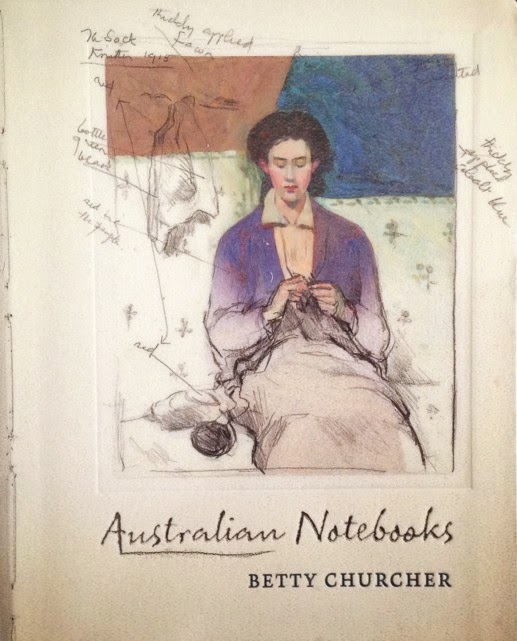
Betty Churcher is a well-known writer on Australian art & was the Director of the National Gallery for many years. Now in her 80s, she has published a series of Notebooks, of which this is the latest. She has visited most of the State Galleries in Australia, visiting her favourite paintings & sketching details of them. As she says, having a pencil in your hand makes you slow down & really observe details.

Churcher is a keen observer of the detail in a work of art & the sad fact that she has lost the sight on one eye, only seems to make her more observant. This is one of the most famous paintings in the National Gallery of Victoria, The Banquet of Cleopatra by Tiepolo.  The sketch on the left catches the expression on the face of the slave standing behind Cleopatra as he realises that she is about to drop a priceless pearl into her glass of wine. You can see the painting much better here.
Other artists featured include Tom Roberts, Frederick McCubbin, Cezanne, Lucian Freud &, one of my favourites, wonderful Grace Cossington-Smith, whose painting, a portrait of the artist's sister, The Sock Knitter, is on the cover. Apart from the fascinating content, this is a beautifully produced book. It's shaped like a notebook & has a notebook's flexible cover & creamy pages.

Bloomsbury is an endlessly fascinating subject & The Bloomsbury Cookbook by Jans Ondaatje Rolls concentrates on the domestic lives of the artists & writers known as the Bloomsberries. The author has told the story of Bloomsbury in a way that gives a different perspective on them. As Anne Chisholm, biographer of Frances Partridge, writes in her Foreward,

Jans Ondaatje Rolls has indeed found a way to cast new light onto Bloomsbury, not by yet again re-examining their personal or professional lives, but by walking into their kitchens and dining rooms, unearthing their cookbooks, trying out their recipes (even the less tempting ones) and, above all, by immersing herself in their writings and paintings.

Anne Chisholm also mentions that she's working on a new edition of Carrington's letters, which is very exciting as the only other edition, edited by David Garnett, was published in 1971 & is long out of print. Something to look forward to.

The book is full of beautiful reproductions of paintings by Vanessa Bell, Duncan Grant & Carrington, photos & sketches of everyone from Virginia Woolf to Lytton Strachey. There are extracts from letters, diaries &, most fascinating of all, are the recipes. The pages above show Interior with Housemaid by Vanessa Bell (1939) & opposite it, recipes for Eccles cakes & Veal Schnitzel with Mushrooms. As well as using the recipe notebooks of the Bloomsberries, there are also descriptions of similar recipes from cookbooks of the day as well as descriptions of the restaurants they visited at home & abroad & the meals they ate there. Virginia's fraught relationships with her servants are described through trenchant quotes from her diaries & there are the social changes that led to Frances Partridge becoming a very good cook after the war when cooks were hard to find. The Bloomsbury Cookbook is published by Thames & Hudson, so it goes without saying that it's beautifully produced & just a joy to look at.

I have some more gorgeous books on the way to me at work so Part Two of this post will be along soon.

Thursday, March 27, 2014

The Mystery of Princess Louise - Lucinda Hawksley

Princess Louise was the most interesting of Queen Victoria's daughters. She was beautiful, artistic & rebellious, determined to break out of the conventions & constrictions of royal life. Lucinda's Hawksley's biography tells her story but focuses on several mysteries in her life.

Louise was the fourth of five daughters of Victoria & Prince Albert. Her childhood was blighted by the indifference of her mother & the strict educational regime of her father. All her siblings, except the baby of the family, Beatrice, were scarred by their childhood. The death of Albert in 1861 at the age of only 42, intensified the misery for all the children. Not only had they lost their father but they also had to cope with their distraught mother who sank into a deep depression that lasted years. Louise's older sister, Alice, bore the brunt of Victoria's demands until her marriage to Louis of Hesse. Next sister, Helena, took over as her mother's secretary, companion & drudge. Louise knew that when Helena married, her turn would be next & she was desperate to escape.

Louise was also genuinely artistic & wanted to develop her talents as a sculptor. This was almost unheard of for a woman, let alone a princess, but she was determined & eventually gained permission to attend classes at the National Art Training School. It helped that the school was one of Albert's projects but, even so, Louise was not permitted to attend life classes & often had to skip lessons if her mother needed her for any reason.

Louise was close to her brothers, especially her younger brother, Leopold, who suffered from haemophilia. Leopold also struggled to escape from his mother's suffocating attention, but with less success. One of the mysteries about Louise is whether she had an illegitimate baby when she was a teenager. The father of the child was said to be Leopold's tutor, Walter Stirling. The child was adopted into the family of one of the Queen's physicians, Sir Charles Locock. Hawksley has no proof of the affair or the child but relies on the tradition in the Locock family. The fact that the files on Princess Louise in the Royal Archives are sealed & no researcher or biographer can get access to them encourages the idea that there must be some great secret that's being hidden, even so many years later. Walter Stirling was dismissed only months into his employment, even though Leopold was said to be thriving in his care. Stirling also received a payment which Hawksley suggests was to buy his discretion & silence.

Louise's rebellious nature increased as she was able to pursue her artistic interests & she became friendly with artists such as Whistler & Gabriel Rossetti. She also became a pupil of the sculptor Joseph Edgar Boehm & was said to have had an affair with him. By this time, Queen Victoria was desperate to get her daughter married. She thought she saw in Louise's nature the same licentiousness that she deplored in her eldest son, Bertie, the Prince of Wales. If the stories of Louise's child are true, the Queen was desperate to prevent any more scandal. Louise, however, wasn't keen on any of the German princes her mother paraded before her. Eventually, she agreed to marry Lord Lorne, the heir to the Duke of Argyll. Although an aristocrat, Lorne was not royal & the match would be the first royal marriage to a commoner since the 16th century. 

The newspapers were delighted with the patriotic idea of a British husband for Louise instead of another penniless prince & depicted it as a great romantic love match. The truth was less idyllic. Louise & Lorne were not in love & he was probably homosexual. Actually this seems to be the best documented of the mysteries in Louise's life. However, whatever Louise's misgivings, the marriage went ahead & Louise endeared herself to her new Scottish family with her unpretentious ways. The Lornes spent some years in Canada when he was appointed Governor General & Louise is fondly remembered there. The province of Alberta is named after her (her full name was Louise Caroline Alberta). The couple increasingly spent time apart & after a number of years of near estrangement, they grew closer as they grew older & accepted each other's separate lives.

The final mystery that Hawksley tries to confirm is the story of Louise's affair with Boehm. Rumours at the time said that Louise was with Boehm when he died suddenly in his studio in 1890. Scandalously he was said to have been making love to the princess when he died. Louise seems to have been the person who discovered his body (or she found him alive but he collapsed when lifting a heavy statue) but she always maintained that she was accompanied by her lady in waiting & a fellow artist who worked in a nearby studio. Again, there's no evidence for the more scandalous story except rumour & the reminiscences of Boehm's artistic friends. As the Royal Archives are closed, no confirmation will come from that source.

Louise's later years after the death of her husband in 1914 were spent in charitable work & supporting the monarch. After her mother's death in 1901, Louise often accompanied her brother, Edward VII & later her nephew, George V, to engagements as she had done throughout Queen Victoria's long period of seclusion. Although she had no children of her own, she was a favourite aunt to her many nephews & nieces & supported many charitable causes. She died in 1939.

Lucinda Hawksley has written an engaging biography. Louise was a fascinating woman & I enjoyed the story of her successful rebellion against Queen Victoria. She was the only one of her sisters who ever got the better of their mother. However, the lack of primary material, Louise's own voice in letters or diaries, naturally leads to quite a bit of speculation & I felt it distanced me from Louise herself. I love biographies where the subject's own words are quoted & there's virtually nothing of that here. The final chapters seem to be little more than a list of engagements & donations to charitable causes gleaned from newspaper reports & Court Circulars.The fact that Louise's files are sealed naturally gives rise to speculation about what has been hidden. Even documents that were in other collections have been "called in" by the Royal Archives which has led to a dearth of primary sources & a reasonable suspicion that there is something to hide. The mysteries in the title of this book - the possible illegitimate child & the affair with Boehm - can be explored but never proven but I did enjoy the journey even though it's frustrating at times.

Thursday, April 4, 2013

The Firebird - Susanna Kearsley

Nicola Marter has a gift. When she holds an object, she can connect with the people who have owned it in the past. Nicola is an expert in Russian art & works in a London gallery. When Margaret Ross brings in a wooden carving of the Russian fairy tale creature, the firebird, Nicola feels an immediate connection to someone called Anna who once owned the object. Margaret's family believed that the firebird was given to their ancestor, Anna, by Empress Catherine, widow of Peter the Great, in the early 18th century. Margaret wants to sell the carving but, without provenance, this will be difficult. Nicola can see how important the sale is to Margaret & she feels compelled to try & trace the history of the firebird.

Nicola has ambivalent feelings about her gift of psychometry. Her family discouraged her from talking about it & she feels embarrassed & defensive about it. Her Russian grandfather was persecuted by the Soviets because of it. When studying in Edinburgh, Nicola had taken part in scientific tests conducted by a parapsychology institute. She met Rob McMorran, who accepts his psychic gifts as just a part of who he is. Nicola & Rob's relationship ended abruptly when Nicola left Edinburgh without explanation & returned to London,. Now, Nicola knows that she needs Rob's help if she is going to trace the firebird. Rob is a policeman, living in Eyemouth near the Scottish border. He & Nicola had always shared a deep bond, even reading each other's thoughts & communicating without speech so he's not surprised by her arrival. Rob is able to see the past & agrees to help Nicola in her quest.

The search for the firebird takes them from Slaines Castle on the coast near Aberdeen to Belgium & on to Russia. They discover Anna Moray as a child, cared for by the Logans after her parents were forced to leave Scotland because of their involvement with the unsuccessful Jacobite rebellion of 1715. Anna is taken to a Belgian convent by her great-uncle, Colonel Graeme & then, after a terrifying encounter in Calais, Anna is taken on to St Petersburg by Vice Admiral Gordon. Gordon is one of the many Scots who were forced to leave their homeland after fighting for King James. Anna becomes his ward & grows up as part of his family & as part of the Jacobite community in Russia. Peter the Great was sympathetic to King James & gave material help & support to the King as he plotted his return to the throne.

When Anna is seventeen, she agrees to stay with the family of General Lacy as companion to his pregnant wife. The General won favour from the Tsar through his bravery at the Battle of Poltava against Sweden & he is a central figure in the expatriate community. Through General Lacy she meets his kinsman, Edmund O'Connor, an Irishman who has been exiled from home because of his Jacobite sympathies. Anna's story is immensely touching. Her longing for family & her careful awareness of the danger of knowledge makes her self-contained & wary. She is also proud of her family although she can never speak of them. Finally, as Anna's story comes to a close, we discover how she acquired the firebird, the fairytale creature who started the quest. I was very moved by the conclusion of Anna's story.

If you've read Susanna Kearsley's earlier books, you will find echoes of two of her books in The Firebird. As a boy, Rob had helped a group of archaeologists searching for the missing Roman Ninth Legion & his story was told in The Shadowy Horses. The story of Anna's parents was central to The Winter Sea, another of my favourite Susanna Kearsley books. Reading The Firebird brought both of these books back to me. There were so many lovely touches. Rob still talks to the Sentinel & Nicola hears the shadowy horses when she stays with Rob's parents. I loved revisiting Slaines Castle & remembering both earlier books. Nicola & Rob's relationship is beautifully romantic but almost understated & I found the psychic elements of the story fascinating. Susanna Kearsley writes contemporary & historical fiction equally well & it was a delight to follow Anna's story as Rob describes it to Nicola, whose own psychic gifts become stronger once she acknowledges that it's an important part of her being. Anna & Nicola have a lot in common. Their characters are both self-contained & reluctant to trust their own instincts. Both women must find a way past their self-imposed restrictions before they can find happiness.

As if the incredibly satisfying & emotional ending of both stories in the 18th & 21st centuries wasn't enough, Susanna Kearsley has also provided a fascinating essay on the research she did when writing the novel.  Russian history has been one of my interests ever since I read two books when I was a teenager - The Youngest Lady-in-Waiting by Mara Kay & Robert K Massie's Nicholas & Alexandra. Since then, I've read many books about Russian history so walking through 18th century St Petersburg in my imagination was just wonderful. Scotland & its history is another interest so a book that combined both was almost too good to be true. Most of the 18th century characters are real & there is documentary evidence for their actions & motives. I loved reading about the process of research, something that always fascinates me. I'm so glad that Colonel Graeme, a character from The Winter Sea wouldn't let go of Susanna Kearsley's imagination & inspired her to write this completely involving story.

Tuesday, March 26, 2013

Pictures at an Exhibition - Camilla Macpherson

The author of Pictures at an Exhibition, Camilla Macpherson, emailed me recently to ask if I would like to review the book for the blog. I had so much else to read that I said thanks but no thanks. But, the blurb was intriguing & we had copies at work so I borrowed one & I loved it. I read it in just a few days & it was a struggle to put the book down at lunchtime & go back to work.

The novel is the story of a young woman, Claire, who has had a miscarriage & can't get over her loss. She blames her husband, Rob, for not being there when she needed him. Her grief is so all-consuming that she has lost interest in her work as well as her marriage. Everywhere there are reminders of her lost baby, Oliver. Then, one day, a parcel arrives that will give Claire a new interest in life. Claire begins reading the letters of a young woman called Daisy Milton who was in London during the Blitz. Daisy was writing to Rob's grandmother, Elizabeth, in Canada & the letters have been left to him in his grandmother's will. The letters are full of Daisy's life in London, the horrors of the Blitz & the boredom & irritations of life in wartime. Daisy decides to visit the National Gallery every month where one painting from the collection was displayed (everything else was stored in caves in Wales for safe keeping) & she describes her visits & the paintings in her letters to Elizabeth. This was part of a Government project to keep up morale which also included a famous series of lunchtime concerts by renowned pianist Dame Myra Hess.

Claire decides to follow Daisy's example & each month after reading Daisy's letter to Elizabeth she visits the painting in the National Gallery. She becomes fascinated by Daisy's life as well as her reactions to the paintings on display. Daisy was engaged to Charles, a young man about to be sent overseas to North Africa. Charles has a very conventional idea of their future. They will live in a house in the country & Daisy will look after the children & the house while he earns a living. Daisy isn't entirely sure that this is the future she wants, or at least, not yet. She enjoys working, although she struggles to see how her work as a typist in a Whitehall ministry is helping the war effort, no matter what her boss says. One day at the Gallery, Daisy meets Richard Dacre, an artist who has a commission as a war artist. They begin meeting at the Gallery to look at the paintings & Daisy knows that she's falling in love with Richard. Her letters to Elizabeth become a way of working through her feelings about Charles & Richard & the decisions she makes that will affect them all.

Claire & Rob grow further apart & she meets a man at the gallery who is obviously attracted to her. Dominic is handsome, knowledgeable & confident & soon Claire has confided in him about Oliver & her marriage as they drift towards an affair. Claire finds she has to make some decisions about her future as Dominic pursues her & Rob seems to have given up waiting for her to forgive him & let him back into her life.

The parallels in the lives of Claire & Daisy are highlighted by the paintings both women see. This is what makes Pictures at an Exhibition stand out among the many novels set in two different periods. If you have an iPhone, you can scan a QR code at the beginning of each chapter to see a reproduction of the painting. I just searched for them on my iPad. The paintings include Botticelli's Mystic Nativity, Apollo and Daphne by Pollaiuolo, Madonna of the Basket by Correggio & Constable's Weymouth Bay. The paintings provide a link between two time periods & two women whose lives are at a crossroads. Claire isn't always a sympathetic character as her absorption in her own grief shuts out Rob as well as her family & friends. She finds a way to deal with her emotions through becoming absorbed in Daisy's story & she begins to heal. Her search to find out more about Daisy & what became of her helps her to reconnect with her own life & accept her loss.

I'm very grateful that Camilla Macpherson emailed me because I hadn't heard of her book & I probably wouldn't have found it without that little push. I always find it interesting to think about how I decide what to read next. Even though I had so much to read I was intrigued enough to download a sample from Amazon & then get hold of a copy from work. Serendipity has a lot to do with my reading choices & this was an especially fortunate example of that.

Tuesday, November 13, 2012

Anglo-Saxon Art - Leslie Webster

This is a beautifully-produced book on a fascinating subject. I've been interested in the Anglo-Saxons ever since I first read about the Sutton Hoo ship burial. The gold & garnets, the mix of Christian & pagan objects, that helmet with the distinctive, mustachioed face looking back at me, were all captivating. Since then I've read about the Sutton Hoo dig & many other archaeological discoveries, all of them adding to our knowledge of this period. The glorious Staffordshire Hoard, discovered only a few years ago, has added to our knowledge & posed more questions at the same time.

The Anglo-Saxon period begins in the 5th century, after the end of Roman occupation of Britannia & ends with the Norman Conquest of 1066. Leslie Webster's book is divided into thematic chapters describing the different influences from Europe & beyond that created the distinctive style known as Anglo-Saxon. The Germanic tribes who settled in Britain after the Romans, the Christian missionaries sent by Pope Gregory in 597, the Celtic Christianity of Iona & Lindisfarne, the trading routes bringing influences from eastern Europe & Byzantium & the Vikings & other Scandinavian raiders & settlers.

What we think of as the characteristic features of Anglo-Saxon art is dependent on what has survived. This seems an obvious point but it's worth making as Leslie Webster does in her book. What has survived is only a fraction of what must have originally existed. If you think about the Viking invasions, the religious upheavals, the periods when Anglo-Saxon manuscripts & artwork wasn't valued, the random events such as fires & floods where so much was destroyed, it's amazing that we have as much as we do. Sometimes objects survived in Europe because they were taken there by missionaries from England. Sometimes, as with the Staffordshire Hoard, objects were buried & only rediscovered centuries later. Sometimes, the objects were grave goods. Imagine how much more could still be buried, waiting for rediscovery.

I wish I could show you every page of this book. There are over 200 illustrations in a book of just over 200pp. Almost every object described in the text is illustrated. There is magnificent gold & garnet jewellery, illuminated manuscripts decorated with interlace & animals in the initials, carved ivory caskets, stone crosses, intricate metalwork & embroidery like the Bayeux Tapestry. Webster describes the objects in detail, explaining the symbolism & imagery used & comparing it to other objects of the same period & style. Looking at the manuscripts, personal possessions & jewellery of the Anglo-Saxons is an excellent way to begin to understand the people.Webster weaves enough history into her narrative to set the scene but the focus is always on the objects. All the iconic objects are here from the Sutton Hoo helmet to the Alfred Jewel, the Lindisfarne Gospels, & the Franks Casket. There are also many objects that were new to me. This is a beautiful book written by someone who knows her subject intimately & can convey her knowledge easily.

Tuesday, October 23, 2012

The Uncommon Appeal of Clouds - Alexander McCall Smith

The Uncommon Appeal of Clouds is the latest in the Isabel Dalhousie series. Isabel is a woman with everything - & she worries about whether she deserves her good fortune. She has inherited money, lives in a beautiful house in a lovely part of Edinburgh & she owns & edits a philosophical review. She's married to Jamie & the mother of three year old Charlie. Isabel is known for helping people with their problems. She's not a conventional detective, she's really a philosophical or moral detective.

Isabel is a philosopher & she has a tendency to over-analyse any situation & reproach herself for any shortcomings in kindness or helpfulness. When she meets a friend, Martha Drummond, she describes her as a heart-sink friend. I think that's the most wonderful description of someone whose appearance has just that effect. Our hearts sink as they're sure to either put us on the spot or put us in the wrong. Martha has this effect on Isabel. No matter what they discuss, Martha manages to either take umbrage or cause offense. This time she wants Isabel to help a friend of hers. Duncan Munrowe is a wealthy man with a considerable estate & a magnificent art collection. One of his most prized paintings by Poussin has been stolen & the thieves have sent a ransom demand to Duncan's insurers. Martha wants Isabel to help Duncan negotiate with the thieves.

Isabel agrees to meet Duncan & ultimately she agrees to accompany Duncan to a meeting with a lawyer representing the thieves & eventually a potentially dangerous meeting with the thieves themselves. She also meets Duncan's two children & discovers that relationships within the family are complicated. The more she discovers about the Munrowes, the more tangled the puzzle of the stolen painting becomes.

Isabel is also dealing with her own family dilemmas. We don't see her spiky niece, Cat, only hear about a particularly nasty bout of gastro that keeps her away from the deli she runs, leading Isabel to offer her help for a few days. Cat's assistant, Eddie, has a new girlfriend & a worrying personal problem that Isabel tries to help him with. Isabel & Jamie are also wondering if Charlie is a mathematical prodigy. Isabel worries about whether they should encourage his genius or just let him be. She has a horror of being a pushy mother & also of ignoring Charlie's potential. When it turns out that Grace, Isabel's housekeeper, has been teaching Charlie maths, Isabel is relieved but then concerned that Grace should interfere in this way. Another moral dilemma that leads to a confrontation with the easily-offended Grace. Isabel does a lot of tiptoeing around people in this book!

I do enjoy this series. I don't think Isabel would be an easy person to live with. Her constant questioning of every action & interaction with her conscience & other people would be very tiring. However, she has the luxury to be able to spend time thinking & questioning her motives & actions. Most people have to get on with life hoping for the best. Isabel is so aware of her blessings that she's sometimes afraid to just enjoy them. I love her civilized life in Edinburgh with visits to Cat's deli, conversations about art & music & her happy contentment with Jamie & Charlie. I enjoy Alexander McCall Smith's Edinburgh novels best & it's always lovely to spend a few hours with Isabel & her moral dilemmas.

Tuesday, June 19, 2012

Illyrian Spring - Ann Bridge

Grace Kilmichael has run away from home. At the beginning of Illyrian Spring, she is sitting in a carriage on the Orient Express, hiding her tears behind a newspaper. Grace is running away from being Lady Kilmichael, wife to Walter, a famous economist. She's running away from her unsatisfactory relationship with her teenage daughter, Linnet. As Grace Stanway, she's a well-known painter & her work sells for considerable sums. However, she feels that Walter resents her work & that her children, Linnet & twin boys at Cambridge, belittle her painting as just a hobby. She's also upset by Walter's affair with a co-worker. Running away to the Dalmatian coast to paint, leaving a perfunctory note for her husband & without telling anyone her destination, is a revolutionary act for Grace.

En route to Dalmatia, in Torcello, she meets Nicholas Humphries, a young man in his twenties. Nicholas wants to be an artist but his family wants him to be an architect. He's sulky, touchy & awkward. His bad digestion makes him fussy & he has all the over-confidence as well as the diffidence of youth. Grace offers to advise him about his work & their friendship grows as they travel together, painting & discussing everything under the sun.

They were getting to know not only the details of each other's lives, but getting to know one another - a different thing. The process of getting to know anyone is not merely a matter of listening, watching and understanding. M Maurois has pointed out how, in any new relationship, we feel an unconscious need to create, as it were, a new picture, a new edition of ourselves to present to the fresh person who claims our interest; for them, we in a strange sense wish to. and do, start life anew. Grace Kilmichael was not analytical enough to recognise either this wish or this process in herself, but she was unconsciously doing it. all she realised was that she was finding this new friendship strangely interesting.

Grace learns about young people through Nicholas, the way they think, & realises that her relationship with her daughter, once so easy, has faltered because of her own lack of confidence. Nicholas is a fine artist & Grace believes he could make a living from it but his father is determined that he will not follow his dream. Meanwhile his sister, Celia, with only mediocre talent is allowed to study at the Slade. Lack of confidence is Grace's problem in all her relationships & the journey she & Nicholas take is not only a physical journey but an emotional journey for both of them. The easy, affectionate mother-son relationship that they have at the beginning of the journey deepens into a romantic love that is never fully expressed & that Grace knows is impossible. The ending of the book is truly satisfactory in that both Grace & Nicholas are ready to move on to the next phase of life with the strength & confidence that their Illyrian idyll has given them.

But imperceptibly the tone of her thoughts had altered since she knelt in the Martins-Kapelle in Spalato. Walter and the children - this time they were not 'after all' hers; they were just hers , her treasure and her joy - she found the current of her affection setting towards them full and clear, without checks and barriers of resentments or doubts. How strange! How had this come about? Was this the beginning of freedom, she wondered, or just a momentary impulse?

Illyrian Spring is a book that has had rave reviews all around the blogosphere. It's almost become a cult book as the Virago edition has become scarce & expensive. Luckily, Daunt Books have reprinted it so we can all discover what Book Snob & Stuck in a Book have been going on about! I've read quite a few of Ann Bridge's novels over the last couple of years. Peking Picnic, her first novel & five of the wonderful Julia Probyn series, recently reprinted & made available as e-books by Bloomsbury. Now that my e-reader is behaving again, I'm eager to get back to Julia, I still have three books in the series to go as well as some other stand alone novels.

One thing that all of Ann Bridge's work has in common is a wonderful sense of place. She was a diplomat's wife & her books are set all over the world, from China to Portugal. The Dalmatian coast of Illyrian Spring is almost a fantasy land because the area which now comprises the countries of the former Yugoslavia has been changed so much by war & strife. Illyrian Spring was published in 1935 so the Balkan Wars are far in the past & WWII is in the future. Bridge writes about nature with such lyricism. Her writing was so enticing that she started a fashion for holidays in the region. The Prince of Wales famously took Mrs Simpson on a boating holiday there. Grace's artistic sensibilities are also expressed in her admiration of the various churches & historical buildings she visits. I loved the sense of really being there that Ann Bridge conveys with her sense of atmosphere & detailed descriptions.

However, the relationship between Grace & Nicholas is the emotional centre of the novel. I loved Grace. Her quiet struggle for independence was so beautifully portrayed & the scenes between Grace & her family at the end of the book were a triumph. There's a quiet feminism in Grace's struggle to be her own person & also to realise that her independence is best for her family as well. Nicholas was less easy to like but I think that's just because I'm much nearer Grace's age than his. I could admire her determination to keep the relationship on a light, easy basis, especially as she realised that he was falling in love with her & even more as she realised the truth of her own feelings. The delicacy of these scenes is perfectly done.

I'm so glad I've finally had the chance to read Illyrian Spring. I agree with all the praise from bloggers & reviewers. It's a lovely book about friendship, love & freedom set in an idyllic part of the world. Highly recommended.

Saturday, December 4, 2010

Romantic Moderns - Alexandra Harris

When I think of the artists of the 1930s, I think of the Modernists. Art Deco ceramics & jewellery, angular, minimalist architecture & pictures. Alexandra Harris has broadened my knowledge & my definition of modernism in her new book, Romantic Moderns. The subtitle sums up the theme of the book, English Writers, Artists & the Imagination from Virginia Woolf to John Piper.

England in the 30s was seen as a bit of a backwater of the Modernist movement. The most innovative work was coming from Europe & the English were portrayed as being in love with the past, especially the rural past. The critic, Roger Fry, was immensely influential in this period. He had organised the famous Post Impressionist exhibition of 1910 & was responsible for shaking off the Victorian past. He was a member of the Bloomsbury Group & Virginia Woolf wrote his biography after his death. The Bloomsbury artists lived in the country & found their inspiration in their houses as well as decorating them with their art & the products of the Omega workshop, another Fry initiative.

The theme of the book that I found most interesting was that these artists & writers were recording their vision of England. As the 30s drew to a close & WWII began, the desire to connect with the landscape was very powerful. As well as the abstract artists who were paring their vision down to the barest & most modern minimum, there were also artists recording their joy in traditional scenes of rural life but with a modernist twist. Stanley Spencer’s pictures of Cookham have recognisable portraits of real people but also fantastic scenes like his vision of the Judgement Day when the dead will rise from the parish churchyard. Poets like T S Eliot & John Betjeman wrote of country villages & the London suburbs. Vita Sackville-West’s poems, The Land & The Garden, were celebrations of home & a reimagining of Milton’s Eden. Her retreat to her garden as war approached was a return to Eden as opposed to Milton’s Paradise Lost. During the war, she was planning the White Garden at Sissinghurst, a little bit of defiance in the face of wholesale destruction.

The 1930s really were the last opportunity for the past to be recorded & conserved before WWII swept away so many aspects of traditional English life. Florence White was collecting the traditional recipes of England that were rapidly disappearing in an age of convenience food. Her book, Good Things in England, has been reprinted by Persephone, & is full of regional specialities that may have disappeared altogether if not for her work.

This is a very inadequate review as there is so much in Alexandra Harris’s book. I’ve just picked out a few of the artists covered in chapters on subjects like the Church, the English weather, village life & the search for a home. I haven’t even mentioned John & Myfanwy Piper, Eric Ravilious, Paul Nash, the Sitwells, Evelyn Waugh & the many other writers & artists with walk-on parts. As well as fascinating reading, the book is beautifully produced, with dozens of illustrations in the text. I want to read Virginia Woolf’s Between the Acts & T S Eliot’s Four Quartets & more Evelyn Waugh. It’s that kind of book that sends the reader off on to new reading paths. Romantic Moderns is a fascinating look at a neglected aspect of English Modernism.

Tuesday, November 2, 2010

Effie : a Victorian scandal - Merryn Williams

Effie Gray was married to two of the giants of the Victorian art world. When she was not quite 18, she married John Ruskin, the most famous art critic of the day. Their marriage was famously unconsummated & after six years of increasingly unhappy frustration, Effie had her marriage annulled. After a year or so, she married the Pre-Raphaelite artist, John Everett Millais. The story of Effie’s marriage & the way it ended was the greatest scandal of the 1850s & the consequences haunted all three of the participants until the end of their lives.

The story of Effie, Ruskin & Millais is a fascinating one. John Ruskin had known Effie & her family for some years. The Grays lived in the house where Ruskin’s grandfather had lived & where he committed suicide. Ruskin’s parents, especially his mother, were so horrified by this that they left Scotland, never to return. When Ruskin & Effie were married, they lived very closely with the elder Ruskins for much of the time. Ruskin was devoted to his parents & they considered him a genius. Effie was quite innocent & didn’t really understand what the physical relationship should be between a husband & wife. There are many theories as to why Ruskin didn’t or couldn’t consummate the marriage. He claimed that Effie had agreed initially not to have a physical relationship as they planned to travel & if she became pregnant it would interfere with their plans. Then, they decided that the marriage would be consummated when Effie was 25. Another theory was that Ruskin had never seen a naked woman, only classical statues & was revolted by Effie’s body. Ruskin also seemed more attracted to quite young women. He first knew Effie when she was just in her teens & his later relationship with Rose La Touche followed a similar pattern. As the girls grew older, his interest in them waned.

Effie felt this lack of interest in her personally as well as the physical rejection. Her relationship with her husband grew more distant as he would go out in the morning to work in his parents’ house close by, leaving her alone all day. She was forced to spend a lot of time with her mother-in-law who was not a sympathetic woman. Her attempts to discuss their relationship with Ruskin were rebuffed & her feelings of loneliness & dissatisfaction grew as the years passed. Effie’s parents were concerned about the amount of time Effie & Ruskin spent apart but she hadn’t told them the truth about her marriage.

The catalyst for change was Ruskin’s involvement with the Pre-Raphaelite Brotherhood. This was a group of young artists who burst on to the London art scene in the late 1840s. Their reverence for early artists like Raphael & their desire to strip away the conventions of the artistic establishment & paint in a purer, more natural way, at first found little favour at the Royal Academy. At the core of the group were Dante Gabriel Rossetti, William Holman Hunt & John Everett Millais. Millais was a boy genius, the youngest artist ever accepted at the Royal Academy schools. Although Ruskin was at first scathing about their work & the subjects they chose, he eventually came to recognise their talent & champion their work.

He invited Millais to accompany himself & Effie on a trip to Scotland so that Millais could paint his portrait. The trip to Glenfinlas resulted in a magnificent portrait of Ruskin staring down a Highland stream, water rushing past him as he contemplates his genius (image above from minutiarum.blogspot.com). Millais & Effie became friends & spent a lot of time together when Ruskin was working. When they returned to London, Millais asked if Effie would model for a figure in one of his greatest pictures, The Order of Release (seen below from the Wikimedia Commons website). Ruskin was happy to agree & it was during the sessions in Millais’s studio that they fell in love. Effie confided to Millais about the state of her marriage & he was torn between his love for Effie & his loyalty & gratitude to Ruskin.

Effie’s 25th birthday passed & Ruskin now declared that he wouldn’t consummate the marriage because he feared Effie was mentally ill & shouldn’t have children. By this time, the last thing Effie wanted was for her marriage to be consummated. She told her parents the true state of affairs & her father, a lawyer, investigated her legal options. Divorce was almost impossible in the Victorian period & Effie’s reputation would be ruined by the scandal. The Church eventually granted her an annulment of her marriage on the grounds of non-consummation & in their judgment said that it was as if she had never been married at all. Ruskin wrote an extraordinary document outlining his side of the story but it was never used as he decided not to contest the action. It was only discovered & published more than 70 years later. He seems to have honestly believed that Effie’s wish to consummate the marriage was unreasonable & a symptom of her diseased mind.

The scandal among London’s artistic community was enormous. Ruskin was the butt of some very crude jokes among the younger men although his standing as a critic remained intact. Effie retreated to her family home, having no contact with Millais for over a year to avoid any more scandal. They were married in 1855 & enjoyed a long & happy marriage. This story is fascinating for the light it throws on Victorian attitudes towards marriage. Many people blamed Effie for the whole scandal. They thought she should have accepted whatever her husband decided & that she was deliberately trying to ruin his reputation. Her decision to have the marriage annulled was seen as deeply unfeminine & immodest. She had to undergo several physical examinations to prove her virginity to make her case.

Supporters of Ruskin, including his 20th century biographers, have seen Effie as a commonplace woman who made a great man into a laughing stock. There were rumours that Effie & Millais had started an affair on the trip to Scotland & had been deceiving Ruskin all the time. Ruskin’s parents turned against Effie completely & thought her mad or bad. The story refused to go away. Years later when Ruskin became involved with the La Touche family & fell in love with the young Rose, Mrs La Touche wrote to Effie to ask about the circumstances of her marriage to Ruskin. She was wary of Ruskin’s interest in her daughter, almost 30 years his junior, & concerned as to what his intentions were. This correspondence brought all the memories of her life with Ruskin back but Effie bravely wrote detailed responses to Mrs La Touche, telling her all she knew of Ruskin without bitterness or reproach. She knew how devastated she had been by the experience & wanted to prevent another young girl suffering in the same way.

Merryn Williams has written a fascinating book about this story. She has also come up with an intriguing theory that I hadn’t heard before. Williams believes that George Eliot was influenced by the story of Effie & Ruskin when she wrote her masterpiece, Middlemarch. It seems obvious now that it’s been suggested to me. The story of Dorothea married to the dry scholar, Casaubon, & falling in love with the young artist, Will Ladislaw, is very close to the story of the Ruskins & Millais. The conventions of fiction mean that Dorothea doesn’t have to endure the scandal of an annulment or a divorce to escape her marriage but there are parallels. I really enjoyed this book. I’ve read many books about the Pre-Raphaelites & I knew the story but it was fascinating to follow the events in such detail. There are lots of quotes from the letters & statements of all the protagonists. I especially enjoyed the insight into personal relationships & the expectations of society. I admired Effie’s courage in exposing herself to rumour & embarrassment in her quest to change her life & escape from an unhappy situation.