Tuesday, November 10, 2015

The Deepening Stream - Dorothy Canfield Fisher

We've come up with several acronyms in my online reading group, including HIU - have it unread (for books that someone mentions that other members own & immediately rush to the shelves & plan to read next). I came up with a new one just recently, RIAL - read it at last. The Deepening Stream was first mentioned in our group at least three years ago. I was enthusiastic, ordered a copy but then, by the time it arrived, I'd moved on & it sat on the tbr shelves. I picked it up several times but didn't actually begin reading it. Then, I saw a review of it on the blog TBR 313 & I just knew I had to read it at once. I didn't even finish reading the review for fear of learning too much about the book.

I loved this book & can't imagine why it took me so long to get around to reading it. It's the coming of age story of Matey Gilbert. We first meet Matey (her name is Penelope & the nickname is never explained) as a small child, living in France with her parents & siblings Priscilla & Francis. Her parents are an unhappy couple, forever trying to get the better of each other. Her father is a literature professor in the States who needs frequent sabbaticals in Europe but only French-speaking countries. Her mother takes up new enthusiasms & new friends, only to have her husband sneer at them. All three children are scarred by the experience of tiptoeing around their parents. Priscilla grows up to be afraid of relationships. When she does marry, it's to an older widower who is looking for a mother for his children rather than a wife. Francis projects confidence but covers up his hurt with a brash exterior. Matey is more vulnerable but learns to cope by avoiding confrontation & through the love of her dog, Sumner. Only when her father is dying does Matey see the real depth of love between her parents.

As a young woman, Matey goes back to her mother's home town of Rustdorf in Dutchess County, New York when she receives an unexpected inheritance. There she meets her extended family, many of them Quakers, including a cousin, Adrian Fort, who works in his family's bank. Matey & Adrian fall in love & their marriage is the beginning of Matey's blossoming. She realises that there can be a true partnership in marriage, without the game playing her parents indulged in. When the Great War breaks out, Matey & Adrian decide to go to France. Matey had stayed in touch with Madame Vinet & her family, with whom she had stayed as a child & Adrian had spent some time studying art in Paris before he decided he didn't have the talent to be an artist. They speak excellent French & when they hear from the Vinets of the hardships that the French are suffering, Adrian decides to become an ambulance driver & Matey to help the Vinets in any way she can. By this time they have two small children &, although they have some qualms about taking their children to Europe in the circumstances, they are determined to do something. The next four years are spent helping refugees & providing a place for soldiers on leave to rest & get news of their families through Madame Vinet's network of friends. When the war ends, Matey & her family return to Rustdorf, to recover from the trauma of their experiences & to try to make their lives valuable & worthwhile in the post-war world.

This is such an absorbing book. I admired the accuracy of Canfield Fisher's psychological insights into the mind of a sensitive child like Matey even though I've never really been interested in books written from a child's eye view. I usually skim the opening chapters of biographies too, especially when they go back several generations. However, here it was compelling. Once Matey grows up & visits Rustdorf, I couldn't put the book down. This is where Matey begins to develop as a person, the deepening stream of her personality begins to emerge from her troubled childhood. We also begin to see her through the eyes of others, Adrian & his father, & she becomes part of their family which is also her own. On the journey to France, with the threat of torpedoes ever-present, Matey realises that no fear will ever really affect her like the fears of her childhood,

It was true. This was not her first encounter with fear. She had met it years ago, and what she felt now could not be compared to that black helpless waiting for catastrophe of the child she had been, tragically unfortified, like all children, by experience. Nothing had then come into her life strong enough to stand between her and her fear - over the oatmeal, bitter as poison on bad mornings - that there was nothing real in life but the wish to hurt. That had been true despair. But this present danger - all that was not physical in her stood apart from it, unthreatened, secure.

The war section of the book is based on Canfield Fisher's own life as she & her husband did just what Matey & Adrian do. I know a little of Canfield Fisher's life through reading Willa Cather's Letters among other things but I would love to read her own letters & more of her fiction. I read The Home-Maker years ago when it was reprinted as one of the first Persephones & I've read some of her short stories. These wartime scenes are wonderful. I loved all the domestic detail of how Matey & Madame Vinet scrimped & saved to put food on the table, how they contrived to get news of soldiers to their families as well as the more personal troubles of the Vinets - Henri & Paul in the Army & Ziza, Matey's closest friend from childhood, keeping her husband's business going in the countryside but with secrets of her own that estrange her from her mother. Matey identifies so much with the Vinets & the French people that she struggles to understand her brother, Francis, when he arrives in Paris with a delegation when America enters the war. His priority is to use America's wealth to win the war & if he makes a profit out of it, all the better. Another instance of how their childhood experiences have shaped their lives. Francis sees his money as a shield against trouble while Matey uses an inheritance from her great-great-aunt Constance to finance the trip to France & their war work. I felt as exhausted as Matey & Adrian when they finally return home & have to pick up the threads of their old lives. There's a real sense of peace at the end of the book which is very satisfying,

Her years with Adrian answered that question, stood before her, beckoning her on. She walked forward again. Had Adrian ever needed words to share with her all she had learned from him? The medium for the communication of the spirit is not words, but life.

Sunday, November 8, 2015

Sunday Poetry - Marjorie Wilson

As November begins I usually find myself thinking about Remembrance Day & reading war poetry. One of my favourite anthologies is this one by Catherine Reilly. It's an omnibus volume of her two anthologies, Scars Upon My Heart (WWI) & Chaos of the Night (WWII). This poem is so poignant. I assume it's Marjorie Wilson's husband who has been killed & Tony is her son. It's from WWII although I don't know exactly when it was written.

To Tony (aged 3)
(In Memory T.P.C.W.)

Gemmed with white daisies was the great green world
Your restless feet have pressed this long day through - 
Come now and let me whisper to your dreams
A little song grown from my love for you.

There was a man once loved green fields like you,
He drew his knowledge from the wild birds' songs;
And he had praise for every beauteous thing,
And he had pity for all piteous wrongs...

A lover of earth's forests - of her hills,
And brother to her sunlight - to her rain - 
Man, with a fresh boy's wonder. He was great
With greatness all too simple to explain.

He was a dreamer and a poet, and brave
To face and hold what he alone found true.
He was a comrade of the old - a friend
To every laughing child like you.

.       .       .

And when across the peaceful English land,
Unhurt by war, the light is growing dim,
And you remember by your shadowed bed
All those - the brave - you must remember him.


And know it was for you who bear his name

And such as you that all his joy he gave - 
His love of quiet fields, his youth, his life,
To win that heritage of peace you have.

Friday, November 6, 2015

Rereading, rambling & relishing - Part 2

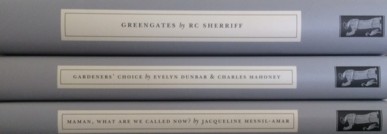
This is the rambling & relishing part of the post (see Part 1 yesterday). The new Persephones arrived late last week & I'm looking forward to reading all three of them. Greengates by R C Sherriff, Gardeners' Choice by Evelyn Dunbar & Charles Mahoney and Maman, what are we called now? by Jacqueline Mesnil-Amar. The new Biannually should be arriving any day now.

I've been a fan of Evelyn Dunbar's work for a while, especially her WWII pictures. I have this lovely book by Gill Clarke on the tbr shelves & as I can't get to either the Persephone shop, where they're displaying some of Dunbar's drawings, or the Pallant House Gallery in Chichester, the books will do very nicely.

Have I mentioned that Greyladies, another favourite publisher, have given their website an update? It looks terrific, they've added author photos & organised their titles by subject - school stories, mysteries, Scottish novels - which makes it easy to find what you're looking for if you're in the mood for a particular kind of book. I'm a fan of D E Stevenson & I've been really pleased that Greyladies have been reprinting not only the manuscripts found in the attic but also some of the previously out of print Stevensons. They began with Peter West and The English Air & early next year will be reprinting Five Windows, which I haven't read but was enthusiastically reviewed by The Captive Reader here.

Does anyone else see a nice, round number as a challenge to be achieved? According to Library Thing, I have 2,995 books. Only five books to go to reach 3,000. Now, I have Claire Harman's biography of Charlotte Brontë on the way & the new biography of Josephine Tey by Jennifer Henderson pre-ordered so that will arrive at the end of the month. There'll be another Slightly Foxed edition at the beginning of December so that will take me up to 2,998. The dilemma is - do I buy two more books to make it to 3,000 by the end of the year when I've stopped buying books & haven't ordered a single thing for a month? My plan was not to buy any books until at least the New Year & as I'm doing nothing but rereading at the moment, I've had no temptation to buy anything until I realised I was so close to the magic 3,000. At the moment, I feel that I won't buy those two books, I'll just wait until something (or two somethings) come along that I can't resist.

Rereading books that I first read in the 1980s led me to go back through my reading lists to see what I was reading in 1985. Does anyone else keep lists of what they've read? I've done it since 1979. Until 2007, I just wrote my lists on paper, as you can see,

then I decided to use one of the many lovely notebooks I had received as presents over the years.


At this point, just as I was about to look at my 1985 list, Phoebe decided to sit on the lists & have a wash & then thought she'd have a snooze. Doesn't she realise I'm in the middle of writing a post? Obviously not... When I was able to get to the lists (she's now asleep on my lap), I find that I read 133 books that year. You won't be surprised to learn that I read Jane Eyre (twice! & I see that I also read it in late 1984 as well), The Citadel by A J Cronin, Beginning the World by Karen Armstrong, several of M M Kaye's Death in... series, some of the Brother Cadfael novels by Ellis Peters, Mary Renault's Alexander trilogy, Lynne Reid Banks' L-shaped Room trilogy, Victoria Holt, Cynthia Harrod-Eagles & Sarah Harrison's A Flower that's Free (sequel to The Flowers of the Field, a big soapy WWI saga that I loved), Love in a Cold Climate, Sylvia Plath, Emily Dickinson & Siegfried Sassoon. I was also studying English Literature at university so I read Madame Bovary, Women in Love & One Hundred Years of Solitude as well as Australian novels - Coonardoo by Katherine Susannah Prichard & Sugar Heaven by Jean Devanny. I'm more surprised by Frank Herbert's Dune novels (I've never been a science fiction fan) & the books I have no memory of at all. What were these about? - A Splendid Defiance by Stella Riley & Nothing to Spare by Jan Carter (actually, I think this was a history of the Great Depression in Australia).

I'm surprised at how little my tastes have changed. I read fewer historical novels & sagas but I still read lots of narrative history, biography, 19th century classics & mysteries. However now I could add so many authors that I've discovered through Persephone, Virago, Greyladies & all the other reprint lists that have added to my tbr shelves over the last 10-15 years. I'd love to know if anyone else keeps lists & how far back your lists go. Have your reading tastes changed?

Thursday, November 5, 2015

Rereading, rambling & relishing - Part 1

What's your definition of rereading? I've been rereading a lot this year but the books I'm rereading are ones I haven't read for over 30 years in most cases. So, do they count as rereads if I read them so long ago or can I count them as brand new reads (for the purposes of my Top 10 of the year list)?

I've just finished listening to Dombey and Son, beautifully read by David Timson. I know I read this years ago because I have a battered old Penguin on the shelf. But, there was so much I'd forgotten. Dombey doesn't seem to be one of Dickens's best-known books. Looking at imdb, there was a TV series in 1983 with Julian Glover as Mr Dombey, Lysette Anthony as Florence & Zelah Clarke (my favourite Jane Eyre) as Susan Nipper. It's on YouTube but the soundtrack is out of sync which is a shame (it seems to be the same on the Region 1 DVD I saw a clip of so must be a fault with the original). I loved the story but the characterisations are very black & white. All the good characters (Walter Gay, Sol Gills, Captain Cuttle, John & Harriet Carker) are so very good & all the bad characters, especially Mr Carker the Manager (his sharp white teeth make so many appearances) are so obviously villains from the beginning. Florence is another of Dickens's unnaturally good girls & poor little Paul is doomed from the beginning with his "old-fashioned" ways. Edith Granger, the second Mrs Dombey, is a fascinating character. Brought up by a horrible, rapacious mother to entice men, any emotional life she might have had has been stunted from childhood & Mr Dombey deserves everything he gets when she refuses to be the compliant, grateful wife he expects. I didn't believe that she would run away as she does, though. The comic characters, especially dear Mr Toots, with his kindness & his inarticulate worship of Florence ("it's of no consequence") & fierce Susan Nipper, are a joy.

I read the Introduction to my Penguin edition after I'd finished listening & there was a reference to Kathleen Tillotson's book, Novels of the Eighteen-forties. Another book I remember reading years ago. I don't have a copy but borrowed it from Open Library. Published in 1954, it's still one of the freshest, most interesting works of literary criticism I've read. The first half of the book is a survey of the literary scene  of the 1840s & then Tillotson looks specifically at four novels - Dombey, Jane Eyre, Vanity Fair & Mary Barton as representing the different kinds of novels published in the decade. I especially enjoyed her discussion about why we shouldn't lump all Victorian novels together. The novels of the 1840s couldn't have been published in the 1860s or 1870s when incidents like Jane's frank discussions with Rochester about his mistresses & Becky's methods of advancing herself would have been banned from the circulating libraries. If you're interested in Victorian fiction, I'd recommend this book. I was only going to read the chapter on Dombey but then I read the chapters on the other novels & then went back to the beginning & read the first half of the book. I've read Jane Eyre many times & Vanity Fair & Mary Barton once but now I really want to read Mary Barton again. More rereading.

I was also reminded of another classic book of Dickens criticism which I have not read, but was able to borrow from Open Library, The Dickens World by Humphry House.

Then, I was pushed forward from the 1840s to the 1940s by reading Mrs Miniver's Daughter's post on the 70th anniversary of Brief Encounter, one of my favourite movies. The mention of the Kate O'Brien novel Laura has just borrowed from Boots reminded me of Nicola Beauman's book, A Very Great Profession (originally Virago, now Persephone). Nicola Beauman saw Brief Encounter & wondered what else Laura was reading & her research became AVGP. I watched the movie again last weekend (I tried to see which O'Brien it was - I decided it must be a mid-1930s O'Brien because that's when the play was written, so The Ante-Room or Mary Lavelle - among other things but failed. Maybe if I saw it on the big screen...) & reread the book.

I also need to stop listening to podcasts (damn the BBC!). I've just listened to a Woman's Hour special celebrating the life of Marguerite Patten, the cookery writer who was so closely associated with the Ministry of Food during WWII (you can listen to it here). She died recently aged 99 & they replayed an interview with her, which included cooking quail parcels & Eve's pudding, from 2009. Well, that made me want to read about the Home Front which reminded me of an article I read recently about a new TV series in the UK called Home Fires, about the Women's Institute during the war. It's based on the book Jambusters by Julie Summers &, even though I have a whole shelf of books about WWII on the tbr shelves, this is the one I want to read. At least we have a couple of copies in my library's collection but they're both on loan - I should be glad our patrons have such excellent taste but I'm just irritated that they got in before me. So, I've downloaded the free Kindle sample & reserved the book.

This post is much too long & I have more rambling & relishing to do so come back tomorrow for Part 2.

Tuesday, November 3, 2015

The Crime at Tattenham Corner - Annie Haynes

It seems appropriate to be reviewing a murder mystery with a link to the racing world on Melbourne Cup Day. The racing link isn't as prominent in The Crime at Tattenham Corner as it was in another of Annie Haynes' novels, The Crystal Beads Murder, which I reviewed last month, but the murder of a racehorse owner does seem to have thrown up a possible motive in this briskly-written Golden Age mystery.

When the body of Sir John Burslem is found in a ditch in Hughlin's Wood on the morning of Derby Day, the fortunes of his horse, Peep o' Day, are of almost as much interest as the discovery of his killer. Peep o' Day was the favourite for the Derby & the horse's only rival was Perlyon, owned by Sir Charles Stanyard. The two men had been seen arguing at their club about the merits of their horses but they also had more personal reasons for disliking each other. Sir Charles had been engaged to Sophie Carlford but the engagement was broken off when Sophie decided to marry Sir John, a very rich, older man. Sir John has been shot, rolled into the ditch & his car dumped some way off. Sir Charles's cigarette case is discovered in Sir John's car & he has no explanation for its presence. Detective Inspector Stoddart & Sergeant Harbord question Sir Charles but are none the wiser at the end of the conversation,

"What do you think of that young man, Harbord?"
"I really don't know." Harbord hesitated. "I thought he was all quite straight and above-board at first; but I didn't quite like his manner over the cigarette case. He wasn't quite frank about that, I am certain. But he doesn't look like a murderer."
"Murderers never do. If they did they wouldn't get the chance to murder anybody." the inspector observed sententiously.

However, what seems to be an open and shut case for Stoddart & Harbord soon becomes much more complicated. On the night of his death, Sir Charles & his wife went to the stables for a last look at Peep o' Day. When they returned home, Sir Charles suddenly decided to write a new will & it was signed in the presence of two of his servants, including his valet, Ellerby. Sir John then left to drive his car to the garage & was murdered. The will left his entire fortune to his wife, disinheriting his grown-up daughter, Pamela, who loathes her stepmother & who immediately accuses Sir Charles of murdering her father with the help of her stepmother. Sophie's behaviour is a mixture of grieving widow & very frightened woman as she tries to carry on her husband's business while also acting so strangely that her maid's suspicions are aroused. Then, the valet, Ellerby, disappears in the middle of the night & another line of enquiry has to be pursued.

Sir John's only other relative, his brother, James, is an explorer, currently trekking in Tibet. James's brash wife, Kitty, has been given an allowance by Sir John as James's investments never do very well & she arrives at the Burslem residence to tell Sophie of messages from Sir John that she has received at a seance conducted by the American medium, Winifred Margetson.

He (Sir Charles) knew a little of Mrs James Burslem's reputation, and also knew that her husband was popularly supposed to have deliberately chosen ruin hunting in Tibet to the lady's society. He had gathered too from the gossip of the day, which of late had greatly concerned itself with the Burslems and their affairs, that Sir John Burslem and his wife had had little to do with Mrs Jimmy. It was distinctly a surprise therefore to meet Pamela in the society of, and apparently on such intimate terms with, her aunt.

Kitty insinuates herself into the lives of both Sophie & Pamela but is she really concerned for them or is she more concerned for her allowance? What exactly does she know or suspect about Sir John's murder?

I enjoyed The Crime at Tattenham Corner very much. I've enjoyed all Annie Haynes' books so far & look forward to reading more of them. Her style is brisk & witty. She can pinpoint a character in just a few lines. I loved her description of three women attending Miss Margetson's seance, "All three were well dressed and evidently belonged to the moneyed class, but none of them looked particularly intelligent; their chins by one consent appeared to be absent." Her books are just the right length for a murder mystery (around 200pp) & so full of plot that it's hard to keep everything straight. I did guess the central idea of the plot but not the way it was worked out. I was concerned at some of the methods used by Stoddart & Harbord in gathering their evidence. Both of them mislead women to get information out of them but would any of that evidence have been admissible in court? I'm sure it wouldn't have been. It's an oddity in Haynes' books that her detectives are allowed to ignore proper procedure although most of the time they seem to follow the rules.

Annie Haynes is a definite discovery of the Golden Age & I'm very pleased that Dean Street Press have reprinted her books. The publisher kindly sent me a review copy of The Crime at Tattenham Corner.

Monday, November 2, 2015

Butter wouldn't melt in her mouth...

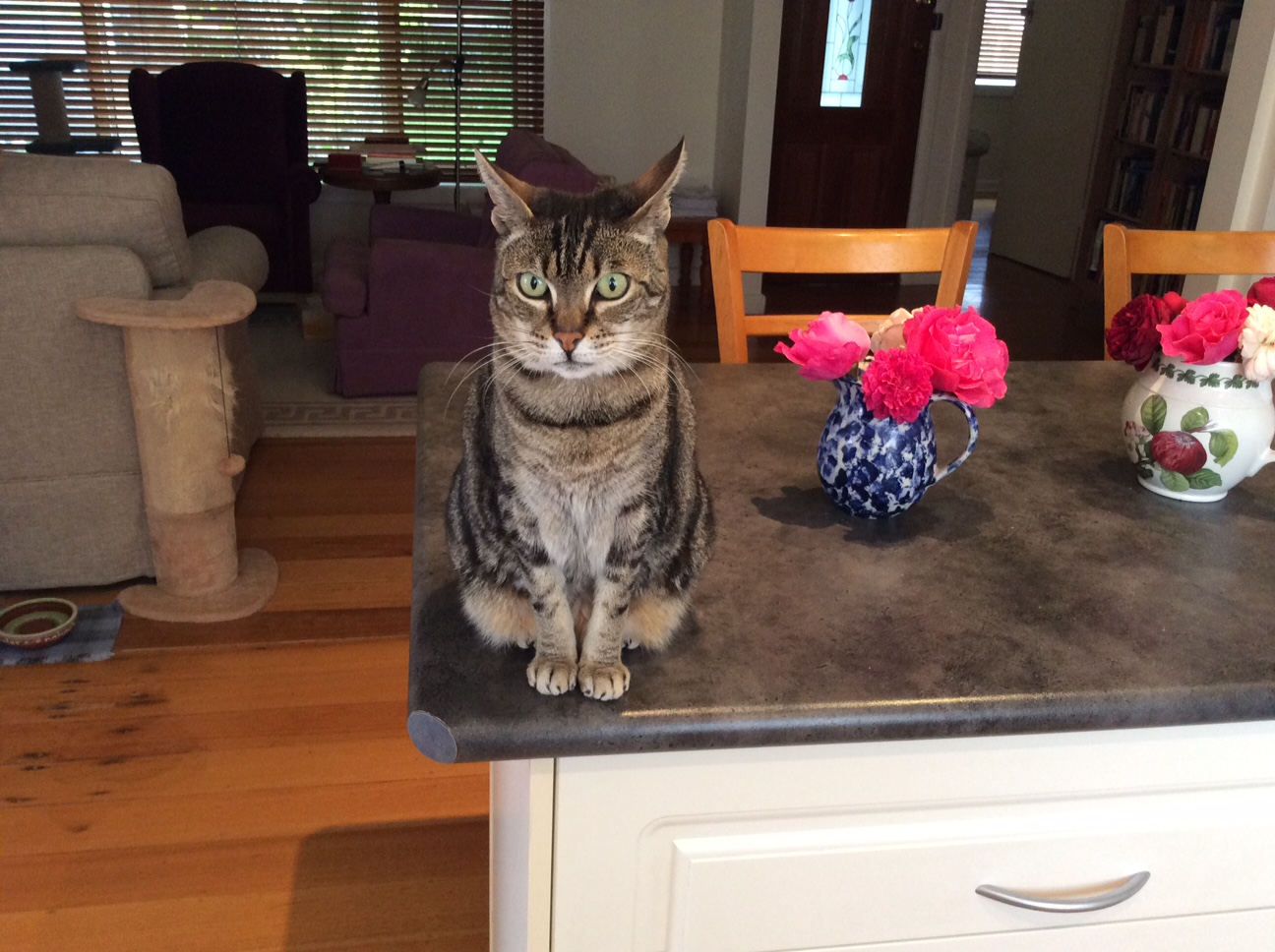
... but before & after this picture was taken, Lucky was chewing on my beautiful roses & pulling off the petals.

She looks the picture of innocence, doesn't she? Well, I know better! I'd call her the phantom Rose Nibbler but she doesn't even try to hide her evil tendencies.

Sunday, November 1, 2015

Sunday Poetry - A A Milne

I'm still reading A A Milne, even though the 1924 Club has just ended. I do love Sir Brian Botany. Does anyone else hear Brian Blessed's voice when they read it? Maybe it's because the other day I listened to the audio sample for Blessed's new memoir, Absolute Pandemonium, & his voice is in my head, or maybe it's just memories of the first series of Blackadder.


Sir Brian had a battleaxe with great big knobs on.
He went among the villagers and blipped them on the head.
On Wednesday and on Saturday,
Especially on the latter day,
He called on all the cottages and this is what he said:

"I am Sir Brian!" (Ting-ling!)
"I am Sir Brian!" (Rat-tat!)
"I am Sir Brian,
"As bold as a lion!
"Take that, and that, and that!"

Sir Brian had a pair of boots with great big spurs on;.
A fighting pair of which he was particularly fond.
On Tuesday and on Friday,
Just to make the street look tidy,
He'd collect the passing villagers and kick them in the pond.

"I am Sir Brian!" (Sper-lash!)
"I am Sir Brian!" (Sper-losh!)
"I am Sir Brian,
"As bold as a Lion!
"Is anyone else for a wash?"

Sir Brian woke one morning and he couldn't find his battleaxe.
He walked into the village in his second pair of boots.
He had gone a hundred paces
When the street was full of faces
And the villagers were round him with ironical salutes.

"You are Sir Brian? My, my.
"You are Sir Brian? Dear, dear.
"You are Sir Brian
"As bold as a lion?
"Delighted to meet you here!"

Sir Brian went a journey and he found a lot of duckweed.
They pulled him out and dried him and they blipped him on the head.
They took him by the breeches
And they hurled him into ditches
And they pushed him under waterfalls and this is what they said:

"You are Sir Brian -- don't laugh!
"You are Sir Brian -- don't cry!
"You are Sir Brian
"As bold as a lion --
"Sir Brian the Lion, goodbye!"

Sir Brian struggled home again and chopped up his battleaxe.
Sir Brian took his fighting boots and threw them in the fire.
He is quite a different person
Now he hasn't got his spurs on,
And he goes about the village as B. Botany, Esquire.

"I am Sir Brian? Oh, no!
"I am Sir Brian? Who's he?
"I haven't any title, I'm Botany;
"Plain Mr. Botany (B.)"