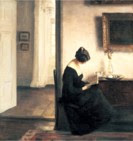
Kate Llewellyn is a poet and diarist who is best-known for her poetry & her memoirs of creating gardens in various parts of Australia. The Waterlily is probably her most famous book, about living in the Blue Mountains. I realised when A Fig at the Gate was published that I still had her previous book, Playing with Water, on the tbr shelves. I've pulled it off now though & look forward to reading it soon.
Llewellyn is now in her seventies & has moved back to Adelaide, South Australia, where she grew up. Her siblings are near by as well as friends she's known from her nursing days. She knows this climate well, & prepares to create a new garden in her house by the sea. The book is a diary, written from 2009-2012, moving through the seasons. Adelaide has experienced even hotter, dryer weather than Melbourne over the last few years so I could relate to her struggles with the climate & the failure of plants to thrive in the hot summers. I love this description of the beginning of autumn,
The first cold day and welcome, too, a feeling of zest and a sting in the air with rain in the night. The tank is half full. I knock, knock with my knuckles on the corrugated iron rings of the tank to hear where the water level makes a dull sound. ... A flock of starlings flies up from the newly mown lawn. A willie wagtail hops around in its cheerful way and a Murray magpie flutters down and then up. when pruning the apricot tree a while ago, I found a small bird's nest high up in the tree. I left the branch in case the bird uses the nest again. A sparrow flew into a dense olive tree in the front garden and, thinking it may be nesting there, I have been out to search but, apart from a small crop of green olives, the tree is empty. A flash of green and a lorikeet flew out. Tuesday, 24 April 2012
Apart from the planning & enthusiastic planting of the garden, Llewellyn visits friends & family, tries to make friends with neighbours, starts a garden on the roadside opposite her house, lies on her bed watching the trees through her window. She is very frugal & always on the lookout for some free seedlings or a way to reuse an object that would otherwise be thrown out. She rescues some old pink bricks from a demolished house (carrying them in a green wheelie bin) to create borders around the garden beds &, walking past a house with a load of soil on offer for free, soon has a friend there to help carry away as much as possible in buckets & wheelbarrows.
The garden causes just as much pain & frustration as pleasure. Seeds are sown & fail to come up. A crop of tomatoes at the side of the house, where nothing has probably ever been planted, give so much fruit that it can't all be eaten. Nothing ever grows there so well again so was it just that it was virgin soil? I loved the story of the blood orange tree. Nurtured, fed, mulched, watered, the tree gave no fruit at all. Listening to a gardening show on the radio, Llewellyn hears that blood oranges should be left alone & if neglected, will thrive. Which hers does as soon as she pulls away the mulch & ignores it.
The other major saga is that of the chickens & later, ducks. Llewellyn grew up with chooks & her brother rears them for a living so she is keen to have her own small flock. She begins with six white pullets & all is well until she introduces six red chickens. She calls the result the War of the Roses. She learns from her mistakes about feeding them & caring for them when ill. She even sets up an intensive care unit in her shower for the hens when they're sick, bathing them & anointing their bare red skin with calamine lotion. The story of the chickens becomes as suspenseful as a soap opera. I find I'm racing on to the next entry to see what has happened to the latest patient. Rearing ducks is more successful as the pair she buys soon have nine ducklings, most of which have to be sold as pets as there's not enough room for them.
There are many beautiful quiet moments in this book where Kate Llewellyn meditates on the pleasures & pains of getting older. The aches & pains of her body & a bout of depression are the downside but the advantages, from being able to lie in bed late watching the trees to being eligible for Council help with maintenance around the house, are also celebrated. I enjoyed reading about Kate Llewellyn's garden, her chooks, her clever contrivances, her successes & failures, everything that goes to make up this one woman's life.
Thursday, November 13, 2014
Tuesday, November 11, 2014
The Professor - Charlotte Brontë
Novelists should never allow themselves to weary of the study of real Life - if they observed this duty conscientiously, they would give us fewer pictures checquered with vivid contrasts of light and shade; they would seldom elevate their heros and heroines to the heights of rapture - still seldomer sink them to the depths of despair; for if we rarely taste the fulness of joy in this life, we yet more rarely savour the acrid bitterness of hopeless anguish...
This is the beginning of Chapter XIX of Charlotte Brontë's first novel, The Professor. As she wrote in a later novel, Shirley, she was determined to give her readers a plain story, "Something real, cool, and solid, lies before you; something unromantic as Monday morning". Maybe the very plainness & lack of excitement in The Professor is the reason that it was never published in her lifetime. It was edited by her widower, Arthur Bell Nicholls, & first published in 1857, two years after her death. It does have a special place in the story of the Brontës though. Charlotte sent the manuscript of The Professor to Smith, Elder (after it was rejected by six other publishers) & it was the kind letter she received in return from William Smith Williams that encouraged her to send them the manuscript of Jane Eyre. It's also fascinating to see Charlotte trying out in The Professor many of the elements that make Jane Eyre & Villette such remarkable novels.
The Professor is the story of William Crimsworth. William has been brought up by his mother's aristocratic family to go into the Church. When he rejects his uncle's offer of a comfortable living & one of his cousins as a wife, William decides to visit his brother, Edward, a mill owner in the North of England. The two brothers barely know each other & Edward is suspicious of William with his rich relations & Southern education & accomplishments. He grudgingly agrees to give William a job as a clerk in his mill but declines to have anything else to do with him. William soon tires of this dismal existence. His employment is uncongenial & he dislikes his brother, who goes out of his way to humiliate him in the office & ignores him socially. William's one friend is Yorke Hunsden, a mill owner like Edward but a man with more liberal principles.
Hunsden gives William a letter of introduction to a friend of his in Brussels & suggests that William might find work as an English teacher there. William has burned his boats with his brother after resigning in a fit of temper & decides to try his luck in Brussels. When he arrives there, he finds a position as tutor in a boys school run by M Pelet. He is permitted to take on additional teaching in his spare time & begins to teach next door at the girls school run by Mdlle Zoraïde Reuter.
William becomes infatuated with Mdlle Reuter who is a few years older than himself but pretty, accomplished & runs her school in a very respectable manner. He also meets Frances Henri, a young Swiss-English woman who teaches needlework in Mdlle Reuter's school. Frances attends William's English lessons so as to improve her English, which she learnt from her English mother. Frances is not pretty but is very neat, modest & an excellent pupil. She lives with her aunt in very reduced circumstances. William's infatuation with Zoraïde comes to an abrupt end when he discovers that she is secretly meeting M Pelet & plans to marry him. He also hears them laughing about his own infatuation with Zoraïde & his presumption in thinking he could marry her. William's attitude to Zoraïde becomes cold & distant & perversely, she now pursues him. When Zoraïde realises that William has become fond of Frances, she dismisses her. William resigns from both his teaching posts &, with the help of the father of a grateful pupil, he finds another job & begins to save. He searches Brussels for Frances, determined to begin a new life with her if she can accept him.
In The Professor Charlotte Brontë tries out her theories of what a novel should be. She was not a novice as she had been writing tales & stories herself & with her brother, Branwell, for many years. These stories of an imaginary land called Angria, were full of sensation, romance & excitement. Charlotte decided that she must calm down her writing to be taken seriously & so she wrote this very quiet, unromantic story. She used Brussels as a location because she had recently returned from teaching there. Her employer, Mde Heger, had grown cool towards Charlotte when she realised that Charlotte had fallen in love with her husband & Charlotte left Brussels hating Madame Heger. Mde Heger is the model for Zoraïde Reuter. A much more well-developed & nuanced portrait of Brussels & Mde Heger appears in Villette.
Frances Henri is an early version of Jane Eyre, even down to the way her clothes are described - plain, quiet, clean & respectable. Frances herself is Jane observed from the outside, with none of the passion & fire within. There's just an echo of the passionate letters Charlotte wrote to M Heger in the letter Frances writes to William when she fears that she will never see him again, "... I am oppressed when I see and feel to what a reverse fate has condemned me; you were kind to me Monsieur, - very kind - I am afflicted - I am heart-broken to be quite separated from you - soon I shall have no friend on earth - but it is useless troubling you with my distresses."
Yorke Hunsdon was based on Mr Taylor, the father of Charlotte's great friend, Mary. The Taylor family appear as the Yorkes in Shirley. William himself is an odd hero. Charlotte never seems comfortable writing from a male perspective & William never convinces. He is proud, always standing on his dignity, yet curiously boastful & overly emotional. All Charlotte's prejudices are on show here - about foreigners but especially about the Catholic Church. She is scathing about Rome & its iniquities. Once William's infatuation with Zoraïde is over, she becomes, for him, everything that is duplicitous & wicked about foreign women.
Even though The Professor is too quiet & sober to be a completely successful novel, I enjoyed reading it again because there's so much of Charlotte's own voice there. It was fascinating to pick out the ideas, even sometimes the very phrases, that Charlotte used in her later, more accomplished novels.
This is the beginning of Chapter XIX of Charlotte Brontë's first novel, The Professor. As she wrote in a later novel, Shirley, she was determined to give her readers a plain story, "Something real, cool, and solid, lies before you; something unromantic as Monday morning". Maybe the very plainness & lack of excitement in The Professor is the reason that it was never published in her lifetime. It was edited by her widower, Arthur Bell Nicholls, & first published in 1857, two years after her death. It does have a special place in the story of the Brontës though. Charlotte sent the manuscript of The Professor to Smith, Elder (after it was rejected by six other publishers) & it was the kind letter she received in return from William Smith Williams that encouraged her to send them the manuscript of Jane Eyre. It's also fascinating to see Charlotte trying out in The Professor many of the elements that make Jane Eyre & Villette such remarkable novels.
The Professor is the story of William Crimsworth. William has been brought up by his mother's aristocratic family to go into the Church. When he rejects his uncle's offer of a comfortable living & one of his cousins as a wife, William decides to visit his brother, Edward, a mill owner in the North of England. The two brothers barely know each other & Edward is suspicious of William with his rich relations & Southern education & accomplishments. He grudgingly agrees to give William a job as a clerk in his mill but declines to have anything else to do with him. William soon tires of this dismal existence. His employment is uncongenial & he dislikes his brother, who goes out of his way to humiliate him in the office & ignores him socially. William's one friend is Yorke Hunsden, a mill owner like Edward but a man with more liberal principles.
Hunsden gives William a letter of introduction to a friend of his in Brussels & suggests that William might find work as an English teacher there. William has burned his boats with his brother after resigning in a fit of temper & decides to try his luck in Brussels. When he arrives there, he finds a position as tutor in a boys school run by M Pelet. He is permitted to take on additional teaching in his spare time & begins to teach next door at the girls school run by Mdlle Zoraïde Reuter.
William becomes infatuated with Mdlle Reuter who is a few years older than himself but pretty, accomplished & runs her school in a very respectable manner. He also meets Frances Henri, a young Swiss-English woman who teaches needlework in Mdlle Reuter's school. Frances attends William's English lessons so as to improve her English, which she learnt from her English mother. Frances is not pretty but is very neat, modest & an excellent pupil. She lives with her aunt in very reduced circumstances. William's infatuation with Zoraïde comes to an abrupt end when he discovers that she is secretly meeting M Pelet & plans to marry him. He also hears them laughing about his own infatuation with Zoraïde & his presumption in thinking he could marry her. William's attitude to Zoraïde becomes cold & distant & perversely, she now pursues him. When Zoraïde realises that William has become fond of Frances, she dismisses her. William resigns from both his teaching posts &, with the help of the father of a grateful pupil, he finds another job & begins to save. He searches Brussels for Frances, determined to begin a new life with her if she can accept him.
In The Professor Charlotte Brontë tries out her theories of what a novel should be. She was not a novice as she had been writing tales & stories herself & with her brother, Branwell, for many years. These stories of an imaginary land called Angria, were full of sensation, romance & excitement. Charlotte decided that she must calm down her writing to be taken seriously & so she wrote this very quiet, unromantic story. She used Brussels as a location because she had recently returned from teaching there. Her employer, Mde Heger, had grown cool towards Charlotte when she realised that Charlotte had fallen in love with her husband & Charlotte left Brussels hating Madame Heger. Mde Heger is the model for Zoraïde Reuter. A much more well-developed & nuanced portrait of Brussels & Mde Heger appears in Villette.
Frances Henri is an early version of Jane Eyre, even down to the way her clothes are described - plain, quiet, clean & respectable. Frances herself is Jane observed from the outside, with none of the passion & fire within. There's just an echo of the passionate letters Charlotte wrote to M Heger in the letter Frances writes to William when she fears that she will never see him again, "... I am oppressed when I see and feel to what a reverse fate has condemned me; you were kind to me Monsieur, - very kind - I am afflicted - I am heart-broken to be quite separated from you - soon I shall have no friend on earth - but it is useless troubling you with my distresses."
Yorke Hunsdon was based on Mr Taylor, the father of Charlotte's great friend, Mary. The Taylor family appear as the Yorkes in Shirley. William himself is an odd hero. Charlotte never seems comfortable writing from a male perspective & William never convinces. He is proud, always standing on his dignity, yet curiously boastful & overly emotional. All Charlotte's prejudices are on show here - about foreigners but especially about the Catholic Church. She is scathing about Rome & its iniquities. Once William's infatuation with Zoraïde is over, she becomes, for him, everything that is duplicitous & wicked about foreign women.
Even though The Professor is too quiet & sober to be a completely successful novel, I enjoyed reading it again because there's so much of Charlotte's own voice there. It was fascinating to pick out the ideas, even sometimes the very phrases, that Charlotte used in her later, more accomplished novels.
Sunday, November 9, 2014
Sunday Poetry - Remembrance Day
With Remembrance Day on Tuesday, I've had to replace Emily Dickinson with a poem by another of my favourite poets, Wilfred Owen. Anthem for Doomed Youth is so poignant & I especially love the second stanza with the image of the sadness of the women at home, living on with that sadness through all the years afterwards.
What passing-bells for these who die as cattle?
— Only the monstrous anger of the guns.
Only the stuttering rifles' rapid rattle
Can patter out their hasty orisons.
No mockeries now for them; no prayers nor bells;
Nor any voice of mourning save the choirs,—
The shrill, demented choirs of wailing shells;
And bugles calling for them from sad shires.
What candles may be held to speed them all?
Not in the hands of boys, but in their eyes
Shall shine the holy glimmers of goodbyes.
The pallor of girls' brows shall be their pall;
Their flowers the tenderness of patient minds,
And each slow dusk a drawing-down of blinds.
Another poem that evokes a similar feeling of looking back to another time was written fifty years later. MCMXIV by Philip Larkin. Looking back at an England that didn't survive the Great War, the innocence that was lost along with the open pubs & the cheery photos of young men joining up for a great adventure.
Those long uneven lines
Standing as patiently
As if they were stretched outside
The Oval or Villa Park,
The crowns of hats, the sun
On moustached archaic faces
Grinning as if it were all
An August Bank Holiday lark;
And the shut shops, the bleached
Established names on the sunblinds,
The farthings and sovereigns,
And dark-clothed children at play
Called after kings and queens,
The tin advertisements
For cocoa and twist, and the pubs
Wide open all day;
And the countryside not caring:
The place-names all hazed over
With flowering grasses, and fields
Shadowing Domesday lines
Under wheat’s restless silence;
The differently-dressed servants
With tiny rooms in huge houses,
The dust behind limousines;
Never such innocence,
Never before or since,
As changed itself to past
Without a word – the men
Leaving the gardens tidy,
The thousands of marriages,
Lasting a little while longer:
Never such innocence again
What passing-bells for these who die as cattle?
— Only the monstrous anger of the guns.
Only the stuttering rifles' rapid rattle
Can patter out their hasty orisons.
No mockeries now for them; no prayers nor bells;
Nor any voice of mourning save the choirs,—
The shrill, demented choirs of wailing shells;
And bugles calling for them from sad shires.
What candles may be held to speed them all?
Not in the hands of boys, but in their eyes
Shall shine the holy glimmers of goodbyes.
The pallor of girls' brows shall be their pall;
Their flowers the tenderness of patient minds,
And each slow dusk a drawing-down of blinds.
Another poem that evokes a similar feeling of looking back to another time was written fifty years later. MCMXIV by Philip Larkin. Looking back at an England that didn't survive the Great War, the innocence that was lost along with the open pubs & the cheery photos of young men joining up for a great adventure.
Those long uneven lines
Standing as patiently
As if they were stretched outside
The Oval or Villa Park,
The crowns of hats, the sun
On moustached archaic faces
Grinning as if it were all
An August Bank Holiday lark;
And the shut shops, the bleached
Established names on the sunblinds,
The farthings and sovereigns,
And dark-clothed children at play
Called after kings and queens,
The tin advertisements
For cocoa and twist, and the pubs
Wide open all day;
And the countryside not caring:
The place-names all hazed over
With flowering grasses, and fields
Shadowing Domesday lines
Under wheat’s restless silence;
The differently-dressed servants
With tiny rooms in huge houses,
The dust behind limousines;
Never such innocence,
Never before or since,
As changed itself to past
Without a word – the men
Leaving the gardens tidy,
The thousands of marriages,
Lasting a little while longer:
Never such innocence again
Thursday, November 6, 2014
Death is a Word - Hazel Holt
The Sheila Malory series by Hazel Holt has always been one of my favourites & Death is a Word is the final book in the series. Set in the fictional town of Taviscombe in Dorset, my interest has always been just as much in Sheila's life, interests & friends as it has been in the various murder mysteries she's found herself involved in.
In this final book, Sheila's friend Rosemary's cousin Eva Jackson has moved back to the area after the death of her husband, Alan. Alan had been a journalist, a foreign correspondent, but instead of being killed in some overseas conflict, he died in London of kidney failure. Eva has a garage full of Alan's papers & Rosemary is keen to help her settle in to her new life, encouraging her to sort through the papers so they can be edited for publication. Sheila is less keen. A widow herself, she knows how raw emotions can be & tries to rein Rosemary in a little. Eva's son, Dan, lives in London & works for a foodie magazine. His relations with his mother are affectionate but a little remote. Both very private people, they've never been very close although he does visit her in Taviscombe & meets Sheila, Rosemary & Rosemary's formidable mother, Mrs Dudley.
Sheila's bossy friend Anthea, who runs local cultural centre Brunswick Lodge, is keen to get Eva involved in her many plans for talks & events. Luckily her attention is soon taken by another new arrival to the area, Donald Webster. Donald has recently retired from working in South America for a pharmaceutical company & seems happy to go along with Anthea's plans. He seems helpful, polite & enthusiastic but Sheila can't help feeling that there's something odd about a successful businessman choosing to retire to sleepy Taviscombe where he has no ties or family associations. Eva becomes interested in researching her family history & Rosemary is pleased that she's moving on from Alan's death. However, she's a little put out when Eva & Donald Webster begin going out together.
Sheila & Rosemary are shocked when Eva dies suddenly. She had been suffering from a virus & the coroner concludes that she must have felt so ill that she forgot to take the insulin for her diabetes. Eva's son, Dan, & his partner Patrick come down for the funeral & decide to stay on in Eva's cottage while Dan decides what to do next. He decides to continue the genealogical research his mother had started. Dan & Patrick seem content to stay at the cottage & Dan becomes very fond of Mrs Dudley, visiting her to ask about the family & looking through her photo albums. One morning, Dan is knocked down by a car & killed while on his usual morning run. Sheila begins to suspect that Dan's death wasn't an accident or a random hit & run. If Dan's death wasn't accidental, could there be more to Eva's death? Was there something in Alan's papers (there was that suspicious fire in the shed where they were stored) or could Eva's genealogical research have disturbed family secrets? Sheila talks to everyone, comes up with several incorrect theories but eventually realises that there can only be one solution, however unlikely it seems.
This is a very satisfying mystery with everything I enjoy about English small town (or village) stories. Sheila is a widow, with a married son, a dog, Tris & cat, Foss, who rule her life in a very believable way! I'm also very fond of Mrs Dudley, who dominates Rosemary's life but is really quite vulnerable & a little lonely. The small town atmosphere of walks by the shore, morning coffee & visits to the theatre in Bath is very inviting, everything a cosy mystery should be, really. It's a shame that there will be no more books in the series but also reassuring that Hazel Holt didn't feel the need to kill off anyone apart from the designated victims. Hazel Holt's books have been brought back into print in recent years by Coffeetown Press & her books about her friend, Barbara Pym, the biography, A Lot To Ask & the edited diaries & letters, A Very Private Eye, are now available as ebooks or POD paperbacks from Bello.
In this final book, Sheila's friend Rosemary's cousin Eva Jackson has moved back to the area after the death of her husband, Alan. Alan had been a journalist, a foreign correspondent, but instead of being killed in some overseas conflict, he died in London of kidney failure. Eva has a garage full of Alan's papers & Rosemary is keen to help her settle in to her new life, encouraging her to sort through the papers so they can be edited for publication. Sheila is less keen. A widow herself, she knows how raw emotions can be & tries to rein Rosemary in a little. Eva's son, Dan, lives in London & works for a foodie magazine. His relations with his mother are affectionate but a little remote. Both very private people, they've never been very close although he does visit her in Taviscombe & meets Sheila, Rosemary & Rosemary's formidable mother, Mrs Dudley.
Sheila's bossy friend Anthea, who runs local cultural centre Brunswick Lodge, is keen to get Eva involved in her many plans for talks & events. Luckily her attention is soon taken by another new arrival to the area, Donald Webster. Donald has recently retired from working in South America for a pharmaceutical company & seems happy to go along with Anthea's plans. He seems helpful, polite & enthusiastic but Sheila can't help feeling that there's something odd about a successful businessman choosing to retire to sleepy Taviscombe where he has no ties or family associations. Eva becomes interested in researching her family history & Rosemary is pleased that she's moving on from Alan's death. However, she's a little put out when Eva & Donald Webster begin going out together.
Sheila & Rosemary are shocked when Eva dies suddenly. She had been suffering from a virus & the coroner concludes that she must have felt so ill that she forgot to take the insulin for her diabetes. Eva's son, Dan, & his partner Patrick come down for the funeral & decide to stay on in Eva's cottage while Dan decides what to do next. He decides to continue the genealogical research his mother had started. Dan & Patrick seem content to stay at the cottage & Dan becomes very fond of Mrs Dudley, visiting her to ask about the family & looking through her photo albums. One morning, Dan is knocked down by a car & killed while on his usual morning run. Sheila begins to suspect that Dan's death wasn't an accident or a random hit & run. If Dan's death wasn't accidental, could there be more to Eva's death? Was there something in Alan's papers (there was that suspicious fire in the shed where they were stored) or could Eva's genealogical research have disturbed family secrets? Sheila talks to everyone, comes up with several incorrect theories but eventually realises that there can only be one solution, however unlikely it seems.
This is a very satisfying mystery with everything I enjoy about English small town (or village) stories. Sheila is a widow, with a married son, a dog, Tris & cat, Foss, who rule her life in a very believable way! I'm also very fond of Mrs Dudley, who dominates Rosemary's life but is really quite vulnerable & a little lonely. The small town atmosphere of walks by the shore, morning coffee & visits to the theatre in Bath is very inviting, everything a cosy mystery should be, really. It's a shame that there will be no more books in the series but also reassuring that Hazel Holt didn't feel the need to kill off anyone apart from the designated victims. Hazel Holt's books have been brought back into print in recent years by Coffeetown Press & her books about her friend, Barbara Pym, the biography, A Lot To Ask & the edited diaries & letters, A Very Private Eye, are now available as ebooks or POD paperbacks from Bello.
Wednesday, November 5, 2014
What I did on Melbourne Cup Day
It's safe to say that, for me, Melbourne Cup Day had no horses in it. It's lovely to have a day off but I spent it gardening, walking, cooking, reading & taking photos. My roses are looking beautiful this year, and as it was going to be a hot, windy day, I was out early to pick some roses for the house. The beautiful deep pink ones at the top are Best Friend, a rose that the RSPCA sells to remember our pets. My friend J bought it for me when Abby died & there are more flowers on it this year than ever before. My other roses are all David Austins. The jug on the bottom left has Eglantine, Pretty Jessica & The Squire. Lucky decided to come in for a lunchtime nap on my reading chair & stayed still long enough for me to get a photo.
I got out into the gardening first thing to do some weeding & water the veggies. The veggies have had a great start again this year thanks to my friend M who gave me the seedlings she grows from seed. My zucchini already has several flowers as do the tomatoes. I have a red & a pink geranium in pots as red flowers are meant to be attractive to bees. After a walk, I made some biscuits for morning tea at work today. These are from the recipe for peanut butter biscuits I've made a few times but I adapted it a little. I made some chocolate almond butter the other day so replaced the peanut butter in the original recipe with that. The mixture was looser than the original so the biscuits spread quite a bit more.
Just a few more photos of the garden - & a second photo of Lucky in one day! My lemon tree is flowering & I love to smell the scent every time I walk past. I have two strawberry plants in a rectangular pot & they're covered in flowers. I need to rig up some netting as last year I got no strawberries at all - the birds had a feast instead. Lucky followed me outside & rolled around on the ground while I tried to get her to stay still long enough for a good photo. This was the best I could do.
I got out into the gardening first thing to do some weeding & water the veggies. The veggies have had a great start again this year thanks to my friend M who gave me the seedlings she grows from seed. My zucchini already has several flowers as do the tomatoes. I have a red & a pink geranium in pots as red flowers are meant to be attractive to bees. After a walk, I made some biscuits for morning tea at work today. These are from the recipe for peanut butter biscuits I've made a few times but I adapted it a little. I made some chocolate almond butter the other day so replaced the peanut butter in the original recipe with that. The mixture was looser than the original so the biscuits spread quite a bit more.
Just a few more photos of the garden - & a second photo of Lucky in one day! My lemon tree is flowering & I love to smell the scent every time I walk past. I have two strawberry plants in a rectangular pot & they're covered in flowers. I need to rig up some netting as last year I got no strawberries at all - the birds had a feast instead. Lucky followed me outside & rolled around on the ground while I tried to get her to stay still long enough for a good photo. This was the best I could do.
Tuesday, November 4, 2014
Weird Stories - Charlotte Riddell
I love a good ghost story & I don't read enough of them. I have quite a few collections on the tbr shelves & with Halloween last week, I decided to read one of the collections reprinted by Victorian Secrets. I was also reminded of this book because, as I mentioned last week, I've ordered the new Tramp Press edition of Charlotte Riddell's A Struggle for Fame, which I'm looking forward to reading even more now.
The popularity of the ghost story really grew in the Victorian period. The sensation novel created a market for the shocking & the unusual & there were many periodicals looking for short stories to fill their pages. Women writers proved to be particularly adept at the ghost story &, on the evidence of this collection, Charlotte Riddell was one of the most effective at creating a genuinely spooky atmosphere. I think she's also unusual in choosing male narrators, often in the first person, for her stories.
The stories in this collection are all similar in their setup. A house, left empty for some time, is rumoured to be haunted. A man, often young & over-confident, agrees to stay in a house to disprove those rumours of haunting. Sometimes it's a married man, like Dick Tippens in Old Mrs Jones, doing quite well for himself, deciding to rent a house said to be haunted by Mrs Jones, a woman who was supposedly ill-treated by her husband & who disappeared mysteriously. All goes well at first but then, Mrs Tippens finds that her lodgers won't stay, her children tell her that an old woman comes into their room at night & stares at them. Finally, Dick's young cousin comes to stay & is tormented by Mrs Jones every night in her dreams until she takes to sleepwalking, desperately trying to remember what the old woman wants her to do.
In The Open Door, a disaffected auctioneer's clerk agrees to go down & investigate the mystery of a house let to one of their clients. The client, Mr Carrison, refuses to stay there because of a door that refuses to stay shut. In The Old House in Vauxhall Walk, a young man who has quarreled with his father & walked out of home with nothing, meets an old servant who allows him to stay overnight in a house that he's about to leave. Stories of a rich, miserly woman who once lived there & spent a lonely old age regretting her failure to help her family with her money have led to stories of haunting & Graham Coulton has a very odd dream that leads to the solution of a mystery about the old woman's money.
Apart from the interest of the stories themselves, what I really enjoyed was the matter of fact style of writing. There are no Gothic overtones or quaintly archaic language. Charlotte Riddell tells her stories in plain, unadorned language that seems very modern compared to some Victorian fiction. I'm reading Charles Reade's The Cloister and the Hearth with my 19th century bookgroup at the moment. I'm enjoying it but it's a real baggy monster of a book. It must be at least 600pp long (it's hard to tell as I'm reading the ebook), set in the 15th century & full of that archaic language that Josephine Tey in The Daughter of Time calls "writing forsoothly". I'm enjoying the book (there are lots of things I love about it, especially Margaret's story & Denys, the Burgundian soldier) but Reade obviously had to fill his three volumes as there are endless adventures that our hero is involved in on his journey from Holland to Rome (several of us were so bogged down in the journey that we'd forgotten where Gerard was going!) & the dialogue is very forsoothly indeed. To read one of Charlotte Riddell's stories every night - short, sharp, very modern in style - was a refreshing change.
I also loved the sense of place. Several of the stories are set in the countryside & Riddell describes the delights of the country beautifully. Of course the beauty of the country side is in contrast to the evil lurking just out of view. Nut Bush Farm, to be let cheaply because there's a mystery about the fate of the last tenant, is just what Jack is looking for.
I looked at it over a low laurel hedge growing inside an open paling about four feet high. Beyond the hedge there was a strip of turf, green as emeralds, smooth as a bowling green - then came a sunk fence, the most picturesque sort of protection the ingenuity of man ever devised; beyond that, a close-cut lawn which sloped down to the sunk fence from a house with projecting gables in the front, the recessed portion of the building having three windows on the first floor. Both gables were covered with creepers, the lawn was girt in by a semicircular sweep of forest trees; the afternoon sun streamed over the grass and tinted the swaying foliage with a thousand tender lights. Hawthorn bushes, pink and white, mingled with their taller and grander brothers. The chestnuts here were in flower, the copper beech made a delightful contrast of colour, and a birch rose delicate and graceful close beside.
Of course, the mystery of what happened to the last tenant - did he elope with a pretty young girl, leaving his wife & children destitute or was he murdered for the large sum of money he'd just withdrawn from his bank? - will colour Jack's opinion of his new home.
Weird Stories is perfect for any time of year, not just Halloween. Read just one story a day & see if you find the tales of ghosts & haunted houses easy to dismiss from your mind.
The popularity of the ghost story really grew in the Victorian period. The sensation novel created a market for the shocking & the unusual & there were many periodicals looking for short stories to fill their pages. Women writers proved to be particularly adept at the ghost story &, on the evidence of this collection, Charlotte Riddell was one of the most effective at creating a genuinely spooky atmosphere. I think she's also unusual in choosing male narrators, often in the first person, for her stories.
The stories in this collection are all similar in their setup. A house, left empty for some time, is rumoured to be haunted. A man, often young & over-confident, agrees to stay in a house to disprove those rumours of haunting. Sometimes it's a married man, like Dick Tippens in Old Mrs Jones, doing quite well for himself, deciding to rent a house said to be haunted by Mrs Jones, a woman who was supposedly ill-treated by her husband & who disappeared mysteriously. All goes well at first but then, Mrs Tippens finds that her lodgers won't stay, her children tell her that an old woman comes into their room at night & stares at them. Finally, Dick's young cousin comes to stay & is tormented by Mrs Jones every night in her dreams until she takes to sleepwalking, desperately trying to remember what the old woman wants her to do.
In The Open Door, a disaffected auctioneer's clerk agrees to go down & investigate the mystery of a house let to one of their clients. The client, Mr Carrison, refuses to stay there because of a door that refuses to stay shut. In The Old House in Vauxhall Walk, a young man who has quarreled with his father & walked out of home with nothing, meets an old servant who allows him to stay overnight in a house that he's about to leave. Stories of a rich, miserly woman who once lived there & spent a lonely old age regretting her failure to help her family with her money have led to stories of haunting & Graham Coulton has a very odd dream that leads to the solution of a mystery about the old woman's money.
Apart from the interest of the stories themselves, what I really enjoyed was the matter of fact style of writing. There are no Gothic overtones or quaintly archaic language. Charlotte Riddell tells her stories in plain, unadorned language that seems very modern compared to some Victorian fiction. I'm reading Charles Reade's The Cloister and the Hearth with my 19th century bookgroup at the moment. I'm enjoying it but it's a real baggy monster of a book. It must be at least 600pp long (it's hard to tell as I'm reading the ebook), set in the 15th century & full of that archaic language that Josephine Tey in The Daughter of Time calls "writing forsoothly". I'm enjoying the book (there are lots of things I love about it, especially Margaret's story & Denys, the Burgundian soldier) but Reade obviously had to fill his three volumes as there are endless adventures that our hero is involved in on his journey from Holland to Rome (several of us were so bogged down in the journey that we'd forgotten where Gerard was going!) & the dialogue is very forsoothly indeed. To read one of Charlotte Riddell's stories every night - short, sharp, very modern in style - was a refreshing change.
I also loved the sense of place. Several of the stories are set in the countryside & Riddell describes the delights of the country beautifully. Of course the beauty of the country side is in contrast to the evil lurking just out of view. Nut Bush Farm, to be let cheaply because there's a mystery about the fate of the last tenant, is just what Jack is looking for.
I looked at it over a low laurel hedge growing inside an open paling about four feet high. Beyond the hedge there was a strip of turf, green as emeralds, smooth as a bowling green - then came a sunk fence, the most picturesque sort of protection the ingenuity of man ever devised; beyond that, a close-cut lawn which sloped down to the sunk fence from a house with projecting gables in the front, the recessed portion of the building having three windows on the first floor. Both gables were covered with creepers, the lawn was girt in by a semicircular sweep of forest trees; the afternoon sun streamed over the grass and tinted the swaying foliage with a thousand tender lights. Hawthorn bushes, pink and white, mingled with their taller and grander brothers. The chestnuts here were in flower, the copper beech made a delightful contrast of colour, and a birch rose delicate and graceful close beside.
Of course, the mystery of what happened to the last tenant - did he elope with a pretty young girl, leaving his wife & children destitute or was he murdered for the large sum of money he'd just withdrawn from his bank? - will colour Jack's opinion of his new home.
Weird Stories is perfect for any time of year, not just Halloween. Read just one story a day & see if you find the tales of ghosts & haunted houses easy to dismiss from your mind.
Sunday, November 2, 2014
Sunday Poetry - Emily Dickinson
Another of my favourite Dickinson poems. I especially love the final image of someone freezing by degrees.
After great pain, a formal feeling comes –
The Nerves sit ceremonious, like Tombs –
The stiff Heart questions ‘was it He, that bore,’
And ‘Yesterday, or Centuries before’?
The Feet, mechanical, go round –
A Wooden way
Of Ground, or Air, or Ought –
Regardless grown,
A Quartz contentment, like a stone –
This is the Hour of Lead –
Remembered, if outlived,
As Freezing persons, recollect the Snow –
First – Chill – then Stupor – then the letting go –
After great pain, a formal feeling comes –
The Nerves sit ceremonious, like Tombs –
The stiff Heart questions ‘was it He, that bore,’
And ‘Yesterday, or Centuries before’?
The Feet, mechanical, go round –
A Wooden way
Of Ground, or Air, or Ought –
Regardless grown,
A Quartz contentment, like a stone –
This is the Hour of Lead –
Remembered, if outlived,
As Freezing persons, recollect the Snow –
First – Chill – then Stupor – then the letting go –
Subscribe to:
Posts (Atom)