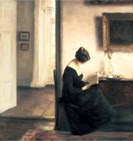
Before Willa Cather died, she did what she could to prevent this book from ever existing. She made a will that clearly forbade all publication of her letters, in full or in part. And now we flagrantly defy Cather's will in the belief that her decision, made in the last, dark years of her life and honored for more than half a century, is outweighed by the value of making these letters available to readers all over the world.
This is how Andrew Jewell & Janis Stout begin their Introduction to this volume of the letters of Willa Cather. My first reaction was to think, Well, they would say that, wouldn't they? Then again, if I was going to take the high moral ground, I would have closed the book immediately & returned it to the library the next day. Instead, I read every word & loved it. Jewell & Stout go on to write that Cather may have wanted to prevent the reputation of her work being overshadowed by her private life. She was always careful to protect the two most important emotional relationships of her life, with Isabelle McClung & Edith Lewis, from prying eyes. As it is, very little of Cather's correspondence with either woman survives. In this book of over 600pp, there are only a couple of short notes or postcards to each of them. She also left the ultimate decision about publication in the future to her Executors & Trustee. Jewell & Stout believe that "These lively, illuminating letters will do nothing to damage her reputation." which is certainly true.
Willa Cather was born in Virginia in 1875 & moved to Red Cloud, Nebraska as a child. After attending university in Lincoln, Nebraska, she worked as editor of McClure's magazine in New York, travelled several times to Europe &, more productively for her fiction, to Arizona, New Mexico & Quebec. While working at McClure's, she began publishing her own work & working on the magazine, often filling the pages herself, was a wonderful apprenticeship. She remained close to her parents & her elder brothers, Roscoe & Douglass; girlhood friends such as the Miner sisters; fellow writers, especially Dorothy Canfield Fisher, & her publisher, Alfred Knopf. All these relationships are well-represented in the letters.
Cather's growing reputation led to correspondence with readers & critics which often leads to fascinating stories about the origins of her novels. The friendship with singer Olive Fremstad that was the inspiration for The Song of the Lark; her memories of her immigrant neighbours in Red Cloud that inspired stories like The Bohemian Girl & the novels O Pioneers! & My Àntonia. The trip to New Mexico & her reading about the French Catholic missionaries that became Death Comes for the Archbishop; the childhood memory of a day at her grandmother's house in Virginia that was the beginning of Sapphira and the Slave Girl. She was also interested & knowledgeable about every aspect of the production, presentation & promotion of her work from the font type & size, the bindings & illustrations to the copy written by the publicity department of her first publisher, Houghton Mifflin.
Cather lived in New York for many years but always tried to leave the city during the heat of summer. She had several favourite places, from Jaffrey, New Hampshire to Grand Manan Island, New Brunswick, where she & Edith Lewis owned a cottage. She also spent considerable time in France & New Mexico.
The editors have left Cather's wayward spelling as a young girl alone & it gives a picture of impetuous enthusiasm about books, music & the theatre as well as an intense interest in everything that was happening to friends & family. Although her spelling improves, her love of literature & music is with her all her life. Cather was a loyal & generous friend, never forgetting S S McClure, who had given her the opportunity of editing his magazine. She also went home to Nebraska frequently & always remembered friends & neighbours at Christmas & especially during the hard times of the Depression years. Her own success meant that she had the ability to help in practical ways as well as with kind thoughts & sympathy.
I always enjoy reading about the elements that go into fiction & the way that writers can take the seed of a story from life, a scene briefly glimpsed, a person known in childhood & transform it into something new. Cather explained to her friend Carrie Miner Sherwood about the characters in her story, Two Friends,
You never can get it through peoples heads that a story is made out of an emotion or an excitement and is not made out of the legs and arms and faces of one's friends or acquaintances. Two Friends, for instance, was not really made out of your father and Mr Richardson; it was made out of an effect they produced on a little girl who used to hang about them. The story, as I told you, is a picture; but it is not the picture of two men, but of a memory. Many things about both men are left out of this sketch because they made no impression on me as a child; other things are exaggerated because they seemed just like that to me then. January 27, 1934
I also enjoyed her responses to critics' opinions of her work. Margaret Laurence wrote a chapter on Cather's work &, in a letter to Carrie Sherwood, Cather praises Laurence for her understanding of her craft,
She seems to understand that I can write successfully only when I write about people or places which I very greatly admire; which, indeed, I actually love. The characters may be cranky or queer, or foolhardy and rash, but they must have something in them which gives me a thrill and warms my heart. June 28, 1939
She also had trenchant views about the value of trying to teach creative writing (in a letter to Egbert Samuel Oliver, who had written to her asking for her views),
I think it is sheer nonsense to attempt to teach "Creative Writing" in colleges. If the college students were taught to write good, sound English sentences (sentences with unmistakable articulation) and to avoid hackneyed woman's-club expressions, such as "colorful", "the desire to create", "worth while books", "a writer universally acclaimed" - all those smug expressions which really mean nothing at all - then creative writing would take care of itself. December 13, 1934
Cather's last years were made difficult by ill health. She damaged her right wrist & this restricted her ability to work. She writes that she learned to dictate her letters but could never dictate her work. She also had several operations. The deaths of those close to her, especially her parents, her brothers & Isabelle McClung, hit her very hard. She writes movingly of the loss of her father (& Dorothy's mother) & the ill-health of her mother to Dorothy Canfield Fisher,
But these vanishings, that come one after another, have such an impoverishing effect on those of us who are left - our world suddenly becomes so diminished - the landmarks disappear and all the splendid distances behind us close up. These losses, one after another, make one feel as if one were going on in a play after most of the principal characters are dead. September 30, 1930
This feeling intensified as those closest to her died, especially those who were far away. Isabelle McClung was living in France with her husband, Jan Hambourg, when she died of kidney disease in 1938. Cather wrote to her niece, Margaret,
Isabelle knew very little about books, but everything about gracious and graceful living. We brought each other up. We kept on doing that all our lives. For most of my life in Pittsburgh (five years) Isabelle and, I think, your father (Cather's brother, Roscoe), were the only two people who thought there was any good reason for my trying to write ... Isabelle has always been my best and soundest critic ... I have sent Isabelle every manuscript before I published (part missing?) were always invaluable. Her husband is returning to me three hundred of my letters which she carried about with her from place to place all the time. She had lived abroad for fourteen years, but I often went to her, and in mind we were never separated. Now we have no means of communication; that is all. One can never form such a friendship twice. One does not want to. As long as she lived, her youth and mine were realities to both of us. November 8, 1938
Reading an author's letters always takes me back to the work & I've been rereading some of Cather's short stories. I bought this Virago edition of the stories, edited by Hermione Lee, in the late 1980s. I've read The Bohemian Girl, Two Friends, A Wagner Matinée & Coming, Aphrodite! & will probably go on to read the rest of the book, as well as the novels I haven't yet read.
Tuesday, June 16, 2015
Sunday, June 14, 2015
Sunday Poetry - Edna St Vincent Millay
Edna St Vincent Millay wrote many sonnets & I especially like this early sonnet about the grief of missing a loved one.
Time does not bring relief; you all have lied
Who told me time would ease me of my pain!
I miss him in the weeping of the rain;
I want him at the shrinking of the tide;
The old snows melt from every mountain-side,
And last year’s leaves are smoke in every lane;
But last year’s bitter loving must remain
Heaped on my heart, and my old thoughts abide.
There are a hundred places where I fear
To go,—so with his memory they brim.
And entering with relief some quiet place
Where never fell his foot or shone his face
I say, “There is no memory of him here!”
And so stand stricken, so remembering him.
Thursday, June 11, 2015
Thursday Bookshelf - BR-CA
A few more Brontë books & the Brownings, Robert & Elizabeth Barrett. By the way, any books you see with library spine labels on them have been legally deaccessioned (weeded) from various libraries I've worked in & brought home to be properly appreciated. I try to remove all the labels (ie getting rid of the evidence) but the spine label on The Brownings : Letters and Poetry is under the covering of the book which has been rebound. We don't rebind books any more, we replace or withdraw, which is quite a contentious topic in library land which I'm going to leave very much alone.
I remember reading the Women's Press edition of Aurora Leigh on the porch of my friend P's house at Daylesford over 30 years ago. I stayed there for a winter week on my own. The house was right on the lake & this was years before Daylesford became a New Age tourist destination. As well as Aurora Leigh, I read a book on Shakespeare's sonnets (which we'll be seeing later on the G shelf) & Byron's Don Juan, which is just below.
John Buchan & Fanny Burney on this shelf as well as Marilyn Butler's terrific books about Jane Austen & her times. I've also read her biography of Maria Edgeworth.
My Byron collection is here (including Don Juan) & A S Byatt. Possession is one of my favourite books, so, of course I have two copies. One of them is a Folio Society edition, so I feel it's completely justified.
Another Folio Society edition of another favourite book, A Month in the Country by J L Carr. Also my childhood copy of Alice & the books by Mary Cadogan & Patricia Craig about girls' school stories and women & detective fiction. I often dip into these & they're great fun if you have any interest in early-mid 20th century fiction. Archaeology is another of my interests & there are two classics there - Martin Carver's book on Sutton Hoo & a facsimile of Howard Carter's book on the discovery of Tutankhamen's tomb.
Next week, CAther-DOnne.
Tuesday, June 9, 2015
The Golden Age of Murder - Martin Edwards
The Golden Age of crime fiction spanned the period between the World Wars. There are many stereotypes about the books written during this period, most of them inaccurate & quite lazy. The books were just puzzles, with cutout characters reminiscent of the board game Cluedo. Their authors didn't play fair with the reader, including untraceable poisons & mysterious Chinamen in an effort to bamboozle the reader. In reality, the best books of this period have been read & loved by millions of readers. Their plots, far from being cosy, featured serial killers, sadistic murders, plots based on real crimes of the period & the beginnings of the forensic thriller. The names of the greatest authors of the period - Agatha Christie, Dorothy L Sayers, Margery Allingham, Ngaio Marsh - are still well-known today. Their books are still read, we listen to audio books & radio productions & watch the many TV adaptations. Martin Edwards tells the story of the Golden Age through the history of The Detection Club & the authors who founded it & were its members. It's the story of a period of history & a group of writers that have always fascinated me.
The Detection Club was founded in 1930 by a group of writers that included Christie, Sayers & Anthony Berkeley Cox, who wrote under the names Anthony Berkeley & Francis Iles. The Club was an exclusive one. Members had to be proposed by a current member & approved by the committee. The initiation ritual, complete with members dressed in ceremonial robes & the swearing of an oath to uphold fair play in the plotting of the detective novel taken while holding a skull known as Eric, was all part of the game. The Club met for dinner & conversation several times a year in London & the meetings provided an opportunity for gossip about publishers, agents, sales, the topics that probably feature in the conversation of any group of writers. For some of the members, the Club provided an escape from the disappointments & problems of their private lives. Writing is a solitary occupation & the opportunity to talk shop with colleagues must have been another attraction.
The Golden Age of Murder focuses principally on three writers - Agatha Christie, Dorothy L Sayers & Anthony Berkeley Cox. Much has been written about Christie & Sayers but I was especially interested to read more about Berkeley. He was an innovative novelist whose brilliant plotting was a feature of his work. Two of his books written under the pseudonym Francis Iles radically changed the conventions of detective fiction. In Malice Aforethought, the reader is in the confidence of the murderer from the beginning & the opening of Before the Fact tells us that Lina Aysgarth was married to a murderer before taking us back to the beginning of their relationship with this knowledge in our minds. Under the name Anthony Berkeley, he wrote a series of novels featuring Roger Sheringham, an amateur detective who usually gets everything wrong before finally coming up with the correct solution. Berkeley felt adrift after his war service & tried various jobs before becoming a writer. He was a contradictory personality, eccentric, obsessive, difficult. His private life was unconventional & this is something he had in common with other members of the Detection Club.
One of the most interesting aspects of the story is the private lives of the members. A theory I've heard several times about the Golden Age writers is that their interest & facility in writing detective stories came from the need to hide secrets in their private lives. Just last week, I listened to the latest episode of BBC Radio's Great Lives where Val McDermid discussed P D James, who gave a lecture on this theory. Christie famously disappeared for twelve days in 1926, distressed over the end of her first marriage. Even after her happy second marriage to archaeologist Max Mallowan, Christie, an intensely shy woman, shunned publicity. Sayers had an illegitimate son, whose existence she kept secret from all her closest friends. Her difficult marriage, to an alcoholic who had suffered from his war experiences, was another reason for her love of the Detection Club's dinners & the gusto with which she entered into the spirit of all the rituals & rules.
Edwards also mentions many other writers, some of them famous in their day but unknown now. Interestingly, as consultant to the very successful British Library Crime Classics series, Edwards has been instrumental in bringing some of these authors back into print. Christopher St John Sprigg, J Jefferson Farjeon & Freeman Wills Croft are just three authors mentioned in this book who have been brought back into print through this series. Another cliche of the Golden Age is that it was dominated by women writers, the Queens of Crime. Martin Edwards features many male authors of the period, some of them undeservedly obscure now. His knowledge of the period is exhaustive & obviously the product of many years reading & research. Martin's blog, Do You Write Under Your Own Name? bears witness to this interest with regular posts on forgotten books & interesting snippets of information from his ongoing research into this fascinating period of literary history.
It's impossible for me to encompass this book in a brief review. I haven't even mentioned the interest in true crime that led to the anthology, The Anatomy of Murder (recently reprinted), or the collaborative novels published by members of the Club (Ask a Policeman, The Floating Admiral) to replenish their funds & pay the rent on their Soho rooms. I enjoyed reading about the group dynamics of these projects, with Dorothy L Sayers bullying & cajoling members into writing their contributions & submitting their copy. The current members of the Detection Club (including Edwards who is the Archivist of the Club) are working on a group novel of their own called The Sinking Admiral in homage to the earlier book. There are also some fascinating photographs in the book, including one of my favourites of Dorothy L Sayers & Helen Simpson drinking beer & Gladys Mitchell in her other job as a PE teacher, instructing her pupils. The research that has gone into the book is phenomenal as can be seen by the rare illustrations & the detail in the footnotes.
I mentioned the British Library Crime Classics above & I've been reading a recent anthology, Capital Crimes, edited by Edwards, which throws light on a discovery in the book that I found really thrilling. Martin Edwards has discovered a connection between Berkeley & one of my favourite authors, E M Delafield, that has been previously unsuspected. I won't go into detail but the clues are there in Delafield's work if you know where to look. Although best-known today for her delightful Diary of a Provincial Lady & its sequels, Delafield had an interest in true crime & wrote a novel, Messalina of the Suburbs, about the Edith Thompson case (which disturbed & fascinated several of the Detection Club members). The story by Delafield in Capital Crimes, They Don't Wear Labels, is a revelation & just one example of the influence her friendship with Berkeley had on her own work.
The success of the British Library Crime Classics as well as the continuing popularity of adaptations of Golden Age novels attest to our love of this period of detective fiction. I'm just as fascinated by the authors as their books so The Golden Age of Murder has been a real treat for me. I think anyone who has read the novels of this period would find much to enjoy in Martin Edwards' book & the recent reprints by several publishers, including Dean Street Press, Langtail Press, Rue Morgue & Felony & Mayhem (featuring Berkeley's The Poisoned Chocolates Case this week) mean that if you've read everything Sayers, Christie & Allingham ever wrote, you have many more authors to discover.
Sunday, June 7, 2015
Sunday Poetry - Edna St Vincent Millay
Another sonnet from Millay's first collection, Renascence and other poems. I love the way we're just dropped into a situation, one of those imaginings that we all have (if we're the worrying sort) about a loved one. It reminds me of the scene in Waterloo Bridge, where Myra (Vivien Leigh) sees the newspaper report of Roy's death while she's waiting to meet his mother in a teashop & has to try to look as though nothing is wrong. I must watch that movie again, it's one of my favourites.
If I should learn, in some quite casual way,
That you were gone, not to return again—
Read from the back-page of a paper, say,
Held by a neighbor in a subway train,
How at the corner of this avenue
And such a street (so are the papers filled)
A hurrying man—who happened to be you—
At noon to-day had happened to be killed,
I should not cry aloud—I could not cry
Aloud, or wring my hands in such a place—
I should but watch the station lights rush by
With a more careful interest on my face,
Or raise my eyes and read with greater care
Where to store furs and how to treat the hair.
Thursday, June 4, 2015
Thursday Bookshelf - BI-BR
Week 3 of the great bookshelf project. Enid Blyton's Tales of Great Adventure (the green book sixth from the right) was one of my favourite books when I was a child. It's a retelling of the stories of King Arthur & Robin Hood & it's the way I always think of them, no matter how many books I read about the origins & maybe real people behind the myths. Ronald Blythe is one of the first authors I reviewed on the blog & I still have several of his books on the tbr shelves.
One of my favourite Sensation authors is featured here, Mary Elizabeth Braddon as well as Ann Bridge. I loved her Julia Probyn series although, as I read them all as ebooks, they have no presence on the shelves. Green for Danger by Christianna Brand is one of the most famous (& best) Golden Age mystery novels. Set in a hospital during WWII, it's an atmospheric book with a great twist in the plot. It was also made into a movie with Alistair Sim, Trevor Howard & Leo Genn.
Vera Brittain & the beginning of the Brontës.
The end of the Brontës. I wish I had the first volume of The Letters of Charlotte Brontë. I bought Vols 2 & 3 but borrowed Vol 1 from the library. It's very expensive & OUP have never reprinted it in paperback. I don't need it, of course, but I'd like to have it.
Next week, BR-CA.
Tuesday, June 2, 2015
The Lady Queen : the notorious reign of Joanna I, Queen of Naples, Jerusalem and Sicily - Nancy Goldstone
I know very little about Italian history & even less about Italy in the medieval period so, when I picked up this biography of Joanna I of Naples, I was interested to learn more. What a fascinating journey it turned out to be.
Joanna was born in 1326, and, after being orphaned very young, grew up at the Court of her grandfather, Robert the Wise, King of Naples & his second wife, the very religious Sancia of Majorca. Robert was a descendant of the Angevin rulers & held his kingdom of Naples as a fiefdom of the Papacy, paying a yearly tribute for the privilege. Robert's reign was a golden age of prosperity but there were problems, mostly of Robert's own making. Robert's second marriage, to Sancia, was childless, mostly because she was extremely religious & would not allow him his conjugal rights. As Robert had no living sons, this was a problem for the succession. He made his granddaughter, Joanna, his heir but, in so doing, dispossessed his nephew, Carobert, the son of Robert's elder brother. Carobert was sent off to Hungary to become King in due course. However, the long-term consequences of this decision would have a catastrophic effect on the security of the kingdom during Joanna's reign. Robert attempted to address Carobert's grievances by offering to marry Joanna to his son, Andrew. The boy was a year younger than Joanna & arrived in Naples at the age of six. Joanna & Andrew were married soon after & Robert made all his nobles swear allegiance to the couple as the future king & queen. It was hoped that this would satisfy the Hungarian claims to the throne of Naples.
Joanna came to the throne at the age of 17. She had had a thorough education in courtly ways from her grandfather & in religious matters from her step-grandmother, Sancia. Joanna's marriage, however, was not a happy one, despite the birth of a son, Charles Martel. Although Joanna & Andrew had been brought up together, they were not close. There was prejudice against Andrew by the leading nobles, both because he was Hungarian & because his marriage to Joanna prevented one of their sons from becoming king. Andrew was also compared unfavourable with Joanna's cousins, the Durazzo & Taranto families, who also aspired to the crown. Joanna faced many challenges during her years as queen but none was more confronting than the murder of Andrew by a group of jealous nobles in 1345, just two years after she came to the throne.
Joanna's Hungarian in-laws were outraged & Andrew's brother, Louis, now King of Hungary & his formidable mother, Elizabeth, demanded justice. They also used the murder as a lever to push Louis' own claims to the throne of Naples. Joanna was accused of involvement in the murder & was forced to flee Naples & seek the Pope's protection at Avignon. She was then forced to go on trial for her husband's murder at the Papal Court before Pope Clement VI. Joanna convinced the Pope of her innocence although she wasn't able to save the lives of many of her closest friends & supporters who were imprisoned, horribly tortured & executed by the Hungarians, who ruled Naples after her flight. Joanna had to leave her young son behind & he was taken back to Hungary by his relations, where he died soon after.
Joanna knew that she had to remarry quickly. She needed a champion, a proven warrior who would help her regain her kingdom. She chose Louis of Taranto, who had his own claim to the throne of Naples. Eventually, after bribing the Pope with the transfer of the city of Avignon to his authority, the Pope recognized Joanna's marriage to Louis & advanced the money they would need to amass an army to drive the Hungarians out of Naples. They were successful & by 1349, Joanna had reclaimed her kingdom. Unfortunately, Joanna's personal life was never easy. She & Louis had two daughters, who both died young. Their marriage collapsed soon after the return to Naples & Louis was accused of treating Joanna very badly, attacking her physically & flaunting his affairs. Joanna married twice more. After Louis' death in 1362, she married James IV, King of Majorca. This was another disaster. James had been imprisoned as a young man by the King of Aragon for over 15 years & emerged from this ordeal with this health shattered, both physically & mentally. After James's death in 1375, Joanna finally found the husband she had needed all along. At the age of 49, she married 55 year old Otto of Brunswick. Otto was a member of a minor German noble family, a very inferior match in worldly terms. However, he was a fine soldier, had no claim to the Neapolitan throne & no expectations of usurping Joanna's prerogatives. Unlike her first three husbands, Otto had no prospect of being crowned King Consort & doesn't seem to have expected it.
Joanna's relations with the Papacy were also fascinating. She was bound very closely to the Pope of the day because of Naples' status as a vassal of the Papacy. Joanna's relations with successive Popes were vital, both because the Pope had such power over the kingdom & its people in both a spiritual & a practical sense. Joanna was excommunicated several times & Naples placed under an Interdict. However, Joanna mostly managed to steer clear of major disruptions, quite a feat during this time when the Pope had been forced to flee Rome for Avignon &, near the end of Joanna's reign, she became involved in the Great Schism, when there were two Popes vying for legitimacy.
It can be very difficult to get a sense of the life of an individual woman in the Middle Ages, especially when there are no private letters or diaries to consult. Joanna speaks to us in the form of official letters but also in her actions. She was remarkable because she was the only woman in this period to rule in her own right. Although she needed to marry to support her rule, she never allowed her consorts to rule alongside her. She was incredibly unlucky as her reign coincided with outbreaks of plague & the growth of the Free Companies, bands of mercenaries let loose across Europe after the conclusion of wars. Economic conditions were also bad, with poor harvests & the collapse of the great banking families who had financially supported Joanna's grandfather, Robert the Wise. Joanna faced constant plotting by her Hungarian relations as well as her Neapolitan family, all of them ruthlessly ambitious. She also had no heir, which only increased the plotting as the factions circled her throne.
Joanna has had a reputation as a wicked adulteress, murdering her first husband & committing almost any crime. However, these stories seem to have more to do with the fact that she was a woman than with any truth about the accusations. She was the last ruler of Naples to hold Provence & to extend her rule to Sicily & Piedmont. She was a solicitous ruler to her people & did what she could to relieve the many privations they suffered due to plague & disaster. She built hospitals & tried to promote justice for all her subjects. Pope Clement VII wrote of Joanna after her death,
Of all the illustrious women of this world, Joanna, radiant rose among thorns, infolded us, the whole Roman Church and her subjects in an amazingly sweet scent ... She passed on from the misery of this world to the beatitude of God's kingdom where she lives and reigns and where, despising and mocking her adversaries, she recovers the sceptre that has been taken from her and receives her crown among the same martyrs.
Clement owed his position to Joanna as she had supported him during the Schism so his accolades are not entirely objective. However, I certainly agree with Nancy Goldstone that Joanna was a remarkable ruler who achieved an enormous amount for a woman in the 14th century. Goldstone tells a complicated story with great clarity. I was able to keep track of the many different factions & families even though I listened to the book on audio. I also have her book, Four Queens, about the Provencal sisters who all married European kings, on the tbr shelves & I'm looking forward to reading it, as well as reading some more Italian history.
Labels:
audio books,
biography,
books,
history,
Hungary,
Italy,
Nancy Goldstone
Subscribe to:
Posts (Atom)