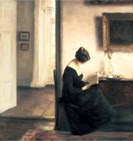
I know the 1924 Club doesn't begin until tomorrow but I couldn't resist a poem from a collection published in 1924, especially as this is one of my favourite poems. Buckingham Palace by A A Milne is from the collection, When We Were Very Young &, as A A Milne is one of Simon's favourite authors, I know he won't object. What is it about the line Says Alice at the end of every verse that is so endearing? Maybe it's the idea that everything Alice says must be right, to Christopher Robin at least. It's that complete trust that a child feels for a loved adult. The King's Breakfast is another favourite poem from this collection.
I've been reading John Buchan & Baroness Orczy for the 1924 Club & I can't wait to see what everyone else has been reading.
They're changing guard at Buckingham Palace -
Christopher Robin went down with Alice.
Alice is marrying one of the guard.
"A soldier's life is terrible hard,"
Says Alice.
They're changing guard at Buckingham Palace -
Christopher Robin went down with Alice.
We saw a guard in a sentry-box.
"One of the sergeants looks after their socks,"
Says Alice.
They're changing guard at Buckingham Palace -
Christopher Robin went down with Alice.
We looked for the King, but he never came.
"Well, God take care of him, all the same,"
Says Alice.
They're changing guard at Buckingham Palace -
Christopher Robin went down with Alice.
They've great big parties inside the grounds.
"I wouldn't be King for a hundred pounds,"
Says Alice.
They're changing guard at Buckingham Palace -
Christopher Robin went down with Alice.
A face looked out, but it wasn't the King's.
"He's much too busy a-signing things,"
Says Alice.
They're changing guard at Buckingham Palace -
Christopher Robin went down with Alice.
"Do you think the King knows all about me?"
"Sure to, dear, but it's time for tea,"
Says Alice.
Sunday, October 18, 2015
Tuesday, October 13, 2015
Into the Whirlwind - Eugenia Ginzberg
This is one of those books that I find more horrifying than the scariest fiction. The word Kafkaesque describes Into the Whirlwind perfectly. It's the story of a woman's physical & mental endurance in circumstances that would & did crush many people.
Eugenia Ginzburg (known as Jenny) lived a comfortable life in the Soviet Union in the 1930s. She was a member of the Communist Party, married to the Mayor of Kazan. She had two children & was a teacher & writer, working on the journal, Red Tartary. When she is arrested, she assumes it's a mistake. Her belief in the Party is absolute & she can't believe that she can be arrested for something she hasn't done. She's accused of not reporting the seditious actions of a colleague & her interrogators refuse to believe that she didn't know of his activities or recognize that they were seditious. This is the beginning of her personal nightmare & the beginning of the purge of intellectuals that was undertaken by Stalin in the 1930s. She was interrogated, imprisoned, thrown out of the Party, & spent the next seventeen years in jail or in prison camps in Siberia, separated from her family & reliant on her own strength to survive.
Her interrogations are almost surreal as she refuses to admit anything & refuses to sign the fabricated confessions she is offered. She has no idea what has become of her family &, as time goes on, she can only be grateful for the fact that her arrest came before the order allowing the torture of suspects was passed. Even so, at one stage she is sentenced to five days in complete darkness in a filthy cell far underground where she can hear rats.Her initial stint of solitary confinement is eased when overcrowding means that she shares her cell with Julia, a woman she knew from the outside. This companionship & the tapping code that enables the women to communicate with the prisoners in nearby cells alleviates the mental torment but the physical privations - lack of exercise, poor food & the heat or cold in inadequate clothing - are difficult to bear.
Almost worse than all these is the lack of books. Eventually they're allowed to borrow books from the prison library but then have to contrive to stay awake all night to read them. There's not enough light in the cell to read during the day but the guards leave the lights on all night as an additional torture. Jenny & Julia manage to sleep during the day by pretending to be reading & read at night by hiding the books under their blankets. All these contrivances are fascinating to read about & the triumph for the prisoners of outwitting the guards keeps their spirits up.
Nothing is simpler to explain the profound effect of books on a prisoner's mind by the absence of outward stimulants. But this is not quite all there is to it. Isolation from everyday life and from its rat-race favours a kind of spiritual lucidity. Sitting in a cell, you don't chase after the phantom of worldly success, you don't play the diplomat or the hypocrite, you don't compromise with your conscience. You can be wholly concerned with the highest problems of existence, and you approach them with a mind purified by suffering.
From Yaroslavl, Jenny is transferred to Kolyma & from there to the prison camps of the far east in Siberia where she is sent on to the camp at Kolyma where she almost died felling trees on a work gang. Each stage of the journey is worse than the one before & Jenny looks back to the previous stage almost with nostalgia as the conditions get worse with every change. As a political prisoner, charged with failing to disclose terrorist activities, she is very low in the hierarchy, looked down upon by other prisoners & derided for her bourgeois attitudes. Many times I wondered how Jenny kept going. The interminable train journey east to the camp in an overcrowded truck; the many times she almost died from exhaustion or disease but survived due to luck or the kindness of a stranger; the sheer inhumanity of the system that had imprisoned her in the first place which is outside the comprehension of any sane person. It's a humbling experience to read a testimony like this & amazing to think that Jenny had the almost total recall she displays in setting down her experiences.
The Afterword to the Persephone edition is interesting in the perspective it brings to the book. Rodric Braithwaite is a former British ambassador to Moscow & he saw a play based on the book while he was in Russia. There have been those who disputed some of the details of Jenny's account but I think it would be unbelievable if she didn't get details wrong. A memoir like this is naturally subjective & others have thought that she had just too much good luck in the people she knew & the comparatively easy time she had. If Jenny's imprisonment was easy, I would hate to read about a harsh imprisonment. Her incredible mental strength & her inner resources kept her going through the worst mental agony of not knowing the fate of her family. She was at least able to write to her mother some of the time & they worked out a code that would get past the censors so she did know a little about her children but her imprisonment & exile lasted for seventeen years & she never saw her eldest son, Alyosha, after her arrest. He died in the siege of Leningrad in 1941. Even after her initial sentence was over, she had to stay in Siberian exile for a further five years & wasn't finally rehabilitated until 1955, after Stalin's death. Into the Whirlwind is about the first few years of her sentence. Ginzburg wrote a sequel, Within the Whirlwind, which continues the story of her exile & was published after her death.
While I was reading Into the Whirlwind I was reminded of an extract from a book I read in a Reader's Digest anthology over 30 years ago. My Dad collected the Reader's Digest condensed books but this was slightly different, an anthology of short extracts from many books. It was bound in white with gold lettering & I only remember one piece, just a few pages long, which I must have read hundreds of times. It was the story of a woman (Edith?), imprisoned in Eastern Europe. She was in solitary confinement & passed the time by reciting all the poetry she could remember & by walking through Europe in her mind while pacing her cell to keep herself fit. She had worked out how many circuits of her cell added up to a mile & she recreated the journeys she had made when she was free. I would love to know what this book was if anyone can tell me.
Sunday, October 11, 2015
Sunday Poetry - Thomas Hardy
I came across this introduction to A Laodicean, one of Hardy's lesser-known novels, yesterday. It's one I haven't read so I skimmed any parts of the article that looked like giving away too much plot. Of course, I immediately wanted to read it, even though I'm reading Buchan's Three Hostages for the 1924 Club, listening to Dombey and Son & just about to start George Meredith's Evan Harrington for my 19th century bookgroup. Luckily I have a copy so I won't be tempted to break my book-buying ban but I'll have to wait for a gap in the reading schedule. In the meantime, here's The Going, one of the lovely poems Hardy wrote after the death of his first wife, Emma.
Why did you give no hint that night
That quickly after the morrow's dawn,
And calmly, as if indifferent quite,
You would close your term here, up and be gone
Where I could not follow
With wing of swallow
To gain one glimpse of you ever anon!
Never to bid good-bye
Or lip me the softest call,
Or utter a wish for a word, while I
Saw morning harden upon the wall,
Unmoved, unknowing
That your great going
Had place that moment, and altered all.
Why do you make me leave the house
And think for a breath it is you I see
At the end of the alley of bending boughs
Where so often at dusk you used to be;
Till in darkening dankness
The yawning blankness
Of the perspective sickens me!
You were she who abode
By those red-veined rocks far West,
You were the swan-necked one who rode
Along the beetling Beeny Crest,
And, reining nigh me,
Would muse and eye me,
While Life unrolled us its very best.
Why, then, latterly did we not speak,
Did we not think of those days long dead,
And ere your vanishing strive to seek
That time's renewal? We might have said,
"In this bright spring weather
We'll visit together
Those places that once we visited."
Well, well! All's past amend,
Unchangeable. It must go.
I seem but a dead man held on end
To sink down soon. . . . O you could not know
That such swift fleeing
No soul foreseeing--
Not even I--would undo me so!
Thursday, October 8, 2015
The Man with the Dark Beard - Annie Haynes
That same evening, the doctor is in his consulting room but doesn't respond to the parlourmaid or Basil knocking on the door. Even Aunt Lavinia can't rouse him. The maid goes goes into the garden, looks through the consulting room window & sees the doctor slumped at his desk. When the household break in, they find him dead, shot through the head at close range. Inspector Stoddart of Scotland Yard is called in & examines the scene of the crime. He finds a half-written letter to Sir Felix, about the subject of their earlier conversation, & a scrap of paper with the words, "It was the Man with the Dark Beard". A Chinese box with the proofs of that other suspected crime has also been stolen. A colleague of Dr Bastow's, Dr Sanford Morris, has a dark beard & when he shaves it off soon after the crime, & confesses that he had an appointment with Dr Bastow on the night of the murder which he says he didn't keep, he becomes one of the main suspects. Adding to the puzzle is the disappearance of the mysterious parlourmaid, Mary Ann Taylor, & the sudden transformation of Iris Houlton, who seems to have inherited money. When a second murder occurs, it seems too much of a coincidence that the same person could be involved with both victims & not be the murderer. Inspector Stoddart & his assistant, Harbord (is he a Sergeant? I assumed he was but I don't think his rank is ever mentioned) have their work cut out for them.
This is the first of four detective novels by Annie Haynes featuring Inspector Stoddart. As with The Crystal Beads Murder, I enjoyed Stoddart's investigation of the crime, with its red herrings & false trails. However, I don't think this book is as good as the later one. The villain is fairly obvious from the start although I didn't work out how the murders were done. There's also a touch too much melodrama for me in several scenes. Some aspects of the plot were more Wilkie Collins than Agatha Christie. I did enjoy some of the characterizations. Hilary's brother, Fee, has been indulged because of his disability & is peevish & demanding because of it. My favourite character was Aunt Lavinia. I enjoy characters who call a spade a spade, even though they may be completely wrong. I can't believe that she ever actually left the house in an outfit like this,
Today she wore a coat and skirt of grey tweed with the waist-line and leg-of-mutton sleeves of the Victorian era, while the length and extreme skimpiness of the skirt were essentially modern, as were her low-necked blouse, which allowed a liberal expanse of chest to be seen, and the grey silk stockings with the grey suede shoes. Her hair was shingled, of course, and had been permanently waved, but the permanent waves had belied their name, and the dyed, stubbly hair betrayed a tendency to stand on end.
I also didn't believe the end of Lavinia's story for one moment. However, The Man with the Dark Beard is a suitably convoluted mystery. Once the second murder is committed, I couldn't stop reading. I'm looking forward to reading more Annie Haynes & luckily, Dean Street Press are reprinting all her novels & kindly sent me this one for review.
Tuesday, October 6, 2015
The Crystal Beads Murder - Annie Haynes
It struck me while I was reading this book that one of the differences between the Golden Age murder mystery & a lot of modern detective novels or thrillers is the status of the victim. In the Golden Age novel (& some modern police procedurals), the victim is hardly regretted. They are introduced only in order to show the reader how repulsive they are & then they're mercifully bumped off. In modern thrillers, particularly those with serial killers, the victims are portrayed as innocents, invariably in the wrong place at the wrong time. They usually don't know their killer so they can't have done anything to "justify" their death. The plot of the Golden Age novel was generally more concerned with the puzzle of the mystery & to have a reasonable number of suspects, the victim had to have made a certain number of enemies. I know this is a terrible generalisation but there it is, for what it's worth. The unlikeable victim is one of the characteristics of the Golden Age puzzle mystery & as I enjoy a good puzzle as much as the next reader, I loved The Crystal Beads Murder by Annie Haynes, another neglected writer rediscovered by Dean Street Press.
When the body of Robert Saunderson is found in the summer house of Lord Medchester's country house, Holford Hall, in Loamshire, there are several people who are glad that he's dead. Saunderson was a man of mysterious antecedents. Rich & connected to the racing set, he had been invited to Lord Medchester's house for a weekend mostly because of those racing connections. There are also rumours that Minnie, Lady Medchester, is having an affair with Saunderson. Saunderson had also become acquainted with Lord Medchester's cousins, Harold & Anne Courtenay. Harold is a weak young man, trying to gamble his way out of financial difficulties & failing. He's running around with a vulgar crowd that includes Maurice & Sybil Stainer, a couple of chancers who have battened on to Harold & are leading him astray. Anne dislikes Saunderson & is repelled by his obvious interest in herself. She is engaged to Michael Burford, the trainer at Lord Medchester's stables. Harold has put himself into Saunderson's power & the only way for him to avoid disgrace is if Anne agrees to marry Saunderson. She is horrified by this but is also afraid of scandal & afraid of upsetting their elderly grandfather.
Some weeks after the weekend house party at Holford House, Saunderson writes to Anne, asking to meet her in the summer house to discuss her future. The scandal over Harold's misdemeanor is about to break & Saunderson is pressuring Anne to marry him. The house is full of guests but Anne goes to her room after dinner & prepares to meet Saunderson. Someone hiding in the shrubbery watches Anne as she enters the summer house & as she leaves with a look of horror on her face. Next morning, the body of a man in evening dress is discovered in the summer house. He has been shot in the heart. Robbery doesn't seem to be the motive but there are three crystal beads found in his pocket. Beads that were not there when the local policeman, Superintendent Meyer, first examined the body.
Inspector Stoddart & Sergeant Harbord of Scotland Yard arrive to lead the investigation into Saunderson's murder. They soon discover that there are almost too many suspects. Saunderson owned a money-lending business & dabbled in blackmail on the side. There are the rumours of his affair with Lady Medchester & the evasiveness of Anne & Harold Courtenay. What was Saunderson doing at Holford Hall when he wasn't a member of the house party? It seems likely that the murderer must have been among the household or guests at the Hall but then a figure from Saunderson's past makes a surprise appearance & sends the investigation in another direction entirely. The significance of the crystal beads continues to be elusive & it takes a visit to the dentist to provide a vital clue.
I thought this was a terrific mystery, I read it in just a couple of days. The pace is brisk & I really liked Stoddart & Harbord. I love a good police procedural & I enjoyed the way that Stoddart works his way through the different scenarios that present themselves. The characters of Anne Courtenay & Lady Medchester are particularly well-done as they are both caught in traps partly of their own making & we watch as they thrash around trying to extricate themselves. The minor characters are individuals, not just stock characters, from Mrs Meyer, wife of the local policeman to Mrs Yates, keeper of the lodge at the Hall & the tramp who becomes a vital witness. The Crystal Beads Murder was published in 1930 & was Annie Haynes's final mystery. In fact, she died leaving it unfinished & another writer completed the manuscript. I couldn't see the join but then, I was reading so fast that I'm not surprised I failed to notice.
Dean Street Press are republishing all twelve of Haynes's mystery novels which she wrote in the 1920s. She was well-regarded in her time, one of only two women mystery writers published by The Bodley Head (the other was Agatha Christie). I'm not sure how relevant that is as Agatha left The Bodley Head for Collins as soon as she was able to get out of her contract, but they did give her a start. Curtis Evans has written the Introduction to all the Haynes reprints & he's done considerable research into her life & career. Born in 1865, she was the daughter of an ironmonger, who lived with her mother & grandparents after her father left the family. Her grandfather was the gardener at Coleorton Hall in Leicestershire. In later life, Haynes lived in London with Ada Heather-Biggs, a prominent feminist & social reformer. Haynes published her first novel, The Bungalow Mystery, in 1923, although she had written newspaper serials. Her novels were admired by critics who enjoyed the crafting of her plots & characterization as much as the twists & turns of the puzzle. She suffered from rheumatoid arthritis for the last 15 years of her life & it's remarkable that she was able to continue working. Her novels were out of print only a few years after her death & were forgotten until this rediscovery.
Dean Street Press kindly sent me a review copy of The Crystal Beads Murder.
Sunday, October 4, 2015
Sunday Poetry - Shakespeare and Finzi
Thanks to Spotify I was also able to explore more Finzi & I especially loved the Eclogue for piano & strings & the Romance in E flat major (beautiful photos of snowy Derbyshire in this clip). One of the wonderful things about the internet (& probably one of the reasons why I'm six months behind in my magazine reading) is that it's so easy to go off on a tangent & explore a new composer or read more about something mentioned in an article. Then there's all the free content from my library through Zinio & our eBook providers.
(I do realise that the photo is upside down, I'm not trying to be arty. It's the right way up in Photo Studio but when I download it here, it's upside down... I thought I'd be clever & turn it upside down in Photo Studio but it was still upside down here)
Come away, come away, death,
And in sad cypress let me be laid.
Fly away, fly away, breath;
I am slain by a fair cruel maid.
My shroud of white, stuck all with yew,
O, prepare it!
My part of death, no one so true
Did share it.
Not a flower, not a flower sweet,
On my black coffin let there be strown.
Not a friend, not a friend greet
My poor corpse, where my bones shall be thrown.
A thousand thousand sighs to save,
Lay me, O, where
Sad true lover never find my grave,
To weep there!
Friday, October 2, 2015
Plans
Now here's a very enticing idea. Simon from Stuck in a Book & Karen from Kaggsy's Bookish Ramblings are hosting a reading challenge later this month called The 1924 Club.
All you have to do is read a book published in 1924. There's a list of possible titles on Simon's blog. I've read quite a few of them but two that I do have on the tbr shelves are The Matriarch by G B Stern & The Three Hostages by John Buchan. I'm looking forward to exploring the shelves to see what other possibilities I have.
Which brings me to my other plan. Christine Poulson (author of Invisible, one of my Top 10 books last year) has just blogged about her plan to stop buying books for a while. I read this & thought Yes! What's good enough for Christine is good enough for me - until Christmas, anyway! I do have several pre-orders on the way - Alison Weir's biography of Lady Margaret Douglas, The Lost Tudor Princess, Claire Harman's biography of Charlotte Brontë, the British Library's collection of Christmas mysteries, Silent Nights, & Jennifer Henderson's biography of Josephine Tey, so I won't feel too deprived. It's the eBooks that are the real temptation because they're so easy to buy & they're invisible so don't even take up room on the tbr shelves. Let's see how long I last.
I've been able to think about all this because we're having a public holiday today - for a football game. It's not even on until tomorrow but we're having a day off on the eve of the AFL Grand Final anyway. So now we're the city with a holiday before a football game & a holiday for a horse race (Melbourne Cup Day in November). It's also the start of the first run of hot weather we've had since last summer. At least the sun is warming up the veggie garden so I can start planting in the next few weeks.
Now for some completely unrelated cat photos. I don't have any new photos of the girls (I almost got a shot of Lucky with my 1924 books but she was unco-operative) so here are the collages I made last year when I discovered the collage app.
The clocks go forward tomorrow night & summer is almost here. Oh well, only six months until I can change the clocks back again!
All you have to do is read a book published in 1924. There's a list of possible titles on Simon's blog. I've read quite a few of them but two that I do have on the tbr shelves are The Matriarch by G B Stern & The Three Hostages by John Buchan. I'm looking forward to exploring the shelves to see what other possibilities I have.
I've been able to think about all this because we're having a public holiday today - for a football game. It's not even on until tomorrow but we're having a day off on the eve of the AFL Grand Final anyway. So now we're the city with a holiday before a football game & a holiday for a horse race (Melbourne Cup Day in November). It's also the start of the first run of hot weather we've had since last summer. At least the sun is warming up the veggie garden so I can start planting in the next few weeks.
Now for some completely unrelated cat photos. I don't have any new photos of the girls (I almost got a shot of Lucky with my 1924 books but she was unco-operative) so here are the collages I made last year when I discovered the collage app.
The clocks go forward tomorrow night & summer is almost here. Oh well, only six months until I can change the clocks back again!
Labels:
1924 Club,
blogs,
book buying,
cats,
Christine Poulson,
Lucky,
Phoebe,
reading plans
Subscribe to:
Posts (Atom)