Sunday, May 31, 2015

Sunday Poetry - Edna St Vincent Millay

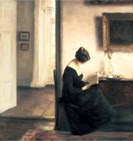
More Edna this week. Another poem from her first collection, Renascence and other poems.

Love, if I weep it will not matter,   
    And if you laugh I shall not care;   
Foolish am I to think about it,   
    But it is good to feel you there.   

Love, in my sleep I dreamed of waking,—           
    White and awful the moonlight reached   
Over the floor, and somewhere, somewhere,   
    There was a shutter loose,—it screeched!   

Swung in the wind,—and no wind blowing!—   
    I was afraid, and turned to you,           
Put out my hand to you for comfort,—   
    And you were gone! Cold, cold as dew,   

Under my hand the moonlight lay!   
    Love, if you laugh I shall not care,   
But if I weep it will not matter,—           
    Ah, it is good to feel you there!

Thursday, May 28, 2015

Thursday Bookshelf - BA-BE

Week 2 of the great bookshelf project. Yacker & Yacker 2 are books of interviews with Australian writers by Candida Baker. Published in the 1980s, she interviewed Helen Garner, Thomas Keneally, David Williamson & David Malouf as well as a previous generation of authors now gone - Ray Lawler, Sumner Locke Elliott, Marjorie Barnard & Christina Stead. Miss Hargreaves by Frank Baker is there thanks to Simon from Stuck In A Book. No book has every had a champion as passionate as Simon so I had to buy a copy.

I loved the L-shaped Room trilogy by Lynne Reid Banks, as well as her two novels about the Brontës. I remember getting the phone call from the bookshop when Juliet Barker's monumental biography, The Brontës, was published. This was the early 1990s & pre-internet for me so I had ordered a copy from the local bookshop in the shopping centre near my library & I could hardly wait to rush over & pick up the book. Thank goodness it was a Thursday & I could whip out in my meal break (I worked the 1-9pm shift on Thursday in those days). I'm not sure how much work I did that evening, I may have been dipping in to the Introduction & looking at the plates...

Unique to Australia by Beatty (about flora & fauna) was a school prize I won for a spelling bee in Grade 5 in 1973. There's also my original Virago copy of Nicola Beauman's A Very Great Profession, the book that began the Persephone phenomenon. Also Bede's Ecclesiastical History of the English People. I read this before I went to the UK in 1999 & it sparked my interest in the Anglo-Saxons. I recently discovered a beautiful blog by A Clerk of Oxford, about the Anglo-Saxons. It's a fascinating mix of poetry, history & stories of the Anglo-Saxons & Scandinavians illustrated with manuscripts of the period. The blog won the History Today award for digital history this year.

I picked up the ancient copy of The Search for Bridey Murphy by Morey Bernstein in a second-hand shop. I'd been fascinated by the Bridey Murphy story ever since I read about it in a Reader's Digest collection. It's a classic reincarnation story (made into a film starring Teresa Wright) about an American woman who regresses under hypnosis to another life in 19th century Ireland. It's been pretty well debunked now, I think, but I love reincarnation stories.

Next week, BI-BR.

Tuesday, May 26, 2015

The Studio Crime - Ianthe Jerrold

A foggy November night in London. In Laurence Newtree's studio, a party is about to begin. Newtree's friend, John Christmas, is there & Christmas has brought along novelist Serafine Wimpole & her slightly dizzy aunt. Philanthropist Sir Marion Steen, suave psychiatrist Dr Simon Mordby & Dr George Merewether complete the party. Newtree is a celebrated cartoonist, but shy & easily overcome by awe for more confident personalities such as Miss Wimpole. His friend, John Christmas, fancies himself as an amateur detective, having assisted the police in a case or two. His father owns a department store & Christmas has no need to work. Serafine's aunt Imogen imagines that she's a nervous personality & Dr Mordby has made his fortune from women like her. Steen & Merewether arrive together & both of them tell a similar tale of being approached in the foggy street by a foreigner wearing a red fez, who asked them for directions to Golders Green.

An indeterminate noise from the studio above, belonging to Gordon Frew, sends Dr Merewether up to investigate. He has attended Frew in a minor illness & insists on going alone. He soon returns, with a reassuring message from Frew that all's well & an invitation to the party to go up to his studio in half an hour. When they do so, they discover Frew dead, murdered, with a knife sticking out of his back. The police doctor believes that Frew has been dead for at least an hour but Merewether sticks to his story that Frew was alive & well half an hour before. Inspector Hembrow allows Christmas to assist with the investigation as they've worked together before. Merewether's position looks grim as he sticks to his story that Frew was alive half an hour before his body was discovered & Christmas begins an investigation into the murder & the life & character of Gordon Frew.

Frew was an unpleasant man, a poseur who published books that he didn't write himself & aspired to be a collector of everything from Persian rugs to Oriental weapons. Several people visited him that night, seen by Newtree's servant, Greenaway, from the man in the fez to his valet, Greenaway's tearaway son, Ernie, & Miss Pandora Shirley, who modeled for Frew & had recently broken off her relationship with Ernie. Christmas dismisses Ernie & Miss Shirley early on & concentrates his attention on the mysterious man in the fez. However, it appears that Frew, besides being unpleasant & phoney, may also have dabbled in fraud & a little blackmail among other crimes. Christmas' investigations uncover more of Frew's background & the more he discovers, the more disreputable Frew seems to have been. The red herrings come thick & fast before Christmas & Hembrow make a surprising discovery that leads them to the solution of the mystery.

I enjoyed The Studio Crime very much. The plot was incredibly convoluted but very entertaining. Jerrold certainly has a vivid way of describing characters & the psychological motivations of several of the characters were very interesting & well-portrayed. I particularly enjoyed Serafine Wimpole. I have a weakness for sensitive female novelists (I much prefer Harriet Vane to Peter Wimsey & wish Dorothy L Sayers had written more books with Harriet) & Serafine's no-nonsense character is shaken a little by her desire to save Dr Merewether from the consequences of his actions (as she sees them). Her quick thinking in an episode surely inspired by Wilkie Collins' The Woman in White is terrific & the interplay between Serafine & her aunt is a lot of fun. London in the gloomy fog is also very atmospheric & Hembrow & Christmas visit some very disreputable parts of the city in their investigations.

Published in 1929, The Studio Crime was the first of two mysteries by Ianthe Jerrold, a member of a family of writers, journalists & actors. Ianthe Jerrold wrote many books over her long career & the success of The Studio Crime led to her being invited to join the Detection Club, the famous group of Golden Age crime writers that included Agatha Christie, Dorothy L Sayers & Anthony Berkeley. I've just started reading Martin Edwards' new book about the Detection Club, The Golden Age of Murder, & in the book, there's a photo of Ianthe Jerrold with E R Punshon, author of the Bobby Owen series (coincidentally about to be reprinted by Dean Street Press, publishers of Jerrold's novels). This edition of the novel also has an informative Introduction by Curtis Evans, who blogs at The Passing Tramp.

Dean Street Press kindly sent me a review copy of The Studio Crime & I'm looking forward to reading Jerrold's other crime novel, Dead Man's Quarry.

Sunday, May 24, 2015

Sunday Poetry - Edna St Vincent Millay

Edna St Vincent Millay is a poet I don't know very much about. I've read her poems in anthologies & always thought I should know more about her. So, when I saw a Dover edition of her poetry for about $3 at Clouston & Hall's website, I decided the time had come to investigate further.

Millay was a poet from childhood, writing her first poem at the age of 5. This edition is a collection of her first three volumes of poetry, the first, Renascence and other poems, published when she was just 25. The title poem of that collection is wonderful, with echoes of Emily Brontë, Emily Dickinson & Andrew Marvell. It's too long to post but you can read it here. Many of the poems are about lost love, often about how difficult it is for the speaker to carry on without the loved one. They're grounded in the everyday, the domestic, which I love. In another poem, Interim, the speaker looks at the book left open on a table, the last words written by the beloved, remembers the first sweet pea of the season brought in from the garden, "'Twas much like any other flower to me, / Save that it was the first. I did not know / Then, that it was the last." I feel that I've discovered a new poet & want to read everything I can get my hands on. There's a biography by Nancy Milford, who wrote a biography of Zelda Fitzgerald that I read & enjoyed many years ago & I must buy some more of the poetry. Anything else I should read? Any recommendations from the Millay fans out there?

Love has gone and left me and the days are all alike;
      Eat I must, and sleep I will, — and would that night were here!
But ah! — to lie awake and hear the slow hours strike!
      Would that it were day again! — with twilight near!

Love has gone and left me and I don't know what to do;
      This or that or what you will is all the same to me;
But all the things that I begin I leave before I'm through, —
      There's little use in anything as far as I can see.

Love has gone and left me, — and the neighbors knock and borrow,
      And life goes on forever like the gnawing of a mouse, —
And to-morrow and to-morrow and to-morrow and to-morrow
      There's this little street and this little house.

Thursday, May 21, 2015

Thursday Bookshelf - A

After unveiling my new bookcases last week, Rose & Lory asked for some close-up photos of the contents. I've also been inspired by Sue, who blogs at My Quiet Life in Suffolk. She posted pictures of all her bookshelves earlier this year & it prompted memories & stories of where she bought the books & when she read them. I'm sure many of us can remember the books we were reading at significant times of our lives when the details of what we did last Tuesday are irretrievable.

So, as a good librarian should, I'm going to begin at A & post a shelf each Thursday. (I hope the pictures are big enough for you to read the titles. I didn't want to make them any bigger because the page then takes too long to load).


I read this copy of By the Sword Divided by John Adair many years before I finally saw the TV series that was partly based on the book. Among Friends was my school reader. My favourite story was about two children who get to know an old lady living in a tumbledown house. They'd always thought she was a witch but, when she lets them pick the peaches from her tree & gives them lemonade, they become friends. I love it because it's set at Christmas, a hot Australian Christmas. I could always smell the warm peaches as I read. I don't read a lot of Australian history but Robyn Annear's books are always well-written & enjoyable. Bearbrass was one of the early names for Melbourne.


Lots of English history here. When I was a child, Mum took me into the city once a year to see an eye specialist in Collins St. There was a bookshop that I always had to go into & Dulcie M Ashdown's Ladies in Waiting was the book I always took off the shelf & coveted. I couldn't afford the book until some years later. I'm not sure how I managed to be seeing a Collins St specialist (Melbourne equivalent of Harley St) as we weren't well-off but I was & I always wanted this book which I finally bought. Theo Aronson was another favourite Royal biographer from around the same period. Also, Karen Armstrong's memoirs of being a nun & afterwards - stories about nuns have always fascinated me.


The beginning of the Austen collection,

& the end of the Austen collection. As you can see, I have no problem owning multiple copies of the same book. The Folio Society set have lovely woodcut illustrations by Joan Hassall & I am a fan of the Penguin Deluxe editions.

Another shelf next Thursday.

Tuesday, May 19, 2015

The Ghost Fields - Elly Griffiths

Forensic archaeologist Ruth Galloway is excavating a possible Bronze Age cemetery when she's called to a nearby field to examine the remains of a WWII plane. The pilot's body is still in the cockpit but Ruth soon realises that he hasn't been there since the 1940s.  DNA testing reveals that the pilot was related to local landowners, the Blackstock family. The family knew that Fred Blackstock had been killed in a plane crash during the war but thought he had crashed at sea. His body was never recovered. So, where has Fred's body been for the last 70 years & why is there a bullet hole in his forehead?

DCI Harry Nelson & DS Dave Clough investigate Fred's death & meet the present day members of the Blackstock family, still living at the lonely family farm near the crash site. Fred's brother, Old George, is still alive & living with his son, Young George & Young George's wife, Sally. George & Sally's son, Chaz, has started a pig farm on some of the family land, & their daughter, Cassandra, is an actress, recently returned home. The land where the plane was found belonged to the Blackstocks but has recently been sold to a developer. The construction work on the new estate uncovered the plane.Old George is the only member of his generation left. His older brother Lewis disappeared after the war & Fred had moved to the United States before the war & was thought to have been killed in a plane crash after joining the US Air Force. The Blackstocks seem to be an unlucky family. Old George's mother said the land was cursed & that the sea would reclaim it one day, before drowning herself & Old George himself has become quite odd in his old age, his "funny turns" only whispered about by the family.

Further complications arise when a TV company wants to use Fred's story as the focus of an episode of their new series The History Men, looking at historical events through the personal stories of those involved. Fred left a wife & daughter in the States when he was killed & his daughter, Nell, travels to Norfolk for his funeral & to meet the family she barely knows. She's also agreed to appear in the TV program. At the funeral, a mysterious man with long grey hair appears & soon after, Cassandra is attacked in the churchyard. The investigations into Fred's death lead Nelson to suspect that one of the Blackstocks was responsible for moving Fred's body from its original burial place to the cockpit of the buried plane. He also suspects that one of the family was responsible for Fred's murder.

I love this series. It's an absorbing combination of archaeology, history & police procedural but, above all, it's the characters that make the series so compelling. Ruth & Nelson had a brief relationship that resulted in their daughter, Kate. Nelson has stayed married to Michelle, the mother of his two daughters, although he feels a protective concern for Ruth & Kate. Ruth has had half-hearted relationships with a couple of men (Frank Barker, the American historian Ruth met in the last book, returns to Norfolk with the film crew in this one) but she loves Nelson, even though she knows he won't leave Michelle. Nelson's team - Dave Clough, DS Judy Johnson & newcomer Tim Heathfield - all play an important role in the story although it's their personal connection & loyalty to the team that is paramount. Clough is the rough diamond of the team, rescuing Cassandra Blackstock from her attacker, & surprised by his own involvement in the Blackstock story. Judy Johnson is now living with Cathbad, Ruth's Druid friend, & very pregnant with her second child. Tim is a good policemen but there's something reserved in his manner that hints at a secret that prevents him bonding with his colleagues completely.

I enjoyed all the personal subplots, especially the fact that Cathbad's predictions about future events, usually foolproof, prove to be way off the mark on a couple of crucial points. Ruth is such an appealing character. She is always doubting her abilities as a single mother & dithering about her relationship with Frank; resenting Nelson's picky comments & over-protectiveness, yet wanting him to be part of Kate's life, & her own. The Norfolk landscape is the other attraction. The loneliness of the marshes where Ruth lives & the coastal areas is described so evocatively. The Ghost Fields is a very satisfying mystery & although I had an inkling about one of the characters, there were still plenty of surprises a second murder & two attempted murders to keep me occupied until the last page. My only problem with Elly Griffiths' books is that I read them too quickly & now I have another year to wait for the next installment.

Sunday, May 17, 2015

Sunday Poetry - Thomas Hardy

A poem from another war this week. Hardy's Drummer Hodge is about a young Wessex soldier, killed during the Boer War in South Africa & buried under a foreign sky, with "strange stars amid the gloam". I thought of this poem because I read an article in the latest BBC History magazine about the Relief of Mafeking & that reminded me that, in Testament of Youth, Vera Brittain writes that the celebrations for the Relief were among her earliest memories (another coincidence - if you read the article on the Relief in History Today that I've linked to, you'll see another highlighted article, about Somerville College as a military hospital in WWI. Is it any wonder that I spend too much time on the internet when one thing leads to another like that?).

The mentions of the veldt, the kopje & the Karoo also reminded me of one of Vera & Roland's favourite books, The Story of an African Farm by Olive Schreiner. I read this many years ago & remember being unimpressed by it. I probably read it in the afterglow of my first reading of Testament of Youth. I feel that I should read it again & see how I feel about it 35 years later.

They throw in Drummer Hodge, to rest
Uncoffined -- just as found:
His landmark is a kopje-crest
That breaks the veldt around:
And foreign constellations west
Each night above his mound.

Young Hodge the drummer never knew --
Fresh from his Wessex home --
The meaning of the broad Karoo,
The Bush, the dusty loam,
And why uprose to nightly view
Strange stars amid the gloam.

Yet portion of that unknown plain
Will Hodge for ever be;
His homely Northern breast and brain
Grow to some Southern tree,
And strange-eyed constellations reign
His stars eternally.